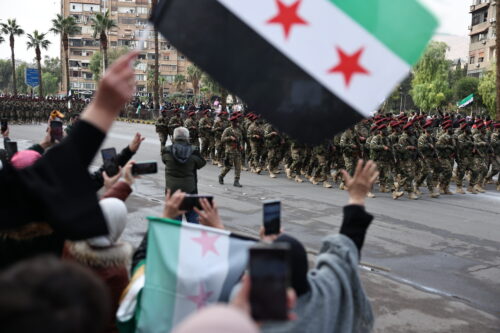
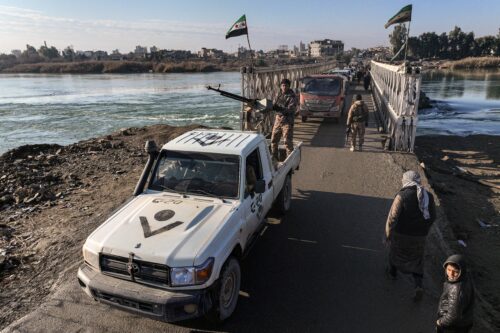
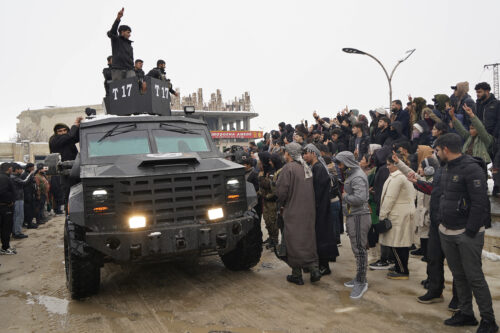
Dramatic developments in Syria have delivered a major blow to Kurdish ambitions for self-rule. In a rapid offensive, Damascus moved into northeast Syria, forcing the Kurdish-led Syrian Democratic Forces (SDF) out and effectively dismantling the autonomous region the Kurds had built during the civil war.
Syria’s transition still faces a formidable array of challenges — from the implementation of the deal to integrate the SDF into state structures and the military, to the economy, reconstruction, transitional justice and accountability, refugee returns, and geopolitical tensions with Israel. However, a steady and significant decline in violence offers perhaps the most encouraging and consequential metric.
From the Middle East to West Asia: Redefining America’s Global Strategy
MEI Senior Fellow Mohammed Soliman joins hosts Alistair Taylor and Matthew Czekaj to discuss his new book, West Asia: A New American Grand Strategy in the Middle East. The book argues that it is time for the United States to move decisively away from nation-building and focus instead on order-building, outlining a framework for a new regional order that links Europe to the Indo-Pacific. Soliman also shares how he conceived of the core ideas behind his book and explains why his thesis is especially relevant in today’s geopolitical, economic, and technological landscape.
Putting Trump on paper: What the new US strategy documents say about the Middle East
Trying to capture US President Donald Trump’s proudly unpredictable approach to foreign policy in fixed policy documents is inherently difficult. Surprise, leverage and improvisation are not bugs in Mr Trump’s world view; they are features. Yet the administration has now attempted this exercise twice: with the release of the National Security Strategy last December and the National Defence Strategy this January.
What Trump’s 2026 Mideast approach could look like
Donald Trump’s first year of his second presidential term has been a roller coaster of twists and turns both at home and abroad—particularly in the Middle East. His regional focus was driven by two main factors: first, Trump’s own ego and sense of possible place in history; and second, the volatile, dynamic events driven by actors in the region.
US Policy in the Middle East in the First Year of Trump 2.0: A Report Card
In the first year of his second term in office, US President Donald Trump focused considerable time and energy on the Middle East, but the results so far have been uneven. This report assesses the US government’s actions in the region over the past 12 months, from January 2025 through January 2026.
With the US and Iran on a knife-edge, can Oman once again step in to mediate?
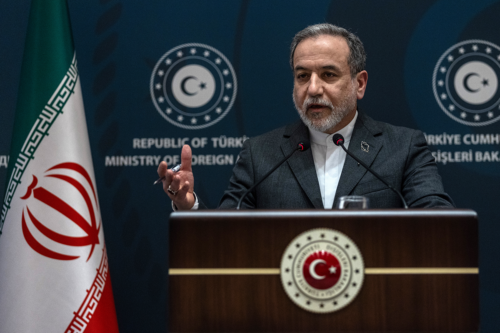
The decision by Washington and Tehran to shift their long-anticipated meeting, set for February 6, from Istanbul to Muscat is not merely a logistical detail. It is the latest reminder that when US-Iran diplomacy is on the verge of breaking down completely, Oman is the regional player the Iranian regime trusts the most to step in and mediate.
Integration or conflict in northeastern Syria? Ten key points to consider
After 10 months of US-mediated talks failed to achieve an integration of the Syrian Democratic Forces into Syria’s transitional state, hostilities erupted in early January. US diplomacy stepped in to try to calm tensions and force through the integration of the SDF’s Kurdish core into the Syrian state. Here are 10 key takeaways and indications of where things could go next.
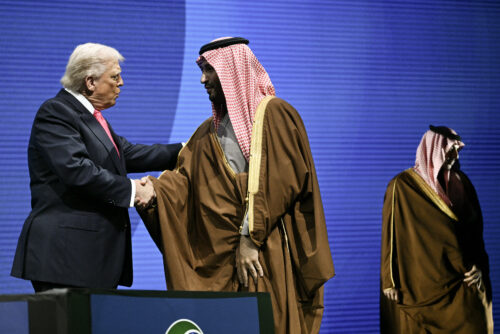
The US Commerce Department announced on November 19, 2025, that it had authorized the export of advanced American semiconductor chips to HUMAIN of Saudi Arabia and G42 of the United Arab Emirates. The approval enables both companies to purchase up to 35,000 Blackwell chips (GB300s). This sale is a core component of a broader “Compute Diplomacy” approach under the second administration of President Donald J. Trump, which was solidified following his May 2025 visit to the Gulf, where a series of multibillion-dollar artificial intelligence (AI) infrastructure agreements were signed.
Ankara’s double win: Kurds, Israel, and the new Syria
Whether the truce between Damascus and the Kurdish-led Syrian Democratic Forces holds or collapses will have major implications for neighboring Turkey, which has long-standing interests in Syria, but recent developments already point to a win for Ankara.
Breaking News Brief: Damascus and the Syrian Kurds Come to Blows
MEI Senior Fellow Charles Lister joins hosts Alistair Taylor and Matthew Czekaj to unpack the latest developments in Syria, as a tenuous cease-fire takes hold after several days of intense fighting between the Syrian army and the Kurdish-led Syrian Democratic Forces (SDF). Their discussion explores the drivers of the conflict, the prospects for a lasting deal that would integrate the SDF into the Syrian military, as well as the role and perspective of key external actors, including the US, Turkey, and Israel.
What Ankara sees in Riyadh — and why it still needs Abu Dhabi
As the rivalry between Riyadh and Abu Dhabi sharpens in Yemen and beyond, Turkey has begun edging closer to Saudi Arabia, sparking claims that a new regional order is taking shape: a Turkey-Saudi axis backed by a NATO-like defense architecture, implicitly aligned against Israel and the United Arab Emirates. This reading overstates the case.
Potential US military strikes on Iran: This won’t be another 12-Day War
President Donald Trump has sharply warned the Iranian regime to halt its brutal crackdown on protesters. Amid speculation that the US is preparing for military action in Iran, Washington should take the lessons and fundamentally different context of its successful June 2025 operation against the Islamic Republic into account as it plans for how to respond.
How Damascus and the SDF came to blows in Aleppo — and what might come next
After months of building tensions, full-blown hostilities erupted between Syria’s transitional government and militia fighters linked to the Syrian Democratic Forces (SDF) in Aleppo on January 6. Through four days of fighting, government forces have now assumed full control of Syria’s second city, after expelling SDF-linked forces from its northwestern districts.