Skip to Content

Research & Commentary Results

Filter by
3114 Results
Iran’s Axis of Resistance after the 12-day war: Adaptation, restructuring, and reconstitution
Photo by Kaveh Kazemi/Getty Images
  • Analysis
  • Iran’s Axis of Resistance after the 12-day war: Adaptation, restructuring, and reconstitution

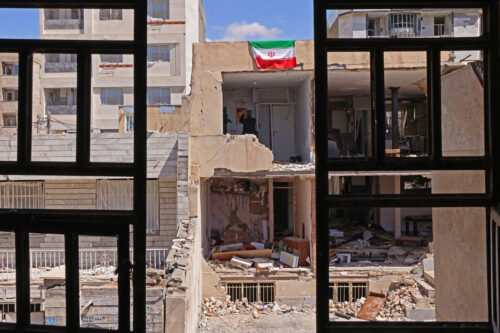
    Since Israel’s 12-day war against Iran, Tehran and its network of regional proxies and non-state allies, the so-called Axis of Resistance, have entered a phase of strategic dormancy — an outward calm concealing rearmament, financial adaptation, and ideological renewal.

    December 19, 2025

    Rob Malley Argues Two States Is an Illusion
  • Podcast
  • Rob Malley Argues Two States Is an Illusion

    Brian sits down with Robert Malley, a former US official best known for his role as the lead negotiator of the 2015 Joint Comprehensive Plan of Action. Malley discusses the motivations behind his new book, Tomorrow Is Yesterday: Life, Death, and the Pursuit of Peace in Israel/Palestine, and offers his assessment of American perspectives on the war in Gaza. The conversation also explores his personal background as the son​ of an Egyptian Jewish father and an American Jewish mother—both outspoken on the political left—and how that upbringing shaped his worldview, alongside a career spanning the Clinton, Obama, and Biden administrations.


    The Axis of Resistance
    Photo by Mohammadali Najib/Middle East Images/AFP via Getty Images
  • Backgrounder
  • The Axis of Resistance

    This backgrounder provides an overview of the Axis of Resistance, a loosely aligned network of armed groups and state actors led and supported by Iran to project its influence and military strength across the Middle East.

    December 3, 2025

    How Palestinian Roots Shaped an American Ambassador
  • Podcast
  • How Palestinian Roots Shaped an American Ambassador

    Brian welcomes Ambassador (ret.) Theodore “Ted” Kattouf, who previously served as US Ambassador to Syria and the United Arab Emirates, as well as President and CEO of the leading nonprofit organization Amideast. Kattouf reflects on how his Palestinian-American background shaped his diplomatic career and worldview. The two also take time to honor the life and legacy of Paul Kattouf, Ted’s son and Brian’s high school classmate, who was murdered in 2024.

    How Iraq’s vote will shape the next phase of US-Iran competition
    Photo by Ameer Al-Mohammedawi/picture alliance via Getty Images
  • Analysis
  • How Iraq’s vote will shape the next phase of US-Iran competition

    For Iran, Iraq is strategic depth, political sanctuary, and economic lifeline all at once. The results of the November 11 Iraqi elections will decide who in Baghdad controls the budgetary levers, internal security appointments, and committees that could codify, or constrain, Iraq’s Iran-backed militias.

    Hamas
    Photo by Eyad Baba/AFP via Getty Images
  • Backgrounder
  • Hamas

    This backgrounder provides an overview of the history of Hamas, its ideology and leadership, military capabilities and goals, the October 7 attack, relevant US government policies and legislation, and the group’s future in Gaza.

    November 18, 2025

    An International Stabilization Force for Gaza
    Photo by Alexander ShcherbakTASS via Getty Images
  • Analysis
  • An International Stabilization Force for Gaza

    The United States plans to submit a resolution on Gaza to the United Nations Security Council by the end of November. Reportedly, the latest draft endorses President Donald Trump’s 20-point plan, recognizes the Board of Peace as a “transitional governance administration,” and authorizes the BoP to establish an International Stabilization Force. In a new MEI Policy Memo, Lucy Kurtzer-Ellenbogen breaks down why it matters for the US and the relevant policy considerations.

    An International Stabilization Force for Gaza
  • Policy Memo
  • An International Stabilization Force for Gaza

    The United States plans to submit a resolution on Gaza to the United Nations Security Council (UNSC) by the end of November. Reportedly, the latest draft endorses President Donald Trump’s 20-point plan, recognizes the Board of Peace (BoP) as a “transitional governance administration,” and authorizes the BoP to establish an International Stabilization Force (ISF). The UN resolution is a first step to achieving buy-in from potential ISF contributors. In turn, a viable ISF will be one key to moving beyond the cease-fire to securing the 20-point plan’s envisioned Hamas disarmament, further Israeli military withdrawal, and a path to Palestinian governance. The US faces several dilemmas as it seeks to transition from cease-fire to stabilization and beyond.  

    The taboo of regret: Iranian reflections on the seizure of the US embassy in 1979
    Photo credit BEHROUZ MEHRI/AFP via Getty Images
  • Analysis
  • The taboo of regret: Iranian reflections on the seizure of the US embassy in 1979

    For decades, the 1979 takeover of the US Embassy in Tehran has symbolized the righteousness of the Islamic Republic of Iran’s revolutionary defiance and the legitimacy of “resistance” as state ideology. To question it is to pry open the logic of the entire enterprise.

    Trump’s big week in the Middle East weighed down by troubles on other fronts
    Photo by Suzanne Plunkett - Pool / Getty Images
  • Analysis
  • Trump’s big week in the Middle East weighed down by troubles on other fronts

    US President Donald Trump started off his week by flying to Israel and Egypt to mark the Gaza cease-fire and release of the last remaining Israeli hostages. But as these positive developments unfolded in the Middle East, the Trump administration’s overall agenda remained weighed down on other fronts.

    From Gaza Cease-fire to Middle East Peace?
    Photo by Suzanne Plunkett - Pool / Getty Images
  • Analysis
  • From Gaza Cease-fire to Middle East Peace?

    The October 2025 cease-fire and hostage-release deal that ended the Israel-Hamas conflict marks the beginning of a complicated post-war phase. In a new MEI Policy Memo, Brian Katulis breaks down why it matters for the US and the relevant policy considerations.

    From Gaza Cease-fire to Middle East Peace?
  • Policy Memo
  • From Gaza Cease-fire to Middle East Peace?

    The October 2025 cease-fire and hostage-release deal that ended the Israel-Hamas conflict marks the beginning of a complicated post-war phase. The agreement has created important opportunities to advance stability in the Middle East and build a lasting and sustainable peace marked by enhanced regional security and integration, but there are considerable risks to manage. Achieving these goals will require coordinated international action along multiple lines of effort: security, rule of law, recovery and reconstruction, responsive governance, and steady and focused diplomacy to build confidence among key parties. 

    Light at the end of the tunnel in the Gaza war? Three questions about Trump’s 20-point plan
    Photo by Kobi Wolf/Bloomberg via Getty Images
  • Analysis
  • Light at the end of the tunnel in the Gaza war? Three questions about Trump’s 20-point plan

    US President Donald Trump sent his top Middle East envoy Steve Witkoff and his son-in-law Jared Kushner to take part in Israel-Hamas talks hosted by Egypt this week aimed at ending the war in Gaza, securing the release of hostages, and producing progress toward a lasting and sustainable resolution to the conflict. Here are three things to watch for in US policy on this front in the coming days and weeks.

    Pakistan’s strategic defense pact with Saudi Arabia: A new security architecture in the wider Middle East
    Photo via Saudi Ministry of Foreign Affairs
  • Analysis
  • Pakistan’s strategic defense pact with Saudi Arabia: A new security architecture in the wider Middle East

    Following Israel’s September 9 strike on Hamas targets in Qatar, Pakistan has taken swift and significant foreign policy steps in response and adopted an unusually assertive stance. This shift was largely influenced by Pakistan’s military chief, Field Marshal Asim Munir. The latter is determined to enhance his country’s strategic autonomy and diplomatic leverage in an increasingly complex international environment by positioning Pakistan as a key security actor and an emerging middle power on the global stage.

    Silent leverage, quiet gains? China and the Saudi-Pakistan defense pact
    Photo by Madoka Ikegami-Pool/Getty Images
  • Analysis
  • Silent leverage, quiet gains? China and the Saudi-Pakistan defense pact

    The Strategic Mutual Defense Agreement (SMDA) between Saudi Arabia and Pakistan, signed in Riyadh on September 17, is far more than a bilateral pledge. It represents a profound reordering of alignments in the Gulf and South Asia, reflecting and reinforcing the broader erosion of US preeminence in the Eurasian security architecture. While much of the initial commentary centered on the striking commitment of a wealthy Gulf monarchy to the defense of a nuclear-armed South Asian state, as well as the question of whether Pakistan had in fact extended its nuclear umbrella to Saudi Arabia, the deeper story is arguably China’s potential advance.