Bonus Episode: Previewing Israel’s First Post-October 7 Election
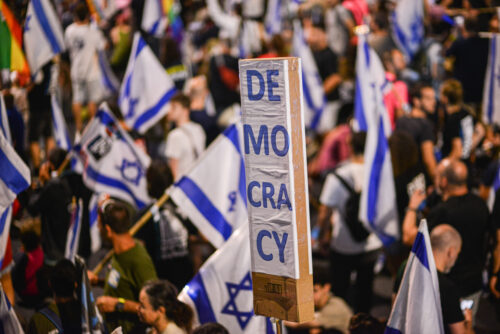
Israel is preparing to hold what may be its most consequential election in decades. On October 27, Prime Minister Benjamin Netanyahu will face his first electoral test since October 7, 2023. In this bonus episode of Middle East Focus, we present the audio from a recent MEI webinar, hosted in Israel on the eve of the vote. Senior Fellow Natan Sachs is joined by Dr. Shira Efron, Distinguished Chair for Israel Policy and senior fellow at the RAND Corporation, and Neri Zilber, veteran journalist and Financial Times correspondent. They explore what’s at stake in this historic election and how different outcomes could reshape Israel’s domestic politics and the wider region.
Israel Was Built on Hope. This Election May Be Our Last Chance to Save It
Israel’s national anthem, Hatikva, means “the hope.” Israel is not just another country, but the culmination of a 2,000-year-old dream of national redemption. The rebirth of the Jewish people’s ancestral homeland, just three years after the Holocaust, was a miraculous triumph of hope over all odds.
Today, that hope has been shattered and the elections on October 27 have become the most consequential in Israel’s history.
Deadlock in Gaza and the West Bank at a Breaking Point
A year after world leaders gathered in Sharm el-Sheikh to mark the end of the war in Gaza, Israel controls about 70% of the Strip, Hamas retains its arms, and reconstruction has yet to begin. Meanwhile, in the West Bank, record settler violence and settlement expansion are colliding with a Palestinian Authority on the brink of fiscal collapse. Hosts Alistair Taylor and Matthew Czekaj are joined by MEI Associate Fellow Tahani Mustafa to discuss why the Gaza peace plan is deadlocked, an increasingly emboldened Israel in the West Bank, Mahmoud Abbas’s postponement of Palestinian elections, the Palestinian Authority’s deepening economic crisis, and what role the US could play.
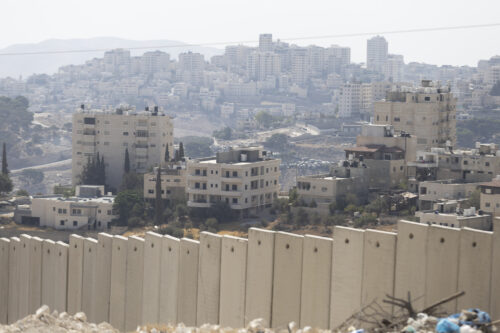
The Israeli government’s plan to build 3,401 housing units in the 12-square-kilometer E-1 corridor, between Jerusalem’s municipal boundary and the Israeli settlement of Ma’ale Adumim, would cut the West Bank in two. Israeli officials are under no illusion about the implications. Announcing the plan’s approval in August 2025, Finance Minister Bezalel Smotrich called it a “significant step that practically erases the two-state delusion.”
Israel/Palestine: What the Iran War Broke and What May Yet Be Salvaged
The 20-point plan for Gaza introduced before the war with Iran began has languished, with no meaningful recovery, reconstruction, Hamas disarmament, governance transition, or Israeli withdrawal. The diplomatic pivot back to Gaza in late July and early August suggests that the Iran war’s stubborn persistence may be causing the US and regional actors to seek wins on other fronts.
This report considers the lack of Palestinian political agency as a driver of regional insecurity that must be resolved before wider conflicts can be settled. The author analyses the conditions that contributed to the destruction of Palestinian political capacity, including Israeli policies, Palestinian shortcomings, and exploitation by Iran, and makes recommendations for an Arab strategic initiative.
This summer, brutally hot temperatures, deepening water scarcity, and spiking fertilizer costs have put North Africa’s agricultural sector under intense pressure. Host Alistair Taylor is joined by Mohammed Mahmoud, CEO and founder of the Climate and Water Initiative and lead for Middle East Climate and Water Policy at the United Nations University Institute for Water, Environment, and Health, to unpack the region’s food and water security challenges. Drawing on Mahmoud’s new report card on agricultural sustainability in North Africa, they explore the diverging picture across the region, why some countries have weathered the strain better than others, and what it will take to build a more resilient and secure food system.
When the Strait of Hormuz closed in March, fertilizer prices spiked within weeks, triggering a food security crisis across North Africa and the Sahel. Host Alistair Taylor is joined by MEI Senior Fellow Intissar Fakir to explore what it means for the region, unpack the link between food security and regional stability, and assess how the strait’s reopening could impact those affected.
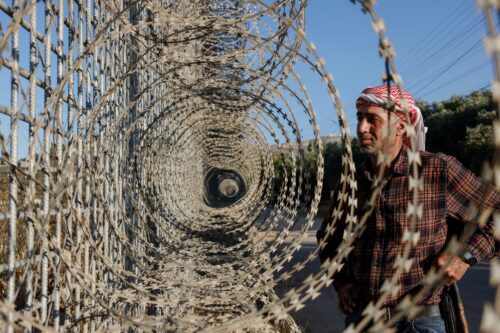
Since 1967, Israeli settlements in the West Bank have been a contested feature of the Israeli-Palestinian conflict. The ultimate disposition of the settlements and ongoing activity related to their growth have repeatedly defied agreement in negotiations over a resolution to the conflict.
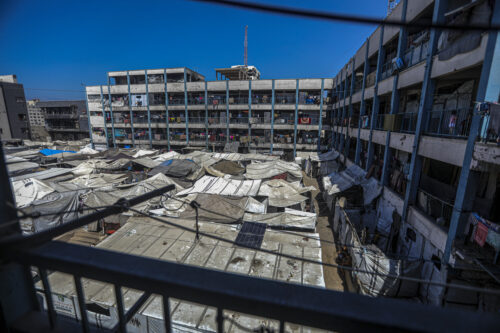
As the world’s attention shifts to the Iran war, Gaza is increasingly disappearing from the international spotlight. But more than six months after the United Nations endorsed a peace plan for Gaza, the humanitarian catastrophe continues. Israeli strikes remain relentless, while major international NGOs and aid groups say critical supplies are still not entering Gaza at anywhere near the scale needed.
Africa and the architecture of the global green transition
Africa sits at the center of the clean-energy transition as both a major source of critical minerals and one of the world’s largest under-electrified regions, making it a key arena for geopolitical and industrial competition among China, the United States, Europe, and emerging actors. At the same time, African governments and regional institutions are becoming more assertive, using mineral leverage, regulatory reforms, and continental frameworks to shape investment terms and capture greater domestic value. Recent developments — including the Democratic Republic of Congo’s (DRC) offer of state mining assets to U.S. investors and China’s 2026 China-Africa engagement initiative — highlight Africa’s growing role not just as a site of competition, but as an active shaper of it.
Violence, Settlements, and Creeping Annexation in the West Bank
As international attention remains fixed on the fallout from the Iran war, conditions in the West Bank continue to deteriorate. Hosts Alistair Taylor and Matthew Czekaj speak with MEI Senior Fellow Lucy Kurtzer-Ellenbogen about the sharp rise in settler violence, expanding settlement activity, and growing Palestinian displacement across the territory. They examine how recent Israeli legal and administrative measures are reshaping realities on the ground, the implications for Israeli-Palestinian relations, and what the United States should do to play a constructive mediator role.
MEI Senior Fellow Jaser AbuMousa joins hosts Alistair Taylor and Matthew Czekaj to unpack how Hamas is navigating the US-Israel conflict with Iran and its impact on Gaza. Nearly two and a half years after the start of the Gaza war, international attention has shifted away from the humanitarian crisis in the devastated coastal strip. Meanwhile, Hamas’ primary state sponsor, Iran, has been severely weakened by US-Israeli military strikes and the death of former Supreme Leader Ayatollah Ali Khamenei. AbuMousa examines how this could affect Hamas’ trajectory moving forward and its place within the Axis of Resistance, as well as what it all means for the Palestinian people.
Hamas at a Crossroads in the Post-Ali Khamenei Era
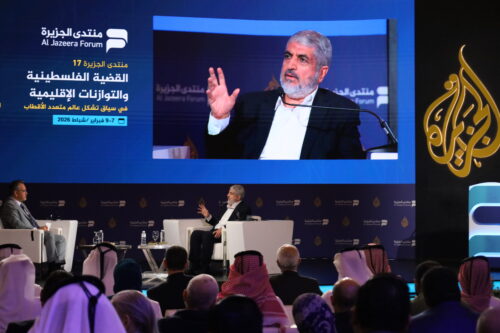
The results of last month’s elections seemed to crystallize a fundamental divide between two competing visions for Hamas’ future. But the US-Israeli war against Iran has cast a heavy shadow over the group’s leadership selection process, shifting it from a contest between personalities to a wider struggle over Hamas’ strategic identity, ideological orientation, and relationship with the broader Middle Eastern order.