Skip to Content

Research & Commentary

Read in-depth research, analysis, and commentary from MEI’s fellows and experts on the Middle East. 

Trump’s Family Business Deals Risk Further Undermining the Credibility of US Middle East Policy
  • Analysis
  • Trump’s Family Business Deals Risk Further Undermining the Credibility of US Middle East Policy

    President Trump’s family businesses are once again in the spotlight as a new financial disclosure showed they earned $2 billion in income in 2025 — a dramatic increase on the year before, with much of it coming from Gulf entities, raising emoluments concerns. Mounting perceptions of corruption, combined with unresolved crises in Iran and Israel-Palestine, are eroding trust among key partners in the Middle East. With the 2026 midterms approaching, these entanglements could represent a major political vulnerability and further undermine America’s already-strained standing in the region.

    Do the Gulf States Need a New Playbook?
  • Podcast
  • Do the Gulf States Need a New Playbook?

    After the US-Israel-Iran war — and the strikes that followed the cease-fire — the Gulf states find themselves dangerously exposed. Host Alistair Taylor is joined by MEI Associate Fellow Gregory Gause to discuss the war’s impact on the Gulf, their partnership with the United States, and whether the turmoil of recent months will push Gulf leaders to reassess their alliances and international engagement.

    July 2, 2026

    Additional Research & Commentary

    Backgrounders

    The Houthis
  • Backgrounder
  • The Houthis

    The Houthis are a political-military faction and Zaydi religious movement founded in northwestern Yemen in the 1980s. A key member of Iran’s Axis of Resistance with links to other militant organizations in the Arabian Peninsula and the Horn of Africa, the group has continued to pose a threat to Western interests on a global scale.

    May 15, 2026

    The Abraham Accords
    Photo by Alex Wong/Getty Images
  • Backgrounder
  • The Abraham Accords

    This backgrounder provides an overview of how the Abraham Accords came about, the US interests involved, their economic and strategic consequences, and the prospects for further enlargement going forward.

    November 17, 2025

    Turkish Foreign Policy
  • Backgrounder
  • Turkish Foreign Policy

    After a decade of post-Arab Spring isolation, Turkey’s leaders have recognized that their ambition to position the country as an agenda-setter on the world stage requires active engagement in all directions. President Recep Tayyip Erdoğan’s consolidation of executive authority has centralized foreign policy decision-making and tied it to his domestic political priorities, transforming the country’s revisionist approach to one shaped primarily by personal and pragmatic interests.

    April 23, 2026

    Western Sahara: Why the conflict still matters
  • Video
  • Western Sahara: Why the conflict still matters

    As the Western Sahara conflict reaches its fifth decade, the territorial dispute remains unresolved and largely unknown. MEI’s Intissar Fakir unpacks the Western Sahara’s complex history and the rival claims by Morocco and the Sahrawi Arab Democratic Republic. She examines recent developments, such as President Trump’s recognition of Moroccan sovereignty over the territory and the collapse of a 30-year cease-fire, as well as the core questions that remain unanswered after half a century.

    August 7, 2025

    Podcasts

    Middle East Focus

    MEI’s flagship weekly podcast on US foreign policy and contemporary political and social issues in the Middle East.

    Taking the Edge Off the Middle East

    MEI Senior Fellow Brian Katulis engages friends, colleagues, and policy experts in casual conversations on the most important happenings in the Middle East. 

    Rethinking Democracy

    MEI Senior Fellow Gonul Tol hosts leading scholars and thought leaders on global democracy trends and the state of the liberal international order. 

    Filter by
    8748 Results
    MEI 67th Annual Conference – Assessing the Transitions: Egypt and Tunisia
    Middle East Institute
  • Podcast
  • MEI 67th Annual Conference – Assessing the Transitions: Egypt and Tunisia

    Panel 1:  Assessing the Transitions: Egypt and Tunisia

    Moderator: Paul Salem, The Middle East InstituteKhalil al Anani, The Middle East InstituteLarry Diamond, Stanford UniversityNoureddine Jebnoun, Georgetown UniversityRabab El Mahdi, American University of Cairo  

    November 20, 2013

    Bombings in Beirut Indicate New Escalation
    Middle East Institute
  • Analysis
  • Bombings in Beirut Indicate New Escalation

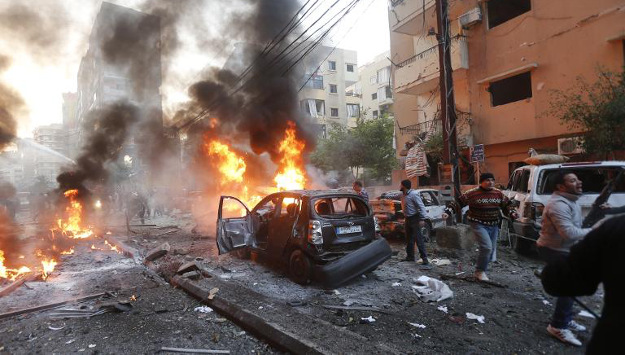
    Earlier today, double explosions near the Iranian embassy in Beirut killed at least 23, including an Iranian diplomat. The Abdullah Azzam Brigades, an Islamist group with links to al-Qa`ida, took responsibility for the attack. MEI sat down with its Vice President for Policy and Research, Paul Salem, to discuss the significance of the bombings in Lebanon as well as their regional and global implications.

    Tell us about the bombing and the group that claimed responsibility for it.  

    November 19, 2013

    Whose “Call for Tunisia?”
  • Analysis
  • Whose “Call for Tunisia?”

    The rise of the Nidaa Tounes (Call for Tunisia) Party has lifted the hopes of many Tunisians who hold Ennahda, the ruling Islamist party, responsible for the increase in religiously-motivated violence and suspect it of trying to establish a theocracy. Yet a closer look at the platform and rhetoric defining Nidaa Tounes suggests that the self-described “modernist” alternative to the Islamists might not be as inclusive and democratic as its leaders claim, as some of the party’s senior figures advocate the exclusion of Ennahda from politics.

    November 19, 2013

    Malaysia-Turkey Relations in History and Today
    Middle East Institute
  • Analysis
  • Malaysia-Turkey Relations in History and Today

    Malaysia and Turkey lie nearly 5,000 miles and seven time zones apart. They have different historical experiences and state structures. The role that religion plays in their public life also differs markedly. Yet Malaysia and Turkey have more in common than is widely acknowledged. Both are newly industrialized, middle-income, predominantly Muslim countries and mid-sized powers in their respective regions. Both are also expected to assume a greater regional and global role in the coming years.

    November 19, 2013

    Tawfik Okasha: Egypt's Glenn Beck
  • Analysis
  • Tawfik Okasha: Egypt's Glenn Beck

    The Egyptian media landscape both before and after Hosni Mubarak’s ouster has been one in which the polemical television personality Tawfik Okasha has thrived. But Okasha, known for his conspiracy theories and strident rhetoric, particularly against the Muslim Brotherhood, has perhaps risen to greater fame and influence recently. With a convergence between anti-Brotherhood positions and Egyptian government policy and public opinion occurring since the mass protests that culminated in Mohamed Morsi’s removal by the military on July 3, Okasha’s views have become more mainstream.

    November 14, 2013

    Read the Middle East Journal

    The oldest peer-reviewed publication dedicated to the study of the modern Middle East, MEI’s flagship journal covers politics, society, and culture in the region.