Skip to Content

Research & Commentary

Read in-depth research, analysis, and commentary from MEI’s fellows and experts on the Middle East. 

Trump’s South Caucasus Peacemaking Is His Most Successful, but It Remains Unfinished
  • Commentary
  • Trump’s South Caucasus Peacemaking Is His Most Successful, but It Remains Unfinished

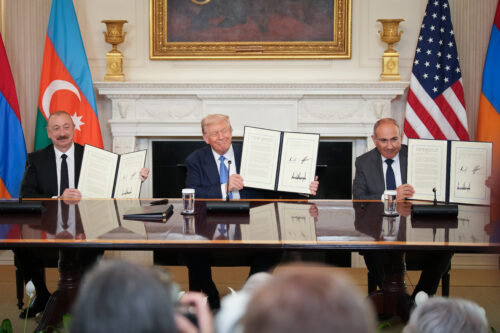
    Of all the fronts in President Trump’s peacemaking agenda, the South Caucasus has delivered the most concrete results. The August 2025 Washington Declaration, signed between Armenia and Azerbaijan and witnessed by Trump, marked an important step toward peace in the region. The two sides initialed a peace agreement and advanced plans to unblock regional connectivity, including through the establishment of the Trump Route for International Peace and Prosperity (TRIPP), which would connect Azerbaijan to its Nakhijevan exclave through southern Armenia. Implementation of TRIPP has since made notable progress, but construction has yet to start. A breakthrough on those two tracks would, in turn, unlock Armenia–Türkiye normalization, transforming a long-fractured region into an area of trade and interdependence.
    The Iran War Was Always About Regime Change
  • Commentary
  • The Iran War Was Always About Regime Change

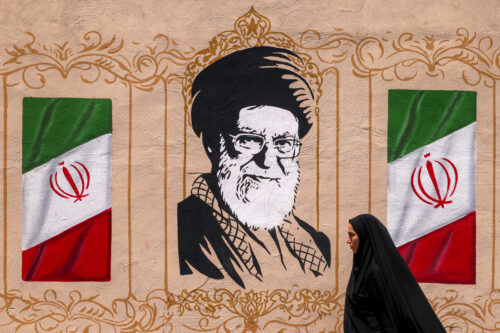
    Wars don’t just end. They get interpreted, reinterpreted, and turned into strategic doctrine. That is what happened after the Iran-Iraq War of the 1980s, a conflict that saw the United States back Tehran’s Iraqi adversaries. The war taught Tehran three lessons it never unlearned: that Washington wants the Islamic Republic gone, that Iran stands essentially alone in the world, and that it cannot survive a direct, overt fight with the U.S. and Israel.

    Iran’s New War Cabinet Is Really an Old One
  • Analysis
  • Iran’s New War Cabinet Is Really an Old One

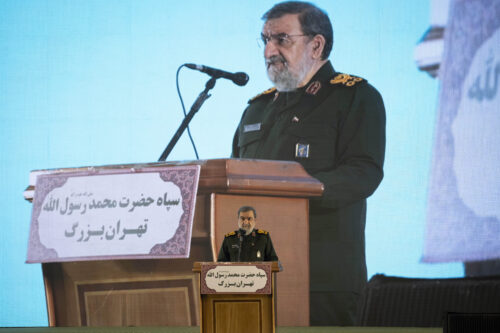
    Within 48 hours this week, Iran filled six of the most important posts in its battered military and security establishment. Read together with the biographies and mandates behind them, the appointments show how Tehran is drawing lessons from successive wars and preparing for a prolonged period of insecurity, without proving it has abandoned negotiation.

    Additional Research & Commentary

    Backgrounders

    Israeli Settlements in the West Bank
  • Backgrounder
  • Israeli Settlements in the West Bank

    Since 1967, Israeli settlements in the West Bank have been a contested feature of the Israeli-Palestinian conflict. The ultimate disposition of the settlements and ongoing activity related to their growth have repeatedly defied agreement in negotiations over a resolution to the conflict.

    June 9, 2026

    The Houthis
  • Backgrounder
  • The Houthis

    The Houthis are a political-military faction and Zaydi religious movement founded in northwestern Yemen in the 1980s. A key member of Iran’s Axis of Resistance with links to other militant organizations in the Arabian Peninsula and the Horn of Africa, the group has continued to pose a threat to Western interests on a global scale.

    May 15, 2026

    The India-Middle East-Europe Economic Corridor
  • Backgrounder
  • The India-Middle East-Europe Economic Corridor

    The India-Middle East-Europe Economic Corridor (IMEC) is a proposed multinational infrastructure initiative aimed at upgrading connectivity between the three regions through integrated trade, energy, and digital networks. Announced at the G20 summit in New Delhi in September 2023, IMEC is envisioned partially as a counterweight to China’s international infrastructure project, the Belt and Road Initiative.

    June 3, 2026

    Turkish Foreign Policy
  • Backgrounder
  • Turkish Foreign Policy

    After a decade of post-Arab Spring isolation, Turkey’s leaders have recognized that their ambition to position the country as an agenda-setter on the world stage requires active engagement in all directions. President Recep Tayyip Erdoğan’s consolidation of executive authority has centralized foreign policy decision-making and tied it to his domestic political priorities, transforming the country’s revisionist approach to one shaped primarily by personal and pragmatic interests.

    April 23, 2026

    Podcasts

    Middle East Focus

    MEI’s flagship weekly podcast on US foreign policy and contemporary political and social issues in the Middle East.

    Taking the Edge Off the Middle East

    MEI Senior Fellow Brian Katulis engages friends, colleagues, and policy experts in casual conversations on the most important happenings in the Middle East. 

    Rethinking Democracy

    MEI Senior Fellow Gonul Tol hosts leading scholars and thought leaders on global democracy trends and the state of the liberal international order. 

    Filter by
    8783 Results
    Mona Makram-Ebeid on Egypt's Political Future
    Middle East Institute
  • Podcast
  • Mona Makram-Ebeid on Egypt's Political Future

    The Middle East Institute is proud to host Dr. Mona Makram-Ebeid for a discussion about the state of affairs in Egypt in the wake of the overthrow of Muslim Brotherhood President Mohamed Morsi.  Dr. Makram-Ebeid is a prominent Egyptian academic and former member of the Shura Council, who recently resigned in support of the Tamarod movement.  She will provide a first-hand perspective on the challenges ahead for Egypt following the recent military takeover of the government and the ensuing violence and unrest.Bios:Dr.

    July 12, 2013

    Mona Makram-Ebeid on Egypt's Political Future
    Middle East Institute
  • Podcast
  • Mona Makram-Ebeid on Egypt's Political Future

    The Middle East Institute is proud to host Dr. Mona Makram-Ebeid for a discussion about the state of affairs in Egypt in the wake of the overthrow of Muslim Brotherhood President Mohamed Morsi.  Dr. Makram-Ebeid is a prominent Egyptian academic and former member of the Shura Council, who recently resigned in support of the Tamarod movement.  She will provide a first-hand perspective on the challenges ahead for Egypt following the recent military takeover of the government and the ensuing violence and unrest.Bios:Dr.

    July 12, 2013

    Mona Makram-Ebeid on Egypt's Political Future
    Middle East Institute
  • Podcast
  • Mona Makram-Ebeid on Egypt's Political Future

    The Middle East Institute is proud to host Dr. Mona Makram-Ebeid for a discussion about the state of affairs in Egypt in the wake of the overthrow of Muslim Brotherhood President Mohamed Morsi.  Dr. Makram-Ebeid is a prominent Egyptian academic and former member of the Shura Council, who recently resigned in support of the Tamarod movement.  She will provide a first-hand perspective on the challenges ahead for Egypt following the recent military takeover of the government and the ensuing violence and unrest.Bios:Dr.

    July 12, 2013

    Mona Makram-Ebeid on Egypt's Political Future
    Middle East Institute
  • Podcast
  • Mona Makram-Ebeid on Egypt's Political Future

    The Middle East Institute is proud to host Dr. Mona Makram-Ebeid for a discussion about the state of affairs in Egypt in the wake of the overthrow of Muslim Brotherhood President Mohamed Morsi.  Dr. Makram-Ebeid is a prominent Egyptian academic and former member of the Shura Council, who recently resigned in support of the Tamarod movement.  She will provide a first-hand perspective on the challenges ahead for Egypt following the recent military takeover of the government and the ensuing violence and unrest.Bios:Dr.

    July 12, 2013

    The U.S. Needs to Walk the Walk on Egypt's Human Rights
  • Analysis
  • The U.S. Needs to Walk the Walk on Egypt's Human Rights

    Originally published July 10, 2013 in U.S. News and World Report

    Assertions and opinions in this publication are solely those of the above-mentioned author(s) and do not necessarily reflect the views of the Middle East Institute, which expressly does not take positions on Middle East policy.

    July 10, 2013

    The Iranian Diaspora in Malaysia: Emergent Pluralism
  • Analysis
  • The Iranian Diaspora in Malaysia: Emergent Pluralism

    The Iranian diaspora in Malaysia is incredibly diverse. Supporters of the Green Movement, students, individuals who fast and pray and those who do not know the direction of the qibla, clerics who promote secularism and those who promote the authority of the vilayat-i faqih, Iranian Kurds, Turks, and Arabs, journalists, artists, and environmentalists: all these—and more—constitute the community of Iranians who have fled or quietly moved to Malaysia.

    July 10, 2013

    Post Morsi: Egypt, Israel, and Hamas
    Middle East Institute
  • Analysis
  • Post Morsi: Egypt, Israel, and Hamas

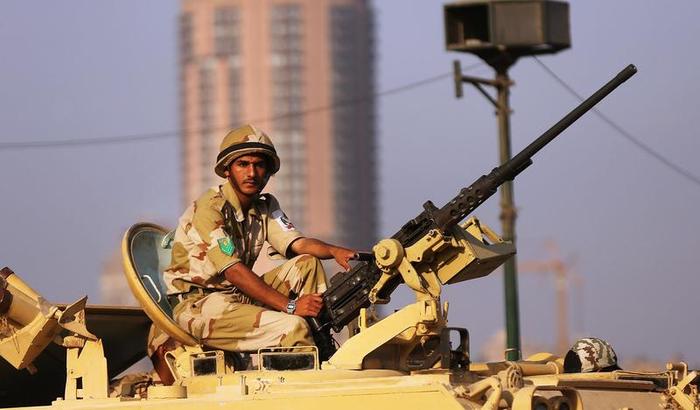
    The dramatic events of July 3, which saw the unseating of Egypt’s first and only democratically-elected government by a military coup stimulated by enormous popular demonstrations, has created a huge question mark as to the future governance of the Arab world’s largest and most important country. The ramifications and repercussions will be playing out for months and years, whatever steps are taken in the next days and weeks. However, two parties acutely affected by these events are watching with particular concern.

    July 10, 2013

    Sexual Assault and the Fall of Morsi
  • Analysis
  • Sexual Assault and the Fall of Morsi

    Amid last week’s uproar, now deposed Egyptian President Mohamed Morsi issued a statement in English via top aide and advisor on foreign relations Essam el-Haddad, citing cases of sexual assault in or around Tahrir Square as evidence that “Tahrir crowds are out of control.”[1] Essam el-Haddad’s son, Gehad, took to Twitter, also in English, to stand up for the “protection of women.” With these moves, the Muslim Brotherhood sunk to a new low in its propaganda war against its detractors.

    July 8, 2013

    Obama and Egypt's Crisis
    Middle East Institute
  • Analysis
  • Obama and Egypt's Crisis

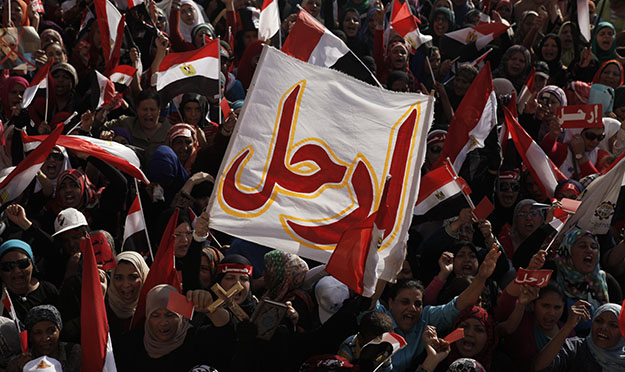
    Over the past two days, millions of Egyptians have taken to the streets, most of them calling for early presidential elections with the aim of ousting Mohamed Morsi. June 30 marked Morsi’s one-year anniversary as president, and while he was elected democratically in 2012, his actions since have been more in the authoritarian style of a Mubarak than a reformer with the demands of the Egyptian street in mind.

    July 2, 2013

    Egypt's Crisis: The Day After
  • Analysis
  • Egypt's Crisis: The Day After

    In the wake of yesterday’s outbreak of what has been called the largest protest ever, against Egyptian president Mohamed Morsi, observers are left with one question: What comes next? None of the major players appear to have a practical answer to this question. For instance, no one has produced a politically sound “exit strategy” beyond the loud demand to remove Morsi and to hold a new presidential election.

    July 1, 2013

    Collection Spotlight: The Arab Awakening
    Middle East Institute
  • Analysis
  • Collection Spotlight: The Arab Awakening

    The Arab Awakening: America and the Transformation of the Middle East, by Kenneth Pollack and Daniel Byman et al., 2011

    July 1, 2013

    Hezbollah's Plunge into the Syrian Abyss
  • Video
  • Hezbollah's Plunge into the Syrian Abyss

    Randa Slim, MEI Scholar and adjunct research fellow at the New America Foundation, discusses the implications of Hezbollah's growing role in Syria for Lebanese politics and Lebanon's Shiite community.

    June 28, 2013

    Hezbollah's Plunge into the Syrian Abyss
    Middle East Institute
  • Podcast
  • Hezbollah's Plunge into the Syrian Abyss

    The Middle East Institute is pleased to welcome MEI Scholar Randa Slim for a discussion on the implications of Hezbollah’s growing role in Syria for Lebanese politics and Lebanon’s Shiite community. Recently returned from a trip to the region, Slim will examine Hezbollah’s potential end game in Syria, and whether Lebanon will be able to resist being drawn into the conflict following Hezbollah’s plunge into the Syrian abyss.

    June 28, 2013

    Hezbollah's Plunge into the Syrian Abyss
    Middle East Institute
  • Podcast
  • Hezbollah's Plunge into the Syrian Abyss

    The Middle East Institute is pleased to welcome MEI Scholar Randa Slim for a discussion on the implications of Hezbollah’s growing role in Syria for Lebanese politics and Lebanon’s Shiite community. Recently returned from a trip to the region, Slim will examine Hezbollah’s potential end game in Syria, and whether Lebanon will be able to resist being drawn into the conflict following Hezbollah’s plunge into the Syrian abyss.

    June 28, 2013

    Hezbollah's Plunge into the Syrian Abyss
    Middle East Institute
  • Podcast
  • Hezbollah's Plunge into the Syrian Abyss

    The Middle East Institute is pleased to welcome MEI Scholar Randa Slim for a discussion on the implications of Hezbollah’s growing role in Syria for Lebanese politics and Lebanon’s Shiite community. Recently returned from a trip to the region, Slim will examine Hezbollah’s potential end game in Syria, and whether Lebanon will be able to resist being drawn into the conflict following Hezbollah’s plunge into the Syrian abyss.

    June 28, 2013

    Read the Middle East Journal

    The oldest peer-reviewed publication dedicated to the study of the modern Middle East, MEI’s flagship journal covers politics, society, and culture in the region.