Skip to Content

Research & Commentary

Read in-depth research, analysis, and commentary from MEI’s fellows and experts on the Middle East. 

Trump’s Family Business Deals Risk Further Undermining the Credibility of US Middle East Policy
  • Analysis
  • Trump’s Family Business Deals Risk Further Undermining the Credibility of US Middle East Policy

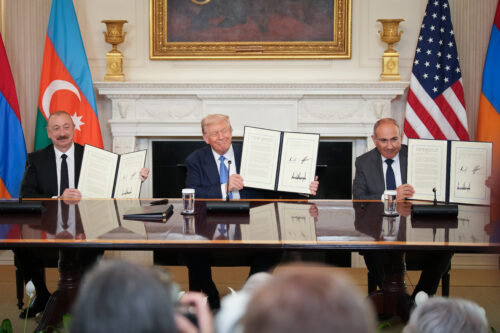
    President Trump’s family businesses are once again in the spotlight as a new financial disclosure showed they earned $2 billion in income in 2025 — a dramatic increase on the year before, with much of it coming from Gulf entities, raising emoluments concerns. Mounting perceptions of corruption, combined with unresolved crises in Iran and Israel-Palestine, are eroding trust among key partners in the Middle East. With the 2026 midterms approaching, these entanglements could represent a major political vulnerability and further undermine America’s already-strained standing in the region.

    Do the Gulf States Need a New Playbook?
  • Podcast
  • Do the Gulf States Need a New Playbook?

    After the US-Israel-Iran war — and the strikes that followed the cease-fire — the Gulf states find themselves dangerously exposed. Host Alistair Taylor is joined by MEI Associate Fellow Gregory Gause to discuss the war’s impact on the Gulf, their partnership with the United States, and whether the turmoil of recent months will push Gulf leaders to reassess their alliances and international engagement.

    July 2, 2026

    Additional Research & Commentary

    Backgrounders

    The Houthis
  • Backgrounder
  • The Houthis

    The Houthis are a political-military faction and Zaydi religious movement founded in northwestern Yemen in the 1980s. A key member of Iran’s Axis of Resistance with links to other militant organizations in the Arabian Peninsula and the Horn of Africa, the group has continued to pose a threat to Western interests on a global scale.

    May 15, 2026

    The Abraham Accords
    Photo by Alex Wong/Getty Images
  • Backgrounder
  • The Abraham Accords

    This backgrounder provides an overview of how the Abraham Accords came about, the US interests involved, their economic and strategic consequences, and the prospects for further enlargement going forward.

    November 17, 2025

    Turkish Foreign Policy
  • Backgrounder
  • Turkish Foreign Policy

    After a decade of post-Arab Spring isolation, Turkey’s leaders have recognized that their ambition to position the country as an agenda-setter on the world stage requires active engagement in all directions. President Recep Tayyip Erdoğan’s consolidation of executive authority has centralized foreign policy decision-making and tied it to his domestic political priorities, transforming the country’s revisionist approach to one shaped primarily by personal and pragmatic interests.

    April 23, 2026

    Western Sahara: Why the conflict still matters
  • Video
  • Western Sahara: Why the conflict still matters

    As the Western Sahara conflict reaches its fifth decade, the territorial dispute remains unresolved and largely unknown. MEI’s Intissar Fakir unpacks the Western Sahara’s complex history and the rival claims by Morocco and the Sahrawi Arab Democratic Republic. She examines recent developments, such as President Trump’s recognition of Moroccan sovereignty over the territory and the collapse of a 30-year cease-fire, as well as the core questions that remain unanswered after half a century.

    August 7, 2025

    Podcasts

    Middle East Focus

    MEI’s flagship weekly podcast on US foreign policy and contemporary political and social issues in the Middle East.

    Taking the Edge Off the Middle East

    MEI Senior Fellow Brian Katulis engages friends, colleagues, and policy experts in casual conversations on the most important happenings in the Middle East. 

    Rethinking Democracy

    MEI Senior Fellow Gonul Tol hosts leading scholars and thought leaders on global democracy trends and the state of the liberal international order. 

    Filter by
    8748 Results
    The Case for Women’s Rights in Post-Uprising Egypt
    Middle East Institute
  • Analysis
  • The Case for Women’s Rights in Post-Uprising Egypt

    When Egyptian women first gained the vote in 1956, a woman in the cabinet swiftly followed. Women likely thought that all would be clear sailing from that point on, but it hasn’t quite worked out that way. Almost 70 years later, only one woman is in the cabinet.

    The Black Bloc: Evolution of the Revolution
  • Analysis
  • The Black Bloc: Evolution of the Revolution

    In March, Egypt’s public prosecutor announced the summoning of five members of the largely unknown group the Black Bloc.[1] The group, which takes its inspiration from “black blocs” the world round who wear black masks in order to protest anonymously, is known for such actions as halting public transportation and aiding people in distress.

    April 26, 2013

    The Predicament of the Obama Administration and the Muslim Brotherhood
  • Analysis
  • The Predicament of the Obama Administration and the Muslim Brotherhood

    Al-Ahram columnist Ahmed al-Beri wrote on 23 March that “while the United States has often been supportive of President Mohamed Morsi’s regime, Egypt’s security and economic deterioration may be forcing it to reevaluate this support.”[1] Such thoughts are not exclusively al-Beri’s; they are dominating intellectual circles inside Egypt. The emergence of the Muslim Brotherhood as the new political warhorse in Egypt has complicated a delicate strategic relationship between Cairo and Washington.

    April 26, 2013

    Are Salafi Parties Turning Against Morsi?
  • Analysis
  • Are Salafi Parties Turning Against Morsi?

    Mohamed Yousry Salama passed away from stomach disease on 24 March 2013. The 39-year-old had been a spokesperson for the Salafi al-Nour Party immediately following Egypt’s revolution. After falling out with members of the party, he resigned in August 2011 and eventually co-founded the Dostour Party with such progressive political figures as Mohamed ElBaradei, George Ishaq, and Gamila Ismail.

    April 26, 2013

    Who are Egypt’s Salafist-Jihadists?
  • Analysis
  • Who are Egypt’s Salafist-Jihadists?

    The Egyptian Islamist Mohamed al-Zawahiri is most famous for being the brother of al-Qaeda front man Ayman, but his story is also a gripping one. Zawahiri was arrested in 1999 for his alleged participation in the assassination of President Anwar Sadat.

    April 26, 2013

    China’s Role in Iran’s Anti-Access / Area Denial Weapons Capability Development
    Middle East Institute
  • Analysis
  • China’s Role in Iran’s Anti-Access / Area Denial Weapons Capability Development

    It is the military aspect of the Sino-Iranian relationship that troubles many observers in the West. China, and to a lesser extent, North Korea, have played a critical role in the development of Iran’s anti-access / area denial (A2/AD) capabilities.

    April 16, 2013

    Morsi’s Un-Revolutionary Foreign Policy
  • Analysis
  • Morsi’s Un-Revolutionary Foreign Policy

    For over 30 years Egypt’s foreign policy has stood on three key pillars: building strategic relations with the United States, maintaining the peace treaty with Israel, and promoting the security of Arab states in the Gulf. The presidency and the security apparatus, moreover, have often overshadowed and minimized the influence of the Ministry of Foreign Affairs in the policymaking process. These pillars solidified under the rule of Hosni Mubarak, and as a result President Mohamed Morsi will not be able to uproot them anytime soon.

    April 15, 2013

    SCAF and the Muslim Brotherhood
  • Analysis
  • SCAF and the Muslim Brotherhood

    Since the most recent but now routine eruptions of violence between street protesters and Egypt’s state, speculation has swirled about the durability of the pact between the Muslim Brotherhood and Egypt’s armed forces.

    April 15, 2013

    Political Opposition and the NSF
  • Analysis
  • Political Opposition and the NSF

    When President Mohamed Morsi granted himself sweeping new powers last November, he unwittingly accomplished something no one had yet achieved. He managed to bring Egypt’s fractious and disparate political factions together around a single cause: bitterly opposing him and his Muslim Brotherhood. 

    April 15, 2013

    Sexual Harassment Post­-Mubarak
  • Analysis
  • Sexual Harassment Post­-Mubarak

    When I moved to Cairo in 1981 I discovered a courtly and safe city. The streets were alive with playful banter, expressions of the renowned Egyptian joie de vivre. Men who wished to attract the attention of lady passers-by sang bits of love songs or called them things like “minaret” and “gazelle.”

    April 15, 2013

    A Conversation with al-Gama`a al-Islamiya’s Hani Nour Eldin
  • Analysis
  • A Conversation with al-Gama`a al-Islamiya’s Hani Nour Eldin

    Hani Nour Eldin is a member of the Egyptian Islamist group al-Gama`a al-Islamiya and an administrative employee of the Suez Canal Authority. In 2011 he was elected to parliament as part of the group’s political arm, the Building and Development Party. In June 2012 he caused considerable controversy when he traveled to Washington, D.C. as part of a parliamentary delegation.

    April 14, 2013

    The Bureaucracy Wins
    Middle East Institute
  • Analysis
  • The Bureaucracy Wins

    Ten months have passed since the election of the Muslim Brotherhood’s Mohamed Morsi as Egypt’s first post-uprising president. During his election campaign, Morsi repeatedly promised “change.” So far, however, it appears that Egypt’s bureaucracy has been more successful at changing Morsi’s plans and discourse than he has been at changing the state’s structures.

    April 14, 2013

    Egypt’s Key Social Forces
  • Analysis
  • Egypt’s Key Social Forces

    EXPLORE EGYPT’S KEY SOCIAL FORCES HERE

    Explore nine of the most influential social forces and non-state actors shaping Egyptian politics and public life today.


    April 14, 2013

    Read the Middle East Journal

    The oldest peer-reviewed publication dedicated to the study of the modern Middle East, MEI’s flagship journal covers politics, society, and culture in the region.