Curb Your Enthusiasm: Why the Midterms Might Not Change Much in US Middle East Policy
With less than a week before the midterm elections in the United States, the spotlight is on the economy and cultural divides. US foreign policy remains mostly on the sidelines, but this year’s inconclusive Iran war and its effect on America’s economy have shaped the broader political environment in this electoral cycle.
The Multiple Costs of the US–Iran War – From Hormuz to Europe and South Asia: The Widening Economic and Political Geography of the Conflict
Wars are decided by those who hold military power, but their costs are increasingly borne by those who have little or no voice in the decisions that start them. The US–Iran war shows this imbalance very clearly. Its economic consequences have gone far beyond the battlefield and have disrupted energy markets, trade routes, food supplies, public finances and investment in the Gulf, Europe, Africa and Asia. The most striking feature of the conflict, however, is not only the size of the damage but its very unequal distribution.
In recent weeks, the Iran-backed Houthis have fired missiles and drones deep into Saudi Arabia, striking high-profile targets, including Riyadh’s airport and Aramco’s headquarters. The attacks follow a rapid Houthi offensive in September to seize key parts of Yemen’s Red Sea coast, which Saudi-backed government forces are now trying to roll back. Fatima Abo Alasrar, an affiliated scholar at MEI and non-resident scholar at the Arab Gulf States Institute, joins hosts Alistair Taylor and Matthew Czekaj to unpack the latest phase of the conflict. They discuss what the Houthis want, Riyadh’s calculus and search for allies, and how this campaign ties into Iran’s confrontation with the United States.
Since 1967, Israeli settlements in the West Bank have been a contested feature of the Israeli-Palestinian conflict. The ultimate disposition of the settlements and ongoing activity related to their growth have repeatedly defied agreement in negotiations over a resolution to the conflict.
The Houthis are a political-military faction and Zaydi religious movement founded in northwestern Yemen in the 1980s. A key member of Iran’s Axis of Resistance with links to other militant organizations in the Arabian Peninsula and the Horn of Africa, the group has continued to pose a threat to Western interests on a global scale.
The India-Middle East-Europe Economic Corridor (IMEC) is a proposed multinational infrastructure initiative aimed at upgrading connectivity between the three regions through integrated trade, energy, and digital networks. Announced at the G20 summit in New Delhi in September 2023, IMEC is envisioned partially as a counterweight to China’s international infrastructure project, the Belt and Road Initiative.
After a decade of post-Arab Spring isolation, Turkey’s leaders have recognized that their ambition to position the country as an agenda-setter on the world stage requires active engagement in all directions. President Recep Tayyip Erdoğan’s consolidation of executive authority has centralized foreign policy decision-making and tied it to his domestic political priorities, transforming the country’s revisionist approach to one shaped primarily by personal and pragmatic interests.
MEI Senior Fellow Brian Katulis engages friends, colleagues, and policy experts in casual conversations on the most important happenings in the Middle East.
Leveraging on Technology via International Collaboration: Open University Malaysia's (OUM) Experience in the Middle East
Originally posted: July, 2010
The development of information communication technology (ICT) has transformed the world into a global village, facilitating the flow of knowledge, information, and people like never before. Its impact on everyday living is apparent, fundamentally changing the way people think, work, and play. Within education, the impact of ICT may not be as extensive as in other fields. This is because education is often perceived as a socially -oriented activity where the teacher’s main role is to transmit knowledge and be a role model.
Policy Privatization and Empowerment of Sub-National Forces: The Case of Private English Language Institutes in Iran
Originally posted July 2010
In the past, there was no need for learning a foreign language. Today, however, learning foreign languages should be included in school curricula … Today is not like yesterday, when our voice could not reach beyond the national boundary. Today, we can stay in Iran but publicize [our ideology] and export our revolution to other parts of the world in different languages.
Western Education in the Gulf: The Costs and Benefits of Reform
Originally posted July 2010
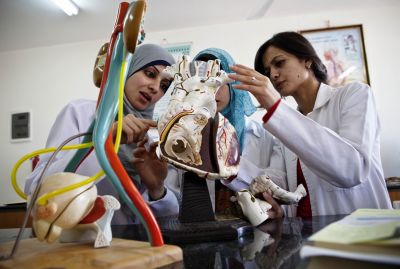
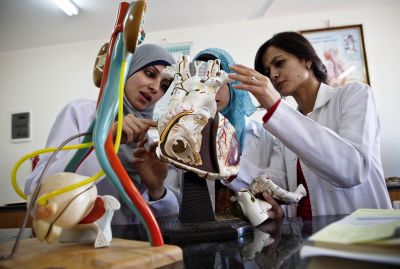
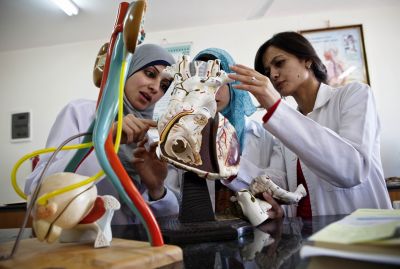
Educational reform from the West has arrived on a grand scale in the Gulf, particularly in higher education. American, Canadian, Australian, and British universities are being established throughout the region. In addition, Western-style methodologies and best-practices are being employed. Although there are considerable benefits to adopting Western models of education, such reform does not come without a price.
Tertiary Education in the Gulf: "A Colossal Wreck, Remaining Boundless and Bare?"
Originally posted July 2010
… “My name is Ozymandias, king of kings:
Look on my works, ye Mighty, and despair!” Nothing beside remains. Round the decay Of that colossal wreck, boundless and bare The lone and level sands stretch far away.[1]
The oldest peer-reviewed publication dedicated to the study of the modern Middle East, MEI’s flagship journal covers politics, society, and culture in the region.