Skip to Content

Research & Commentary

Read in-depth research, analysis, and commentary from MEI’s fellows and experts on the Middle East. 

Trump’s South Caucasus Peacemaking Is His Most Successful, but It Remains Unfinished
  • Commentary
  • Trump’s South Caucasus Peacemaking Is His Most Successful, but It Remains Unfinished

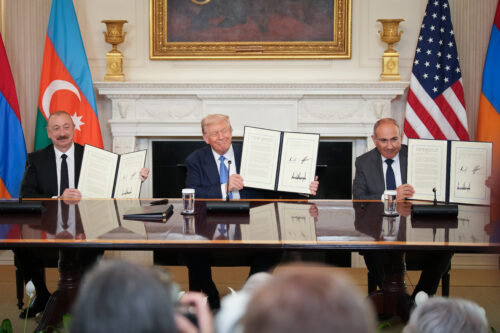
    Of all the fronts in President Trump’s peacemaking agenda, the South Caucasus has delivered the most concrete results. The August 2025 Washington Declaration, signed between Armenia and Azerbaijan and witnessed by Trump, marked an important step toward peace in the region. The two sides initialed a peace agreement and advanced plans to unblock regional connectivity, including through the establishment of the Trump Route for International Peace and Prosperity (TRIPP), which would connect Azerbaijan to its Nakhijevan exclave through southern Armenia. Implementation of TRIPP has since made notable progress, but construction has yet to start. A breakthrough on those two tracks would, in turn, unlock Armenia–Türkiye normalization, transforming a long-fractured region into an area of trade and interdependence.
    The Iran War Was Always About Regime Change
  • Commentary
  • The Iran War Was Always About Regime Change

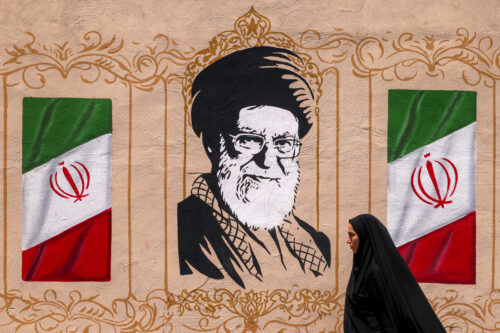
    Wars don’t just end. They get interpreted, reinterpreted, and turned into strategic doctrine. That is what happened after the Iran-Iraq War of the 1980s, a conflict that saw the United States back Tehran’s Iraqi adversaries. The war taught Tehran three lessons it never unlearned: that Washington wants the Islamic Republic gone, that Iran stands essentially alone in the world, and that it cannot survive a direct, overt fight with the U.S. and Israel.

    Iran’s New War Cabinet Is Really an Old One
  • Analysis
  • Iran’s New War Cabinet Is Really an Old One

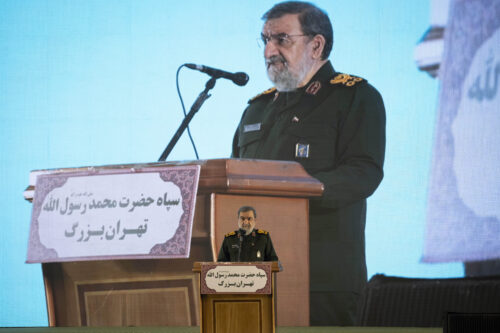
    Within 48 hours this week, Iran filled six of the most important posts in its battered military and security establishment. Read together with the biographies and mandates behind them, the appointments show how Tehran is drawing lessons from successive wars and preparing for a prolonged period of insecurity, without proving it has abandoned negotiation.

    Additional Research & Commentary

    Backgrounders

    Israeli Settlements in the West Bank
  • Backgrounder
  • Israeli Settlements in the West Bank

    Since 1967, Israeli settlements in the West Bank have been a contested feature of the Israeli-Palestinian conflict. The ultimate disposition of the settlements and ongoing activity related to their growth have repeatedly defied agreement in negotiations over a resolution to the conflict.

    June 9, 2026

    The Houthis
  • Backgrounder
  • The Houthis

    The Houthis are a political-military faction and Zaydi religious movement founded in northwestern Yemen in the 1980s. A key member of Iran’s Axis of Resistance with links to other militant organizations in the Arabian Peninsula and the Horn of Africa, the group has continued to pose a threat to Western interests on a global scale.

    May 15, 2026

    The India-Middle East-Europe Economic Corridor
  • Backgrounder
  • The India-Middle East-Europe Economic Corridor

    The India-Middle East-Europe Economic Corridor (IMEC) is a proposed multinational infrastructure initiative aimed at upgrading connectivity between the three regions through integrated trade, energy, and digital networks. Announced at the G20 summit in New Delhi in September 2023, IMEC is envisioned partially as a counterweight to China’s international infrastructure project, the Belt and Road Initiative.

    June 3, 2026

    Turkish Foreign Policy
  • Backgrounder
  • Turkish Foreign Policy

    After a decade of post-Arab Spring isolation, Turkey’s leaders have recognized that their ambition to position the country as an agenda-setter on the world stage requires active engagement in all directions. President Recep Tayyip Erdoğan’s consolidation of executive authority has centralized foreign policy decision-making and tied it to his domestic political priorities, transforming the country’s revisionist approach to one shaped primarily by personal and pragmatic interests.

    April 23, 2026

    Podcasts

    Middle East Focus

    MEI’s flagship weekly podcast on US foreign policy and contemporary political and social issues in the Middle East.

    Taking the Edge Off the Middle East

    MEI Senior Fellow Brian Katulis engages friends, colleagues, and policy experts in casual conversations on the most important happenings in the Middle East. 

    Rethinking Democracy

    MEI Senior Fellow Gonul Tol hosts leading scholars and thought leaders on global democracy trends and the state of the liberal international order. 

    Filter by
    8783 Results
    June 2011: Al-Qa'ida after Usama bin Ladin
  • Analysis
  • June 2011: Al-Qa'ida after Usama bin Ladin

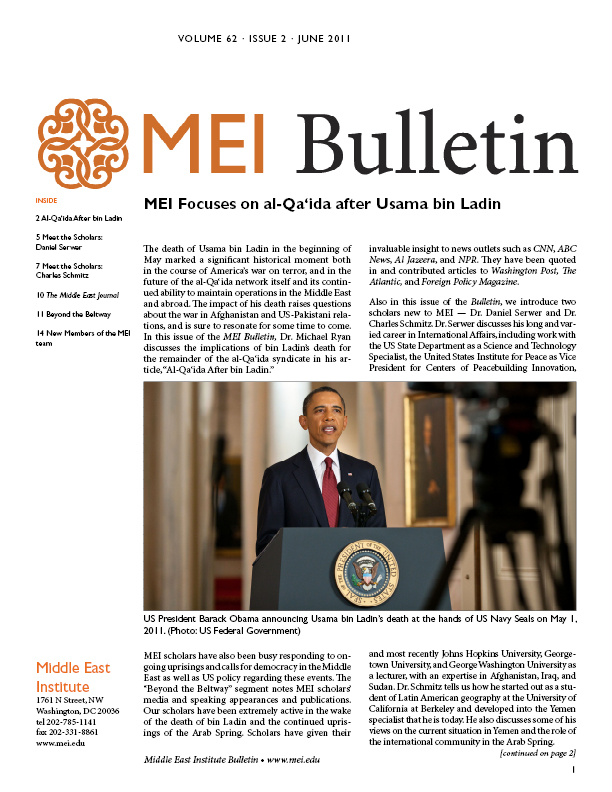
    In the June 2011 Bulletin, Dr. Michael Ryan discusses the implications of bin Ladin’s death for the remainder of the al-Qa’ida network. It also introduces new MEI scholars Dr. Daniel Serwer, who is interviewed on his career in technology and peacebuilding, and Dr. Charles Schmitz, who speaks about his work on Yemen.

    October 7, 2011

    March 2011: Political Protest and Transformation
  • Analysis
  • March 2011: Political Protest and Transformation

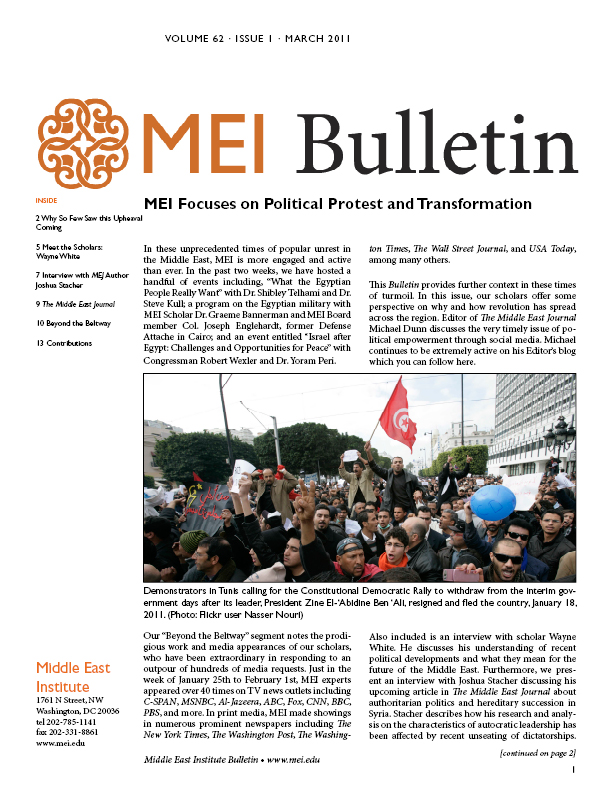
    Amidst the historic turmoil sweeping across the Arab world, in the March 2011 Bulletin, MEJ editor Michael Dunn addresses political empowerment through social media, scholar Wayne White is interviewed on recent political developments, and Joshua Stacher previews his forthcoming article on authoritarian politics and hereditary succession in Syria.

    October 6, 2011

    December 2010: Transitions in Iraq
  • Analysis
  • December 2010: Transitions in Iraq

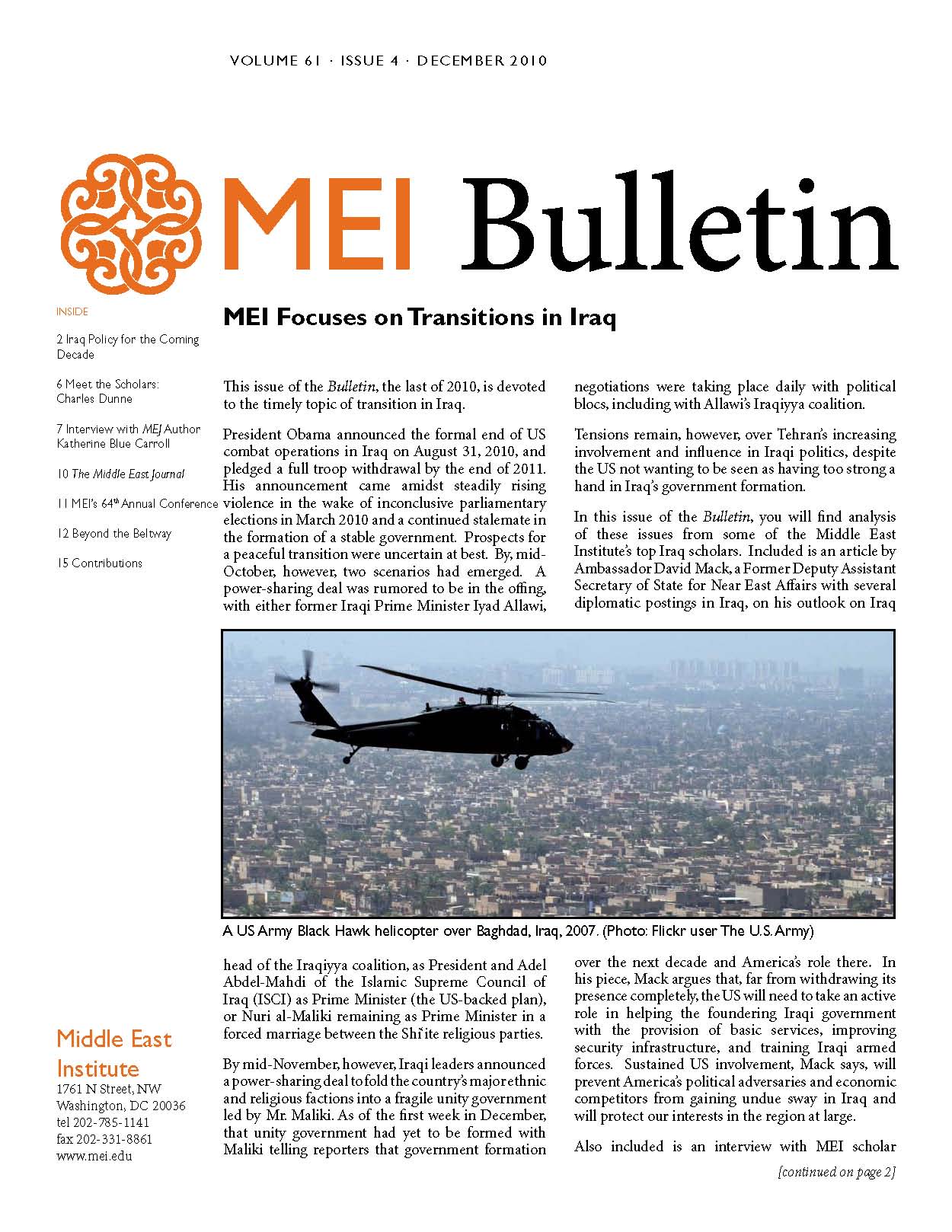
    In the wake of the August 31 drawdown of US forces and the formation of a fragile unity government after months of negotiations, the December 2010 Bulletin features an argument from Ambassador David Mack for sustained US assistance to the Iraqi government, interviews with MEI Scholar Charles Dunne the political situation in Iraq and with Katherine Blue Carroll on her forthcoming MEJ article, and a summary of MEI’s 64th Annual Conference.

    October 5, 2011

    Women, Shari‘a, and Personal Status Law Reform in Egypt after the Revolution
    Middle East Institute
  • Analysis
  • Women, Shari‘a, and Personal Status Law Reform in Egypt after the Revolution

    Like almost everything else during the uncertain period of the transitional government, the future of personal status law reform is at a crossroads in Egypt. The new constitution (assuming one will exist)[1] may technically have little direct impact on how the country’s laws affect women’s lives, but the legislative process that emerges thereafter most certainly will.

    October 1, 2011

    Morocco’s “Arab” Spring
    Middle East Institute
  • Analysis
  • Morocco’s “Arab” Spring

    As elsewhere in North Africa and the Middle East, the youth-driven revolts in Tunisia and Egypt produced a tsunami in Morocco’s political landscape. On February 20, a movement took shape that publicly demanded a constitutional monarchy in which an elected and accountable government would have control over the country’s social, economic, and security policies. All across the country, it organized rallies in which tens of thousands of Moroccans participated.

    October 1, 2011

    “The Beginning of Arabia’s Spring:” The Khalid Revolution
    Middle East Institute
  • Analysis
  • “The Beginning of Arabia’s Spring:” The Khalid Revolution

    “Knowledge and freedom carry no national identity…. There is no nation that has known light and preferred receding back.”

    Ameen Rihani (The Rihani Essays, 421)

    October 1, 2011

    Tunisia Tests the Waters of Democracy
    Middle East Institute
  • Analysis
  • Tunisia Tests the Waters of Democracy

    Ten months after a young fruit seller set himself alight in a small, marginalized town in central Tunisia, his compatriots will be voting in what many are hoping will be the country’s first free and fair elections. In the poll set for October 23, Tunisians will be electing a national constituent assembly that will be charged with writing the rules of the new political era. That assembly will spend up to a year writing a new constitution and deciding which form of government the country will have.

    October 1, 2011

    Arab Countries: Dynamics of Change
    Middle East Institute
  • Podcast
  • Arab Countries: Dynamics of Change

    Join us for a discussion with Adel Abdellatif who, in his capacity as Chief of the UNDP's Regional Programme Division of the Regional Bureau for Arab States, oversees its flagship Arab Human Development Reports. Mr. Abdellatif will be discussing the dynamics of change in an Arab world undergoing seismic political transformations.

    September 30, 2011

    Yemen's Unhappy Ending
    Middle East Institute
  • Analysis
  • Yemen's Unhappy Ending

    This Commentary was first published as an op-ed in Foreign Policy’s “Middle East Channel” on September 27, 2011

    September 27, 2011

    Erdogan's Arab Spring Tour
    Middle East Institute
  • Analysis
  • Erdogan's Arab Spring Tour

    When President Obama met with Turkish Prime Minister Recep Tayyip Erdogan on Tuesday, the two discussed cooperation on Syria, counter-terrorism and supporting the Arab spring. But a central theme of the talks, and what most concerns the U.S. at the moment, is a sharply deteriorating Turkish relationship with Israel that the U.S. hopes to reverse. Conversely, this deterioration was the source of much acclaim when Erdogan visited Arab spring countries last week.

    Read the Middle East Journal

    The oldest peer-reviewed publication dedicated to the study of the modern Middle East, MEI’s flagship journal covers politics, society, and culture in the region.