Skip to Content

Research & Commentary

Read in-depth research, analysis, and commentary from MEI’s fellows and experts on the Middle East. 

Trump, Syria, and the Hizballah Question
  • Podcast
  • Trump, Syria, and the Hizballah Question

    US President Donald Trump recently proposed that Syria intervene militarily against Hizballah in Lebanon. Is that a good idea? This episode of Middle East Focus features a recent MEI Virtual Briefing. Director of Communications Zeina Al-Shaib is joined by Ambassador David Hale, MEI Distinguished Diplomatic Fellow and Charles Lister, MEI Senior Fellow. Together they examine the prospects and implications of renewed Syrian involvement in Lebanon, the potential impact on US relations with both countries, and how evolving dynamics in Lebanon and Syria could reshape the regional balance of power and affect countries such as Turkey and Israel.

    July 9, 2026

    Trump’s Family Business Deals Risk Further Undermining the Credibility of US Middle East Policy
  • Analysis
  • Trump’s Family Business Deals Risk Further Undermining the Credibility of US Middle East Policy

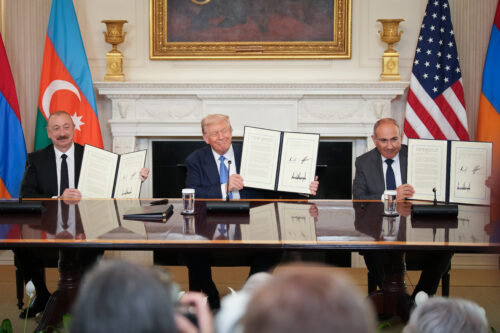
    President Trump’s family businesses are once again in the spotlight as a new financial disclosure showed they earned $2 billion in income in 2025 — a dramatic increase on the year before, with much of it coming from Gulf entities, raising emoluments concerns. Mounting perceptions of corruption, combined with unresolved crises in Iran and Israel-Palestine, are eroding trust among key partners in the Middle East. With the 2026 midterms approaching, these entanglements could represent a major political vulnerability and further undermine America’s already-strained standing in the region.

    Do the Gulf States Need a New Playbook?
  • Podcast
  • Do the Gulf States Need a New Playbook?

    After the US-Israel-Iran war — and the strikes that followed the cease-fire — the Gulf states find themselves dangerously exposed. Host Alistair Taylor is joined by MEI Associate Fellow Gregory Gause to discuss the war’s impact on the Gulf, their partnership with the United States, and whether the turmoil of recent months will push Gulf leaders to reassess their alliances and international engagement.

    July 2, 2026

    Additional Research & Commentary

    Backgrounders

    The Houthis
  • Backgrounder
  • The Houthis

    The Houthis are a political-military faction and Zaydi religious movement founded in northwestern Yemen in the 1980s. A key member of Iran’s Axis of Resistance with links to other militant organizations in the Arabian Peninsula and the Horn of Africa, the group has continued to pose a threat to Western interests on a global scale.

    May 15, 2026

    The Abraham Accords
    Photo by Alex Wong/Getty Images
  • Backgrounder
  • The Abraham Accords

    This backgrounder provides an overview of how the Abraham Accords came about, the US interests involved, their economic and strategic consequences, and the prospects for further enlargement going forward.

    November 17, 2025

    Turkish Foreign Policy
  • Backgrounder
  • Turkish Foreign Policy

    After a decade of post-Arab Spring isolation, Turkey’s leaders have recognized that their ambition to position the country as an agenda-setter on the world stage requires active engagement in all directions. President Recep Tayyip Erdoğan’s consolidation of executive authority has centralized foreign policy decision-making and tied it to his domestic political priorities, transforming the country’s revisionist approach to one shaped primarily by personal and pragmatic interests.

    April 23, 2026

    Western Sahara: Why the conflict still matters
  • Video
  • Western Sahara: Why the conflict still matters

    As the Western Sahara conflict reaches its fifth decade, the territorial dispute remains unresolved and largely unknown. MEI’s Intissar Fakir unpacks the Western Sahara’s complex history and the rival claims by Morocco and the Sahrawi Arab Democratic Republic. She examines recent developments, such as President Trump’s recognition of Moroccan sovereignty over the territory and the collapse of a 30-year cease-fire, as well as the core questions that remain unanswered after half a century.

    August 7, 2025

    Podcasts

    Middle East Focus

    MEI’s flagship weekly podcast on US foreign policy and contemporary political and social issues in the Middle East.

    Taking the Edge Off the Middle East

    MEI Senior Fellow Brian Katulis engages friends, colleagues, and policy experts in casual conversations on the most important happenings in the Middle East. 

    Rethinking Democracy

    MEI Senior Fellow Gonul Tol hosts leading scholars and thought leaders on global democracy trends and the state of the liberal international order. 

    Filter by
    8749 Results
    Saudi-Shi'ite Political Relations in the Kingdom
    Middle East Institute
  • Analysis
  • Saudi-Shi'ite Political Relations in the Kingdom

    Saudi Arabia always has been a tough neighborhood for religious minorities. This has been especially true for the Kingdom’s Shi‘ites, the country’s largest minority, with almost two million of them living in the oil-rich Eastern Province. From early in the 20th century, Shi‘ites have been the targets of scorn and opprobrium, much of it with the official blessing of the Saudi rulers. The origins of anti-Shi‘ite enmity are hardly a mystery.

    October 1, 2009

    The 1979 "Oil Shock:" Legacy, Lessons, and Lasting Reverberations
    Middle East Institute
  • Analysis
  • The 1979 "Oil Shock:" Legacy, Lessons, and Lasting Reverberations

    The 1979 “oil shock,” which was precipitated by the Iranian Revolution and compounded by the outbreak of the Iran-Iraq War, was the second major market disturbance of the decade. The curtailment of oil supplies and the skyrocketing of oil prices had far-reaching effects on producers, consumers, and the oil industry itself.

    October 1, 2009

    Reforming the Judiciary in Saudi Arabia
    Middle East Institute
  • Analysis
  • Reforming the Judiciary in Saudi Arabia

    Though the Saudi royal family still rules the realm, they have initiated a number of reforms over the past 30 years. Some of these reforms have been bolder and more successful than others. Some have been doomed from the very start — a few, perhaps, were intended to be stillborn. Judicial reform is one of the most recent and potentially one of the most important reform initiatives undertaken in the Kingdom.

    October 1, 2009

    Tribes and the Saudi Legal-System: An Assessment of Coexistence
    Middle East Institute
  • Analysis
  • Tribes and the Saudi Legal-System: An Assessment of Coexistence

    Saudi Arabia is overwhelmingly Islamic and has always been ruled under the Shari‘a, or Islamic law. The sheer existence of an additional legal system in Saudi Arabia, besides the Islamic Shari‘a, is regarded as an offense against the Islamic character or modernity of the country and its judicial system. Islamic law is supreme in Saudi Arabia, and the idea of the divine right of kings, used to justify absolute monarchies in Christian Europe, would be considered heresy. As divine law, it is immutable and unchangeable. As constitutional law it cannot be amended.

    October 1, 2009

    From Generation to Generation: The Succession Problem in Saudi Arabia
    Middle East Institute
  • Analysis
  • From Generation to Generation: The Succession Problem in Saudi Arabia

    The question of succession is the core issue of contention among the members of the Saudi royal family. Ever since its advent in the second half of the 18th century, the dynasty has been suffering from this problem and been trying to overcome it, succeeding as often as failing. This problem is due to the power structure inspired by the local system of kinship.

    October 1, 2009

    Saudi Arabia: Victim or Hegemon?
    Middle East Institute
  • Analysis
  • Saudi Arabia: Victim or Hegemon?

    For the past 50 years, Saudi Arabia has been endlessly engaged in defending and expanding its position in the Middle East. This is, in part, a function of its self-image as the guardian of Mecca and Medina, the two holiest shrines in the Islamic world, but it also reflects its dominant role as the world’s largest repository of oil and as one of its largest producers. Ironically, these two factors behind the Kingdom’s foreign policy have made, at times, uncomfortable bedfellows, particularly when set against its domestic politics and foreign attitudes towards them.

    October 1, 2009

    Saudi Arabia and Iran: Less Antagonism, More Pragmatism
    Middle East Institute
  • Analysis
  • Saudi Arabia and Iran: Less Antagonism, More Pragmatism

    The siege of the Grand Mosque in November 1979 came on the heels of the Islamic Revolution in Iran. Juhayman al-‘Utaybi, the leader of the rebels, though, seemed not be very much inspired by what had happened next door. Whatever he may have noticed from Iran’s turmoil — and it might not have been too much because he never watched TV and rarely browsed newspapers — he deemed it to be irrelevant because Iranians were Shi‘ites, incorrigibly stuck in their heretic beliefs.

    October 1, 2009

    How Salafism Came to Yemen: An Unknown Legacy of Juhayman al-'Utaybi 30 Years On
    Middle East Institute
  • Analysis
  • How Salafism Came to Yemen: An Unknown Legacy of Juhayman al-'Utaybi 30 Years On

    Since it emerged in Yemen around three decades ago, the country’s Salafi movement has maintained complex, if not tense links with Saudi Arabia.[1] Before establishing a Yemeni manifestation of Salafism with its own features and clerics,

    October 1, 2009

    Saudi-Russian Relations: 1979-2009
    Middle East Institute
  • Analysis
  • Saudi-Russian Relations: 1979-2009

    In 1979, Saudi-Russian relations were extremely poor. The two countries did not even have diplomatic relations — nor had they since the 1930s. Many observers regarded Soviet military support for Marxist regimes in Ethiopia, South Yemen, and Afghanistan as ultimately aimed at surrounding the oil-rich Kingdom and bringing about the downfall of its US-allied ruling family. The Soviet invasion of Afghanistan and the uncertainty about whether the Iranian Revolution might evolve in a Marxist direction only served to intensify the perception of a Soviet threat to the Kingdom.

    October 1, 2009

    Cooperation under the Radar: The US-Saudi Arabian Joint Commission for Economic Cooperation (JECOR)
    Middle East Institute
  • Analysis
  • Cooperation under the Radar: The US-Saudi Arabian Joint Commission for Economic Cooperation (JECOR)

    Economists and political analysts who write about Saudi Arabia often say that the most difficult part of their research is finding accurate statistics about the Kingdom. Population, food production, water resources, oil and gas reserves, industrial output — many kinds of data that are essential to sound planning and accurate evaluation cannot be taken at face value, especially if they are generated by Saudi government agencies.

    October 1, 2009

    Saudi-American Relations
    Middle East Institute
  • Analysis
  • Saudi-American Relations

    The past 30 years of the Saudi-American relationship have seen highs of intense geopolitical cooperation and the lows of the post-September 11, 2001 period. What has tied those ups and downs together is the fluctuating relationship between both governments and the transnational Salafi Islamist movement. Both governments fostered the movement — domestically in Saudi Arabia and as an international force — during the Afghan jihad against the Soviet Union in the 1980s. Both have seen the movement shift from a tool of their foreign policies to a threat.

    Saudi Wahhabi Islam in the Service of Uncle Sam
    Middle East Institute
  • Analysis
  • Saudi Wahhabi Islam in the Service of Uncle Sam

    In various entries in his unpublished diaries, British Mesopotamian officer Harry St. John Philby, on special mission to central Arabia during 1917-1918, recorded the minutes of his many private “interviews” with Ibn Saud. He concluded that the newly re-emerging Wahhabi movement under Ibn Saud would, with British political and military support, effectively serve British military and political objectives in the Arabian Peninsula and beyond during the ongoing war and in its aftermath.

    October 1, 2009

    The United States and Saudi Arabia: Challenges Ahead
    Middle East Institute
  • Analysis
  • The United States and Saudi Arabia: Challenges Ahead

    The Obama Administration confronts a vexing set of challenges across the greater Middle East, an area that stretches from Egypt in the west, Afghanistan and Pakistan in the east, Central Asia in the north and Yemen in the south. In the midst of this “arc of instability” sits Saudi Arabia, a long-standing partner whose relationship with the United States has been enduring but fraught.

    October 1, 2009

    Turkish Cypriot Women Artists and Their Role in Society
    Middle East Institute
  • Analysis
  • Turkish Cypriot Women Artists and Their Role in Society

    Art in the sense of Western style is a rather new concept for the Turkish society living in Cyprus. Under British rule, Turkish Cypriots were slow to follow new trends due to their lack of education and desire to preserve their national and religious identities. The British government reinforced this by fostering an education policy based on the Hellenic and Ottoman systems, in which the Orthodox Church and the Turkish Evkaf[1] organization took the responsibility for educating each society.

    September 2, 2009

    Samia Zaru
    Middle East Institute
  • Analysis
  • Samia Zaru

    I have wanted to tell the world about Samia Zaru for a long time. It is difficult to write about her, not because her works are inscrutable — for they are straightforward — but because the sheer power of the woman herself gets in the way. She embodies contained passion and tough love … she combines a restless mind, a contrarian’s tongue, a designer’s eye, and a compassionate soul.

    September 2, 2009

    Read the Middle East Journal

    The oldest peer-reviewed publication dedicated to the study of the modern Middle East, MEI’s flagship journal covers politics, society, and culture in the region.