Skip to Content

Research & Commentary

Read in-depth research, analysis, and commentary from MEI’s fellows and experts on the Middle East. 

Trump, Syria, and the Hizballah Question
  • Podcast
  • Trump, Syria, and the Hizballah Question

    US President Donald Trump recently proposed that Syria intervene militarily against Hizballah in Lebanon. Is that a good idea? This episode of Middle East Focus features a recent MEI Virtual Briefing. Director of Communications Zeina Al-Shaib is joined by Ambassador David Hale, MEI Distinguished Diplomatic Fellow and Charles Lister, MEI Senior Fellow. Together they examine the prospects and implications of renewed Syrian involvement in Lebanon, the potential impact on US relations with both countries, and how evolving dynamics in Lebanon and Syria could reshape the regional balance of power and affect countries such as Turkey and Israel.

    July 9, 2026

    Trump’s Family Business Deals Risk Further Undermining the Credibility of US Middle East Policy
  • Analysis
  • Trump’s Family Business Deals Risk Further Undermining the Credibility of US Middle East Policy

    President Trump’s family businesses are once again in the spotlight as a new financial disclosure showed they earned $2 billion in income in 2025 — a dramatic increase on the year before, with much of it coming from Gulf entities, raising emoluments concerns. Mounting perceptions of corruption, combined with unresolved crises in Iran and Israel-Palestine, are eroding trust among key partners in the Middle East. With the 2026 midterms approaching, these entanglements could represent a major political vulnerability and further undermine America’s already-strained standing in the region.

    Do the Gulf States Need a New Playbook?
  • Podcast
  • Do the Gulf States Need a New Playbook?

    After the US-Israel-Iran war — and the strikes that followed the cease-fire — the Gulf states find themselves dangerously exposed. Host Alistair Taylor is joined by MEI Associate Fellow Gregory Gause to discuss the war’s impact on the Gulf, their partnership with the United States, and whether the turmoil of recent months will push Gulf leaders to reassess their alliances and international engagement.

    July 2, 2026

    Additional Research & Commentary

    Backgrounders

    The Houthis
  • Backgrounder
  • The Houthis

    The Houthis are a political-military faction and Zaydi religious movement founded in northwestern Yemen in the 1980s. A key member of Iran’s Axis of Resistance with links to other militant organizations in the Arabian Peninsula and the Horn of Africa, the group has continued to pose a threat to Western interests on a global scale.

    May 15, 2026

    The Abraham Accords
    Photo by Alex Wong/Getty Images
  • Backgrounder
  • The Abraham Accords

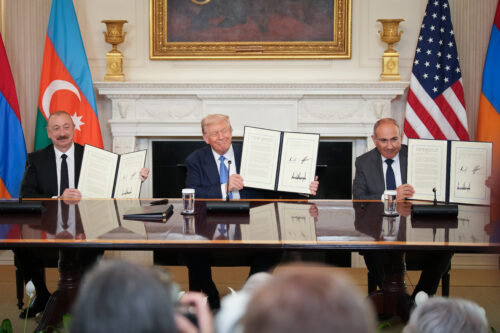
    This backgrounder provides an overview of how the Abraham Accords came about, the US interests involved, their economic and strategic consequences, and the prospects for further enlargement going forward.

    November 17, 2025

    Turkish Foreign Policy
  • Backgrounder
  • Turkish Foreign Policy

    After a decade of post-Arab Spring isolation, Turkey’s leaders have recognized that their ambition to position the country as an agenda-setter on the world stage requires active engagement in all directions. President Recep Tayyip Erdoğan’s consolidation of executive authority has centralized foreign policy decision-making and tied it to his domestic political priorities, transforming the country’s revisionist approach to one shaped primarily by personal and pragmatic interests.

    April 23, 2026

    Western Sahara: Why the conflict still matters
  • Video
  • Western Sahara: Why the conflict still matters

    As the Western Sahara conflict reaches its fifth decade, the territorial dispute remains unresolved and largely unknown. MEI’s Intissar Fakir unpacks the Western Sahara’s complex history and the rival claims by Morocco and the Sahrawi Arab Democratic Republic. She examines recent developments, such as President Trump’s recognition of Moroccan sovereignty over the territory and the collapse of a 30-year cease-fire, as well as the core questions that remain unanswered after half a century.

    August 7, 2025

    Podcasts

    Middle East Focus

    MEI’s flagship weekly podcast on US foreign policy and contemporary political and social issues in the Middle East.

    Taking the Edge Off the Middle East

    MEI Senior Fellow Brian Katulis engages friends, colleagues, and policy experts in casual conversations on the most important happenings in the Middle East. 

    Rethinking Democracy

    MEI Senior Fellow Gonul Tol hosts leading scholars and thought leaders on global democracy trends and the state of the liberal international order. 

    Filter by
    8749 Results
    Mutiny in the Harem: Nadir Moknèche’s Algiers Trilogy
    Middle East Institute
  • Analysis
  • Mutiny in the Harem: Nadir Moknèche’s Algiers Trilogy

    In her book Harem: The World behind the Veil, Alev Lytle Croutier proposes the following definition of the harem: “The word harem, derived from the Arabic haram, means ‘unlawful’, ‘protected’ or ‘forbidden.’ The sacred area around Mecca and Medina is haram, closed to all but the Faithful.

    September 1, 2009

    Kuwait Looks towards the East: Relations with China
    Middle East Institute
  • Analysis
  • Kuwait Looks towards the East: Relations with China

    Originally posted September 2009

    There is a growing tendency among the Gulf Cooperation Council (GCC) states to benefit from the favorable conditions in the rapidly growing economies of the East. As was amply demonstrated at a symposium organized by the Centre for Gulf and Arabian Peninsula Studies at Kuwait University in May 2009 on the “Reality of GCC-Asian Relationship — opportunities and challenges,” Kuwait exemplifies this trend.

    September 1, 2009

    Introduction to The State of the Arts in the Middle East Vol II
    Middle East Institute
  • Analysis
  • Introduction to The State of the Arts in the Middle East Vol II

    This special edition of MEI Viewpoints is the second volume in a continuing series which explores the State of the Arts in the Middle East. The essays comprising this volume examine the art and influence of the distinguished Palestinian artist and educator Samia Zaru, representations of female communities in Algiers in three of renowned filmmaker Nadir Moknèche’s cinematic works, and the cultural production and societal roles of female Turkish Cypriot artists.

    September 1, 2009

    Introduction to The Legacy of Camp David: 1979-2009
    Middle East Institute
  • Analysis
  • Introduction to The Legacy of Camp David: 1979-2009

    Since the “Six Day War” in June 1967, countless American and other diplomats have sought almost continuously to broker peace between Israel and its surrounding Arab enemies. From that tangled history, one achievement stands tallest in a forest of scrub: the Egypt-Israel Treaty signed on March 26, 1979 on the White House front lawn by President Anwar Sadat, Prime Minister Menachem Begin, and President Jimmy Carter.

    July 14, 2009

    The Islamization of Pakistan, 1979-2009
    Middle East Institute
  • Analysis
  • The Islamization of Pakistan, 1979-2009

    Since 2007, Pakistan, though not on the verge of becoming a failed state, nonetheless has been gripped by a series of interrelated crises. As the contributors to this volume demonstrate, Pakistan’s current travails have deep and tangled historical roots. They also demonstrate that Pakistan’s domestic situation historically has been influenced by, and has affected developments in neighboring countries as well as those farther afield.

    July 14, 2009

    Discerning Yemen's Political Future
  • Analysis
  • Discerning Yemen's Political Future

    This project was originally imagined as a multi-authored consideration of Yemen’s April 2009 parliamentary process — its lead-up, outcomes, and likely consequences. Following the postponement of these elections, the authors have instead sought to examine not only the stated and implicit reasons for the delay, but also Yemen’s increasing political unrest — turmoil which the regime has helped foster and to which it has begun to overreact. For the authors, the key question is less whether the elections will be held in 2011, but whether the country will remain intact until then.

    June 11, 2009

    Non-Oil Industries in the Persian Gulf
  • Analysis
  • Non-Oil Industries in the Persian Gulf

    For decades the Arab Gulf states and members of the Gulf Cooperation Council (GCC) — Bahrain, Kuwait, Oman, Qatar, Saudi Arabia, and the United Arab Emirates (UAE) — have seen their economic fortunes rise and fall with the demand for their chief export, oil. To shield themselves from the volatility of global oil markets, these states have sought to diversify their economies by investing in a host of non-oil industries, especially services, commerce, and manufacturing.

    June 3, 2009

    Read the Middle East Journal

    The oldest peer-reviewed publication dedicated to the study of the modern Middle East, MEI’s flagship journal covers politics, society, and culture in the region.