This individual is a guest contributor. MEI is not able to assist with contact requests.
Attiya Ahmad is Georgetown University’s 2009-10 Center for International and Regional Studies Post-Doctoral Fellow. She recently completed her PhD in Cultural Anthropology at Duke University. Dr. Ahmad’s work brings together scholarship on Islamic studies, globalization, diaspora and migration studies, economic anthropology, and political economy.
New Questions on the International Stabilization Force for Gaza
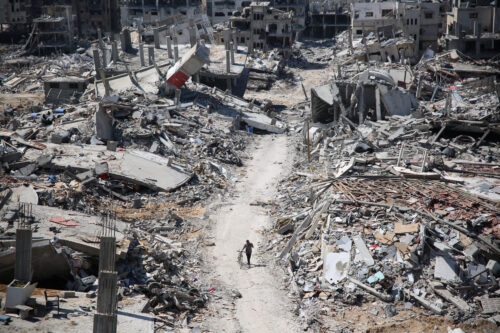
In November 2025, the United States sought and obtained approval for a United Nations Security Council Resolution (UNSCR 2803) endorsing the formation of a Board of Peace (BoP) and International Stabilization Force (ISF) to support the implementation of the 20-point peace plan agreed to by Israel and Hamas the previous month. The ISF’s stated role is to help secure and demilitarize the Gaza Strip, primarily by facilitating the decommissioning of weapons, protecting civilians, and training and advising burgeoning Palestinian police forces. In the intervening months, however, progress on standing up the ISF has stalled, and conflicting messaging from US officials provides more questions than answers.
What Trump’s 2026 Mideast approach could look like
Donald Trump’s first year of his second presidential term has been a roller coaster of twists and turns both at home and abroad—particularly in the Middle East. His regional focus was driven by two main factors: first, Trump’s own ego and sense of possible place in history; and second, the volatile, dynamic events driven by actors in the region.
US Policy in the Middle East in the First Year of Trump 2.0: A Report Card
In the first year of his second term in office, US President Donald Trump focused considerable time and energy on the Middle East, but the results so far have been uneven. This report assesses the US government’s actions in the region over the past 12 months, from January 2025 through January 2026.
America’s New Defense Strategy — and What It Means for Iran
Hosts Alistair Taylor and Matthew Czekaj are joined by MEI Distinguished Military Fellow Mick Mulroy to discuss the Trump administration’s new National Defense Strategy (NDS) and its implications for the Middle East. While serving as the Deputy Assistant Secretary of Defense (DASD) for the Middle East from 2017 to 2019, Mulroy helped prepare the 2018 NDS, giving him an insider perspective on US defense planning. Together, Taylor, Czekaj, and Mulroy unpack what the new strategy means for US priorities globally and for the Middle East in particular, including how it could be reflected in a potentially looming military strike on Iran.
With the US and Iran on a knife-edge, can Oman once again step in to mediate?
The decision by Washington and Tehran to shift their long-anticipated meeting, set for February 6, from Istanbul to Muscat is not merely a logistical detail. It is the latest reminder that when US-Iran diplomacy is on the verge of breaking down completely, Oman is the regional player the Iranian regime trusts the most to step in and mediate.
Long before the Gaza war erupted in 2023, a broad consensus had already taken hold across policymakers, activists, and foreign-policy circles: the Israeli-Palestinian conflict was at a political dead end. The Oslo framework—and the promise of a two-state solution—had steadily lost credibility as a realistic path forward. Since Hamas’s October 7 attacks, the devastation in Gaza and the accelerating realities on the ground have made a two-state outcome even harder to imagine. And yet, it remains the default language of Middle East diplomacy. Most recently, UN Secretary-General António Guterres reaffirmed his determination to oppose Israeli actions undermining the two-state solution and called for renewed momentum toward Palestinian statehood.
Against the backdrop of the Iranian government’s brutal crackdown on protestors, Brian is joined by Emad Shargi, an Iranian-American businessman who was unjustly detained by the regime in 2018 until his release in 2023. Shargi recounts his firsthand experience in the notorious Evin Prison and offers rare insights into the mentality and tactics of the Islamic Republic. He and Brian also discuss his recommendations for US engagement in Iran and his hopes for the country’s future.
Bolstering US, Japan, and Gulf Cooperation in the High Tech Field
In recent years, both Washington and the Middle East have been looking eastward. The United States has been executing its own “pivot to Asia,” seeking to strengthen alliances and manage competition in the Indo-Pacific, while many Middle Eastern states are simultaneously deepening their economic and strategic ties with Asian partners. This dual pivot is creating new intersections for US–Japan cooperation. The discussion featured Ambassador Barbara Leaf, Mohammed Soliman and Amane Kobayashi, and was moderated by Ken Pollack. Drawing on their experience, the speakers examined how Japanese, American, and Gulf public and private initiatives can be integrated to create more dynamic, cutting-edge economies, symbiotic diplomatic relationships, and stronger mutual security ties.
Integration or conflict in northeastern Syria? Ten key points to consider
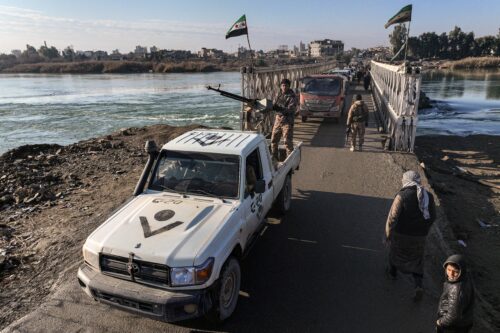
After 10 months of US-mediated talks failed to achieve an integration of the Syrian Democratic Forces into Syria’s transitional state, hostilities erupted in early January. US diplomacy stepped in to try to calm tensions and force through the integration of the SDF’s Kurdish core into the Syrian state. Here are 10 key takeaways and indications of where things could go next.
Ambiguous Uncertainties: Phase Two of Trump’s Plan for Gaza
MEI Senior Fellow Lucy Kurtzer-Ellenbogen joins hosts Alistair Taylor and Matthew Czekaj to discuss the latest developments in Gaza. Nearly four months after the Israeli government and Hamas agreed to President Donald Trump’s 20-point plan, Washington has announced that phase two of the process is now underway. Kurtzer-Ellenbogen, Taylor, and Czekaj examine the humanitarian situation in the devastated coastal strip, assess what phase two could entail, break down how international actors are responding, and explore what would need to happen to realize the plan’s aspirations.
Media and politicians on both sides of the Atlantic are hyping the idea that President Trump’s attempt to gain sovereign control of Greenland has caused unprecedented and irreparable damage to the over 75 year-old Transatlantic Alliance. This “analysis” stems from multiple sources. On both sides of the ocean, there are those who pounce on any deviation from the norm by Trump as evidence the world as we know it is ending. And in Europe, there is the human but unattractive reaction of weak, dependent states against their one powerful ally when it rejects Europe’s preferred script. Much of the US media criticism is summarized by the concept that our other NATO allies can never again “trust” the US.
The US Commerce Department announced on November 19, 2025, that it had authorized the export of advanced American semiconductor chips to HUMAIN of Saudi Arabia and G42 of the United Arab Emirates. The approval enables both companies to purchase up to 35,000 Blackwell chips (GB300s). This sale is a core component of a broader “Compute Diplomacy” approach under the second administration of President Donald J. Trump, which was solidified following his May 2025 visit to the Gulf, where a series of multibillion-dollar artificial intelligence (AI) infrastructure agreements were signed.