Skip to Content

Research & Commentary Results

Filter by
300 Results
How Lebanon’s authorities can keep the Iran war from engulfing the country
Photo by Nidal SOLH / AFP via Getty Images
  • Commentary
  • How Lebanon’s authorities can keep the Iran war from engulfing the country

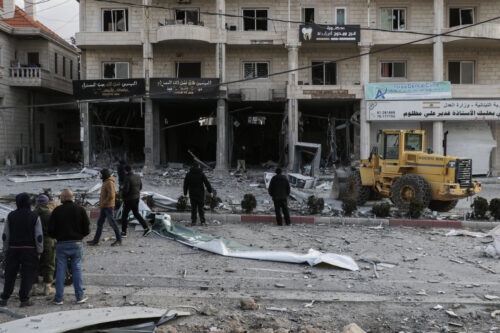
    Today’s decision taken by the Lebanese government — to declare all of Hizballah’s security and military activities illegal — is a landmark development. But how the government and the Lebanese Armed Forces implement this directive now that a new round of attacks has actually taken place will be the ultimate test of their credibility.

    Tehran Has Discovered Moscow Is a Fair-Weather Friend
  • Commentary
  • Tehran Has Discovered Moscow Is a Fair-Weather Friend

    The latest cycle of U.S.-Iran escalation has followed a familiar script: sharpened rhetoric from the United States, calibrated military signaling by Iran in the Persian Gulf, indirect diplomacy through Oman, and Israeli warnings that remain deliberately ambiguous but unmistakably real. Yet beneath this choreography lies a more consequential development inside Tehran. The current crisis is forcing Iran’s political class to reassess its central foreign-policy wager of the past decade: that deepening alignment with Russia and China would provide strategic insulation against Western coercion.

    America’s New Defense Strategy — and What It Means for Iran
  • Podcast
  • America’s New Defense Strategy — and What It Means for Iran

    Hosts Alistair Taylor and Matthew Czekaj are joined by MEI Distinguished Military Fellow Mick Mulroy to discuss the Trump administration’s new National Defense Strategy (NDS) and its implications for the Middle East. While serving as the Deputy Assistant Secretary of Defense (DASD) for the Middle East from 2017 to 2019, Mulroy helped prepare the 2018 NDS, giving him an insider perspective on US defense planning. Together, Taylor, Czekaj, and Mulroy unpack what the new strategy means for US priorities globally and for the Middle East in particular, including how it could be reflected in a potentially looming military strike on Iran.

    February 5, 2026

    With the US and Iran on a knife-edge, can Oman once again step in to mediate?
    Photo by Burak Kara/Getty Image
  • Analysis
  • With the US and Iran on a knife-edge, can Oman once again step in to mediate?

    The decision by Washington and Tehran to shift their long-anticipated meeting, set for February 6, from Istanbul to Muscat is not merely a logistical detail. It is the latest reminder that when US-Iran diplomacy is on the verge of breaking down completely, Oman is the regional player the Iranian regime trusts the most to step in and mediate.

    Ambiguous Uncertainties: Phase Two of Trump’s Plan for Gaza
  • Podcast
  • Ambiguous Uncertainties: Phase Two of Trump’s Plan for Gaza

    MEI Senior Fellow Lucy Kurtzer-Ellenbogen joins hosts Alistair Taylor and Matthew Czekaj to discuss the latest developments in Gaza. Nearly four months after the Israeli government and Hamas agreed to President Donald Trump’s 20-point plan, Washington has announced that phase two of the process is now underway. Kurtzer-Ellenbogen, Taylor, and Czekaj examine the humanitarian situation in the devastated coastal strip, assess what phase two could entail, break down how international actors are responding, and explore what would need to happen to realize the plan’s aspirations.

    January 29, 2026

    Iran’s Axis of Resistance after the 12-day war: Adaptation, restructuring, and reconstitution
    Photo by Kaveh Kazemi/Getty Images
  • Analysis
  • Iran’s Axis of Resistance after the 12-day war: Adaptation, restructuring, and reconstitution

    Since Israel’s 12-day war against Iran, Tehran and its network of regional proxies and non-state allies, the so-called Axis of Resistance, have entered a phase of strategic dormancy — an outward calm concealing rearmament, financial adaptation, and ideological renewal.

    December 19, 2025

    Rob Malley Argues Two States Is an Illusion
  • Podcast
  • Rob Malley Argues Two States Is an Illusion

    Brian sits down with Robert Malley, a former US official best known for his role as the lead negotiator of the 2015 Joint Comprehensive Plan of Action. Malley discusses the motivations behind his new book, Tomorrow Is Yesterday: Life, Death, and the Pursuit of Peace in Israel/Palestine, and offers his assessment of American perspectives on the war in Gaza. The conversation also explores his personal background as the son​ of an Egyptian Jewish father and an American Jewish mother—both outspoken on the political left—and how that upbringing shaped his worldview, alongside a career spanning the Clinton, Obama, and Biden administrations.


    The Axis of Resistance
    Photo by Mohammadali Najib/Middle East Images/AFP via Getty Images
  • Backgrounder
  • The Axis of Resistance

    This backgrounder provides an overview of the Axis of Resistance, a loosely aligned network of armed groups and state actors led and supported by Iran to project its influence and military strength across the Middle East.

    December 3, 2025

    Hamas
    Photo by Eyad Baba/AFP via Getty Images
  • Backgrounder
  • Hamas

    This backgrounder provides an overview of the history of Hamas, its ideology and leadership, military capabilities and goals, the October 7 attack, relevant US government policies and legislation, and the group’s future in Gaza.

    November 18, 2025

    The legitimacy trap: How international institutions sustain the Houthis’ hold on Yemen
    Photo by MOHAMMED HUWAIS/AFP via Getty Images
  • Analysis
  • The legitimacy trap: How international institutions sustain the Houthis’ hold on Yemen

    For years, the prevailing assumption was that the Houthis’ survival depended on battlefield victories and Iranian support. Both are essential, but there is a third critical and often overlooked factor: the weaponization of international engagement. In a pattern that continues to repeat itself, engagement without accountability strengthens rather than moderates Houthi behavior.

    November 3, 2025

    Will Syria join the Global Coalition to Defeat ISIS?
    US Army photo by Sgt. Julio Hernandez courtesy of CENTCOM
  • Analysis
  • Will Syria join the Global Coalition to Defeat ISIS?

    The joint al-Dumayr operation in mid-October was the fifth instance of coordination between the Global Coalition to Defeat ISIS and the Syrian government to confront the Islamic State, amid Western calls for Damascus to officially join the international effort. What’s at stake and what are the potential scenarios moving forward?

    October 27, 2025

    From Gaza Cease-fire to Middle East Peace?
  • Policy Memo
  • From Gaza Cease-fire to Middle East Peace?

    The October 2025 cease-fire and hostage-release deal that ended the Israel-Hamas conflict marks the beginning of a complicated post-war phase. The agreement has created important opportunities to advance stability in the Middle East and build a lasting and sustainable peace marked by enhanced regional security and integration, but there are considerable risks to manage. Achieving these goals will require coordinated international action along multiple lines of effort: security, rule of law, recovery and reconstruction, responsive governance, and steady and focused diplomacy to build confidence among key parties. 

    Has Pakistan agreed to use nuclear force to defend Saudi Arabia?
  • Video
  • Has Pakistan agreed to use nuclear force to defend Saudi Arabia?

    Saudi Arabia and Pakistan signed a mutual defense pact on September 17, 2025, declaring that “any aggression against either country shall be considered an aggression against both.” The wording of the agreement sparked speculation that Pakistan might use its nuclear capabilities to defend Saudi Arabia. MEI’s F. Gregory Gause contends otherwise, offering insight into the history and strategic calculations driving the deal. To learn more about the deal, visit our website.

    Pakistan’s strategic defense pact with Saudi Arabia: A new security architecture in the wider Middle East
    Photo via Saudi Ministry of Foreign Affairs
  • Analysis
  • Pakistan’s strategic defense pact with Saudi Arabia: A new security architecture in the wider Middle East

    Following Israel’s September 9 strike on Hamas targets in Qatar, Pakistan has taken swift and significant foreign policy steps in response and adopted an unusually assertive stance. This shift was largely influenced by Pakistan’s military chief, Field Marshal Asim Munir. The latter is determined to enhance his country’s strategic autonomy and diplomatic leverage in an increasingly complex international environment by positioning Pakistan as a key security actor and an emerging middle power on the global stage.

    Silent leverage, quiet gains? China and the Saudi-Pakistan defense pact
    Photo by Madoka Ikegami-Pool/Getty Images
  • Analysis
  • Silent leverage, quiet gains? China and the Saudi-Pakistan defense pact

    The Strategic Mutual Defense Agreement (SMDA) between Saudi Arabia and Pakistan, signed in Riyadh on September 17, is far more than a bilateral pledge. It represents a profound reordering of alignments in the Gulf and South Asia, reflecting and reinforcing the broader erosion of US preeminence in the Eurasian security architecture. While much of the initial commentary centered on the striking commitment of a wealthy Gulf monarchy to the defense of a nuclear-armed South Asian state, as well as the question of whether Pakistan had in fact extended its nuclear umbrella to Saudi Arabia, the deeper story is arguably China’s potential advance.