After decades of political setbacks, Iran’s former Revolutionary Guards commander has returned to the center of power. Is he an incidental beneficiary of war, or have observers underestimated him all along?
The Human Story Behind Gaza: Jaser AbuMousa on the Costs of Survival for Palestinians
Brian sits down with MEI Senior Fellow Jaser AbuMousa to assess the situation on the ground in Gaza three years after October 7 and a year into the ceasefire. Drawing on his own personal experience, Jaser explores the toll that the war and continued destruction have taken on Gaza’s residents, the implications of the recent Israeli and US elections, and the difficult path forward.
The Unavoidable Neighbor: Managing Iran Beyond the War
Gulf states and their partners are increasingly looking beyond their most immediate interests of containing the war with Iran. While recent talks between Saudi Arabia, Turkey, Pakistan, and Iran have kept de-escalation on the agenda, a broader regional security framework and non-aggression pact has also emerged, envisioning a longer-lasting solution to regional conflicts. The talks have yet to produce a settlement, but they reflect a growing recognition that Gulf security cannot depend entirely on Washington. Iran will still be there, and its neighbors will have to find ways of living with it.
Since 1967, Israeli settlements in the West Bank have been a contested feature of the Israeli-Palestinian conflict. The ultimate disposition of the settlements and ongoing activity related to their growth have repeatedly defied agreement in negotiations over a resolution to the conflict.
The Houthis are a political-military faction and Zaydi religious movement founded in northwestern Yemen in the 1980s. A key member of Iran’s Axis of Resistance with links to other militant organizations in the Arabian Peninsula and the Horn of Africa, the group has continued to pose a threat to Western interests on a global scale.
The India-Middle East-Europe Economic Corridor (IMEC) is a proposed multinational infrastructure initiative aimed at upgrading connectivity between the three regions through integrated trade, energy, and digital networks. Announced at the G20 summit in New Delhi in September 2023, IMEC is envisioned partially as a counterweight to China’s international infrastructure project, the Belt and Road Initiative.
After a decade of post-Arab Spring isolation, Turkey’s leaders have recognized that their ambition to position the country as an agenda-setter on the world stage requires active engagement in all directions. President Recep Tayyip Erdoğan’s consolidation of executive authority has centralized foreign policy decision-making and tied it to his domestic political priorities, transforming the country’s revisionist approach to one shaped primarily by personal and pragmatic interests.
MEI Senior Fellow Brian Katulis engages friends, colleagues, and policy experts in casual conversations on the most important happenings in the Middle East.
The Middle East Institute is proud to host a discussion with Trita Parsi and Michael Singh on the prospects for a diplomatic solution to the Iran nuclear crisis in the wake of recently imposed UN and US sanctions.
Their discussion will draw upon a forthcoming Middle East Journal article entitled "The Case Against the Case Against Iran" written pseudonymously by a European diplomat, who argues for greater engagement by regional actors like Turkey, Saudi Arabia, Russia and China to mediate and mitigate Iran's nuclear ambitions.
Syria on the Verge: Implications for a Nation in Revolt
The Middle East Institute (MEI) and International Relief and Development will jointly host a discussion on the reconstruction of Libya following the fall of the Qaddhafi regime and the humanitarian dimensions of the rebuilding efforts. As the rebels root out the last of Qaddhafi royalists and regime strongholds, the question of Libya's future looms large.
Syria on the Verge: Implications for a Nation in Revolt
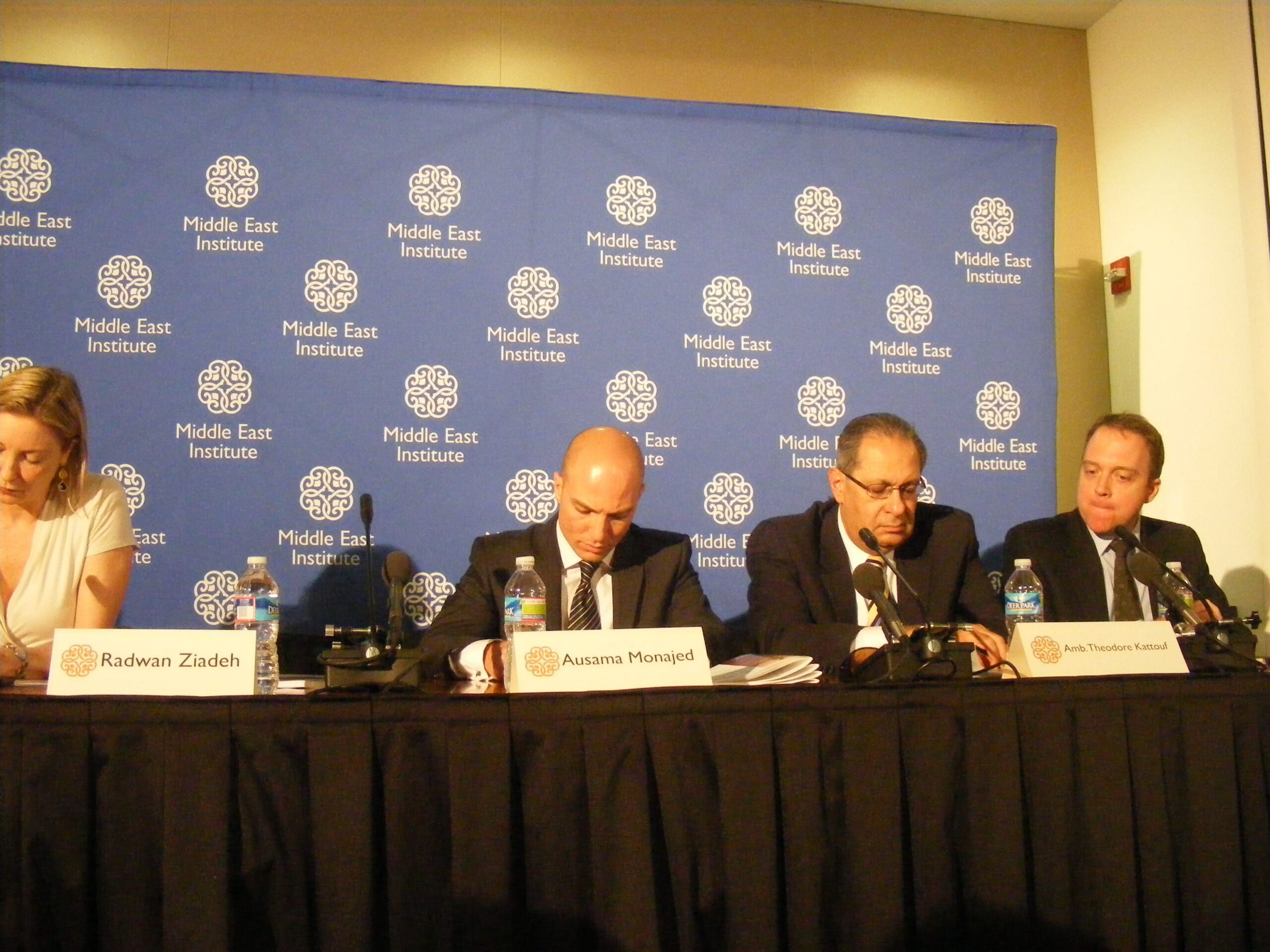
The Middle East Institute is honored to host Syria experts Radwan Ziadeh, Ausama Monajed, Amb. Theodore Kattouf, and Andrew Tabler for a panel discussion about the domestic and regional implications of the ongoing political unrest and violence in Syria. With protests continuing to rock Syria for the sixth month, the Assad government recently introduced a law allowing the formation of independent parties. But protesters say it's too little too late and point to the government's ongoing crackdown.
This Commentary was first published as an op-ed in the Washington Post on August 4, 2011
The political crisis in Bahrain appears to have subsided, even if the issues that provoked it remain unresolved. Now, the challenge before Washington is redefining the terms on which it deals with an important but seriously tarnished ally.
F. Stephen Larrabee, Distinguished Chair in European Security at the RAND Corporation, and Gonul Tol, Executive Director of the Middle East Institute’s Center for Turkish Studies, highlight the importance of drafting a new civilian constitution to solve Turkey’s Kurdish issue.
Supporting Democratic Movements in the Arab World: An Economist's Perspective
The global community was surprised by the suddenness and intensity of democratic movements in the Arab countries. While universally welcomed, the global response in support of these movements has so far been reactive, uncertain, and slow to build up. The only coherent rendering of such an initiative is the declaration of Deauville Partnership by the Group of 8 countries on May26-27, 2011.
This Commentary was first published as an op-ed in the Washington Post on July 29, 2011
With debt talks at an impasse, foreign policy is the last thing on many American minds. But how Congress and the president deal with the debt will affect US relations with other countries and our national security for years to come.
Egypt's Revolutionary Elite and the Silent Majority
It was a small group that set out on January 25, marching on National Police Day to decry the quotidian indignities they suffered at the hands of Husni Mubarak’s abusive police. Public protest in Egypt had long been a minority practice, rarely mustering more than a few hundred, or at best a few thousand, core movement activists. The organizers of the January 25 march expected the same base of dedicated demonstrators, and were shocked when the crowd swelled to more than 10,000.
Looking across the Middle East and North Africa (MENA), there is a real fear that both reform movements and revolutions risk snatching defeat from the jaws of victory. The momentum that made so many inspirational gains a few months ago is slowing, and the forces of conservatism remain in control. The only hope is that stamina, vigilance, and strategy will lead to a complete transition to democracy in at least one of the region’s countries. Not one revolution has yet been completed. If such a success is to happen soon, I hope it will be in Egypt.
The Syrian Revolution: The Role of "Emerging Leaders"
In January 2011, Syrian President Bashar al-Asad granted an interview to The Wall Street Journal in which he claimed that, because he was so close to the beliefs and aspirations of his people, Syria was “immune” to the revolutionary fever of nearby Arab lands.
Syria has the same preconditions for revolution as Tunisia and Egypt: poverty, unemployment, corruption, and repression. What Syrians were looking for was the spark.
The recent uprisings in Bahrain, Egypt, Libya, Syria, Tunisia, and Yemen share associated economic grievances and a common call for responsive government and a more dignified way of life; however, their underlying social dynamics are the product of diverse encounters with the outside world and years of oppression under very different political regimes. This is particularly true in the Libyan case, where socioeconomic and political structures and institutions shaped before as well as during the Qadhafi years have combined to produce a unique political economy.
People Power: The Real Force behind the "Bad Year for the Bad Guys"
It has been a bad year for bad guys. The events and political changes that marked 2011 were previously thought to be impossible. Yet, before July 1, 2011, Egyptian President Husni Mubarak and Tunisian President Zine el-‘Abidine Ben ‘Ali were out of power and prosecuted, Libyan leader Colonel Muammar Qadhafi and Yemeni President ‘Ali ‘Abdullah Salih were on their knees, Syrian President Bashar al-Asad was seriously challenged, and, unrelated but equally significant: Usama bin Ladin dead and Ratko Mladic in jail.
The Power of Strategic Nonviolent Action in Arab Revolutions
The largely nonviolent pro-democracy insurrections that have swept the Arab world in recent months have succeeded in toppling dictators in Tunisia and Egypt and have threatened the survival of autocratic regimes in Yemen, Bahrain, and Syria.
The oldest peer-reviewed publication dedicated to the study of the modern Middle East, MEI’s flagship journal covers politics, society, and culture in the region.