Skip to Content

Research & Commentary

Read in-depth research, analysis, and commentary from MEI’s fellows and experts on the Middle East. 

Trump’s Family Business Deals Risk Further Undermining the Credibility of US Middle East Policy
  • Analysis
  • Trump’s Family Business Deals Risk Further Undermining the Credibility of US Middle East Policy

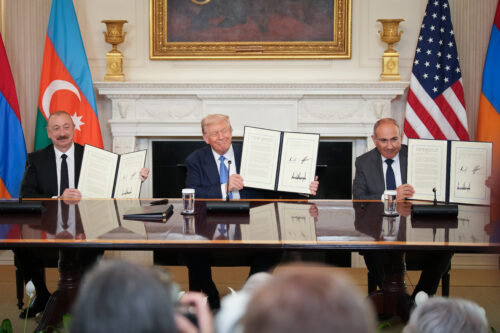
    President Trump’s family businesses are once again in the spotlight as a new financial disclosure showed they earned $2 billion in income in 2025 — a dramatic increase on the year before, with much of it coming from Gulf entities, raising emoluments concerns. Mounting perceptions of corruption, combined with unresolved crises in Iran and Israel-Palestine, are eroding trust among key partners in the Middle East. With the 2026 midterms approaching, these entanglements could represent a major political vulnerability and further undermine America’s already-strained standing in the region.

    Do the Gulf States Need a New Playbook?
  • Podcast
  • Do the Gulf States Need a New Playbook?

    After the US-Israel-Iran war — and the strikes that followed the cease-fire — the Gulf states find themselves dangerously exposed. Host Alistair Taylor is joined by MEI Associate Fellow Gregory Gause to discuss the war’s impact on the Gulf, their partnership with the United States, and whether the turmoil of recent months will push Gulf leaders to reassess their alliances and international engagement.

    July 2, 2026

    Additional Research & Commentary

    Backgrounders

    The Houthis
  • Backgrounder
  • The Houthis

    The Houthis are a political-military faction and Zaydi religious movement founded in northwestern Yemen in the 1980s. A key member of Iran’s Axis of Resistance with links to other militant organizations in the Arabian Peninsula and the Horn of Africa, the group has continued to pose a threat to Western interests on a global scale.

    May 15, 2026

    The Abraham Accords
    Photo by Alex Wong/Getty Images
  • Backgrounder
  • The Abraham Accords

    This backgrounder provides an overview of how the Abraham Accords came about, the US interests involved, their economic and strategic consequences, and the prospects for further enlargement going forward.

    November 17, 2025

    Turkish Foreign Policy
  • Backgrounder
  • Turkish Foreign Policy

    After a decade of post-Arab Spring isolation, Turkey’s leaders have recognized that their ambition to position the country as an agenda-setter on the world stage requires active engagement in all directions. President Recep Tayyip Erdoğan’s consolidation of executive authority has centralized foreign policy decision-making and tied it to his domestic political priorities, transforming the country’s revisionist approach to one shaped primarily by personal and pragmatic interests.

    April 23, 2026

    Western Sahara: Why the conflict still matters
  • Video
  • Western Sahara: Why the conflict still matters

    As the Western Sahara conflict reaches its fifth decade, the territorial dispute remains unresolved and largely unknown. MEI’s Intissar Fakir unpacks the Western Sahara’s complex history and the rival claims by Morocco and the Sahrawi Arab Democratic Republic. She examines recent developments, such as President Trump’s recognition of Moroccan sovereignty over the territory and the collapse of a 30-year cease-fire, as well as the core questions that remain unanswered after half a century.

    August 7, 2025

    Podcasts

    Middle East Focus

    MEI’s flagship weekly podcast on US foreign policy and contemporary political and social issues in the Middle East.

    Taking the Edge Off the Middle East

    MEI Senior Fellow Brian Katulis engages friends, colleagues, and policy experts in casual conversations on the most important happenings in the Middle East. 

    Rethinking Democracy

    MEI Senior Fellow Gonul Tol hosts leading scholars and thought leaders on global democracy trends and the state of the liberal international order. 

    Filter by
    8748 Results
    Defying Gravity: Working Toward a Regional Strategy for a Stable Middle East
  • Analysis
  • Defying Gravity: Working Toward a Regional Strategy for a Stable Middle East

    In this MEI Policy Paper, Ross Harrison asserts that a new regional order is emerging out of the conflicts of the Middle East. The relationships among the pillars of this order–Egypt, Saudi Arabia, Turkey, and Iran–are crucial, as they will largely determine “whether the future of the Middle East will be a continuation of the current chaos and destruction or a more positive transition toward stability and prosperity.” Harrison argues that global powers must concentrate on creating conditions conducive to cooperation among the pillars.

    Will China Interfere in the Israeli-Palestinian Conflict?
    Middle East Institute
  • Analysis
  • Will China Interfere in the Israeli-Palestinian Conflict?

    In June 1954, the leaders of China, India, and Burma (now Myanmar) issued a joint statement affirming the Five Principles of Peaceful Coexistence―mutual respect for sovereignty and territorial integrity, mutual non-aggression, non-interference in each other’s internal affairs, equality and mutual benefit, and peaceful coexistence―as the basis for conducting international relations. Since then, China has adhered strictly to the principle of non-interference in other countries’ domestic turmoil, as displayed prominently over the past several years in Beijing’s response to the Syrian civil war.

    May 6, 2015

    Egypt's Deregulated Property Market: A Crisis of Affordability
  • Analysis
  • Egypt's Deregulated Property Market: A Crisis of Affordability

    What Egyptians call the azmit al-iskan—the housing crisis—is exemplified by the 1986 movie, Karakon fi-l-Shari‘a, or Prison in the Street. The film depicts a typical middle class family that, evicted from its condemned home, must resort to living in a horse-drawn caravan because a regular apartment is unaffordable. The “prison” in the title is a reference to the father’s numerous altercations with the police, who deem his attempts to make a home quasi-legal—not illegal, but also not legal.

    May 5, 2015

    Saudi Arabia’s Return to Traditional Yemen Policy
  • Analysis
  • Saudi Arabia’s Return to Traditional Yemen Policy

    Saudi Arabia’s intervention in Yemen is not surprising given Riyadh’s past policies and current perspectives on Gulf security. Yemen has always suffered from varying degrees of chaos and civil strife. Even in the best of times, large areas of the country lacked government control, and few if any in the region saw it as a functioning nation state. Whatever Gulf Arab leaders may have said publicly, most have viewed Yemen as a loose collection of autonomous or even independent regions, held together only by the lines drawn on a map.

    May 4, 2015

    Islamic Calligraphy in China: Images and Histories
  • Analysis
  • Islamic Calligraphy in China: Images and Histories

    Given the prominence of calligraphy in the traditional arts of both the Islamic world and China, it is only natural that Islamic calligraphy plays an important cultural role in Chinese Muslim communities. The art form’s survival over the centuries in China, even during prolonged periods of isolation from the rest of the Islamic world, reflects the strength of Chinese Muslims’ religious traditions, as well as the critical function of the written word within these traditions.

    May 1, 2015

    Iran’s Failed Foreign Policy: Dealing from a Position of Weakness
    Middle East Institute
  • Analysis
  • Iran’s Failed Foreign Policy: Dealing from a Position of Weakness

    In this MEI Policy Paper, Thomas Juneau examines Iran’s role in Yemen, Syria, Iraq, and the Arab-Israeli conflict to explain why Iran is not a “rising regional hegemon” but rather a “mid-sized regional power frustrated at not reaching its ambitions.”

    May 1, 2015

    A Response to Iranian Foreign Minister Zarif
    Middle East Institute
  • Analysis
  • A Response to Iranian Foreign Minister Zarif

    In a significant New York Times op-ed on April 20, Iranian Foreign Minister Mohammad Javad Zarif made a pitch for regional dialogue between Iran and its neighbors.

    April 30, 2015

    Bringing China and Islam Closer: The First Chinese Azharites
    Middle East Institute
  • Analysis
  • Bringing China and Islam Closer: The First Chinese Azharites

    In the 1930s, several groups of Muslim students from China arrived to study at Al-Azhar University in Cairo. They were destined to play an important role in the history of modern Chinese Islam. These 35 Chinese Azharites, all but two from the Sinophone Hui community, helped China to establish lasting links with Egypt and other Muslim countries in the Middle East. They also left a considerable cultural legacy, including translations of crucial texts from both the Islamic and Chinese traditions.

    April 28, 2015

    Cairo’s Townhouse Gallery: Social Transformation through Art
  • Analysis
  • Cairo’s Townhouse Gallery: Social Transformation through Art

    As the urban historian Lewis Mumford pointed out, “When a city has reached the megapolitan stage, it is plainly on the downward path: it needs a terrific exertion of social force to overcome the inertia, to alter the direction of the movement, to resist the immanent processes of disintegration.”[1]

    April 27, 2015

    The Assad Regime: The Beginning of the End?
  • Analysis
  • The Assad Regime: The Beginning of the End?

    Bashar al-Assad’s regime in Syria did not have a good winter. His forces lost a provincial capital, Idlib, and despite repeated efforts could not even seize northern and eastern suburbs adjoining Damascus. There were also failures in Aleppo and Dara‘a. He had to relieve heads of two of the regime’s four secret police services. The economic situation worsened.

    Pakistan’s Balancing Act Between Saudi Arabia and Iran
    Middle East Institute
  • Analysis
  • Pakistan’s Balancing Act Between Saudi Arabia and Iran

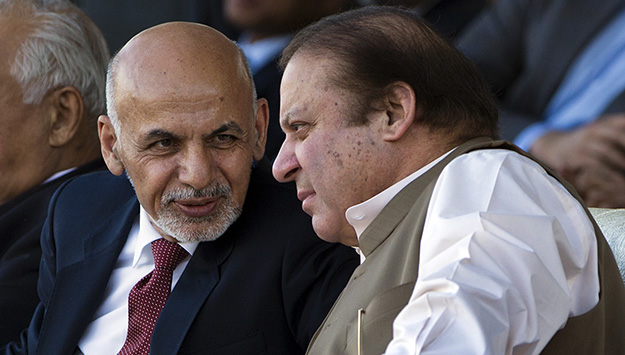
    April 23, 2015 – Marvin Weinbaum, director of the Center for Pakistan Studies at The Middle East Institute, explains Pakistan’s decision not to provide military aid for Saudi Arabia’s operation in Yemen, and how Prime Minister Sharif is working to repair relations with Riyadh.

    Atrocities in Syria: Who Will Be Left to Speak for Me?
  • Analysis
  • Atrocities in Syria: Who Will Be Left to Speak for Me?

    “Then they came for me—and there was no one left to speak for me.” – Martin Niemöller, German anti-Nazi theologian

    April 23, 2015

    When it Comes to Israeli Occupation, Better is Not Good Enough
  • Analysis
  • When it Comes to Israeli Occupation, Better is Not Good Enough

    Palestinians, beset by calamities at every turn, have all but ceased to think about their indeterminate prospects for independence and freedom. This dismal state of affairs suits Israel’s newly reelected Prime Minister Benjamin Netanyahu fine. His opposition to a sovereign Palestinian state, broadcast in word and deed, leaves little room for doubt.

    The bar has been set so low that all concerned are searching for any shred of evidence that merely hints at better times for Palestinians, who have now lived under Israeli rule for almost a half century.

    April 21, 2015

    Read the Middle East Journal

    The oldest peer-reviewed publication dedicated to the study of the modern Middle East, MEI’s flagship journal covers politics, society, and culture in the region.