Skip to Content

Research & Commentary

Read in-depth research, analysis, and commentary from MEI’s fellows and experts on the Middle East. 

Trump’s Family Business Deals Risk Further Undermining the Credibility of US Middle East Policy
  • Analysis
  • Trump’s Family Business Deals Risk Further Undermining the Credibility of US Middle East Policy

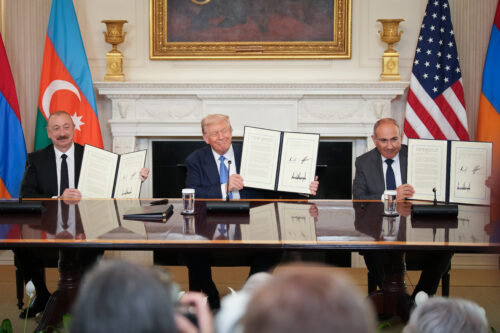
    President Trump’s family businesses are once again in the spotlight as a new financial disclosure showed they earned $2 billion in income in 2025 — a dramatic increase on the year before, with much of it coming from Gulf entities, raising emoluments concerns. Mounting perceptions of corruption, combined with unresolved crises in Iran and Israel-Palestine, are eroding trust among key partners in the Middle East. With the 2026 midterms approaching, these entanglements could represent a major political vulnerability and further undermine America’s already-strained standing in the region.

    Do the Gulf States Need a New Playbook?
  • Podcast
  • Do the Gulf States Need a New Playbook?

    After the US-Israel-Iran war — and the strikes that followed the cease-fire — the Gulf states find themselves dangerously exposed. Host Alistair Taylor is joined by MEI Associate Fellow Gregory Gause to discuss the war’s impact on the Gulf, their partnership with the United States, and whether the turmoil of recent months will push Gulf leaders to reassess their alliances and international engagement.

    July 2, 2026

    Additional Research & Commentary

    Backgrounders

    The Houthis
  • Backgrounder
  • The Houthis

    The Houthis are a political-military faction and Zaydi religious movement founded in northwestern Yemen in the 1980s. A key member of Iran’s Axis of Resistance with links to other militant organizations in the Arabian Peninsula and the Horn of Africa, the group has continued to pose a threat to Western interests on a global scale.

    May 15, 2026

    The Abraham Accords
    Photo by Alex Wong/Getty Images
  • Backgrounder
  • The Abraham Accords

    This backgrounder provides an overview of how the Abraham Accords came about, the US interests involved, their economic and strategic consequences, and the prospects for further enlargement going forward.

    November 17, 2025

    Turkish Foreign Policy
  • Backgrounder
  • Turkish Foreign Policy

    After a decade of post-Arab Spring isolation, Turkey’s leaders have recognized that their ambition to position the country as an agenda-setter on the world stage requires active engagement in all directions. President Recep Tayyip Erdoğan’s consolidation of executive authority has centralized foreign policy decision-making and tied it to his domestic political priorities, transforming the country’s revisionist approach to one shaped primarily by personal and pragmatic interests.

    April 23, 2026

    Western Sahara: Why the conflict still matters
  • Video
  • Western Sahara: Why the conflict still matters

    As the Western Sahara conflict reaches its fifth decade, the territorial dispute remains unresolved and largely unknown. MEI’s Intissar Fakir unpacks the Western Sahara’s complex history and the rival claims by Morocco and the Sahrawi Arab Democratic Republic. She examines recent developments, such as President Trump’s recognition of Moroccan sovereignty over the territory and the collapse of a 30-year cease-fire, as well as the core questions that remain unanswered after half a century.

    August 7, 2025

    Podcasts

    Middle East Focus

    MEI’s flagship weekly podcast on US foreign policy and contemporary political and social issues in the Middle East.

    Taking the Edge Off the Middle East

    MEI Senior Fellow Brian Katulis engages friends, colleagues, and policy experts in casual conversations on the most important happenings in the Middle East. 

    Rethinking Democracy

    MEI Senior Fellow Gonul Tol hosts leading scholars and thought leaders on global democracy trends and the state of the liberal international order. 

    Filter by
    8748 Results
    Egypt’s New Parliamentary Election Law: Back to the Future
    Middle East Institute
  • Analysis
  • Egypt’s New Parliamentary Election Law: Back to the Future

    Just 48 hours before handing over the reigns to now President Abdel Fattah al-Sisi, Egypt’s interim President Adly Mansour signed into law a controversial piece of legislation that regulates elections for Egypt’s new House of Representatives.[1] Since the law was announced in early June, it has generated conflicting analysis regarding its impact on the nature of the electoral system, the character of the legislature that will be elected as a result, and the extent to which it might further empower the president.

    July 17, 2014

    Violence and Peace Spoilers in the Southern Philippines
    Middle East Institute
  • Analysis
  • Violence and Peace Spoilers in the Southern Philippines

    The 27 March 2014 signing of the Comprehensive Agreement on the Bangsamoro (CAB) by the Philippine Government (GPH) and the Moro Islamic Liberation Front was heralded as the start of enduring peace and development in Mindanao. Unfortunately, spoilers opposed to the CAB remain capable of derailing the process. Joseph Franco explains some of the nuances of spoiling efforts as well as the prevailing socioeconomic milieu in the Southern Philippines that sustains latent enablers for sectarian conflict.

    July 15, 2014

    Why Securing a Cease-Fire Will Be Harder This Time
  • Analysis
  • Why Securing a Cease-Fire Will Be Harder This Time

    In thinking about how the crisis between Israel and the Hamas leadership in Gaza might play out, it’s useful to reflect upon the preceding Israeli incursion into Gaza in November 2012.

    July 15, 2014

    Putting Out the Fire in Southern Thailand: An Appeal for Truce Seeking
    Middle East Institute
  • Analysis
  • Putting Out the Fire in Southern Thailand: An Appeal for Truce Seeking

    Observers have struggled to explain ongoing sectarian violence in southern Thailand given that both Thai Buddhists and Malay/Thai Muslims are victims of violence, have historically coexisted peacefully, and share local customs and spiritual traditions. Tim Rackett explores the role of majority and minority ethnic and religious identities in fueling sectarian violence and identifies a way out.

    July 14, 2014

    The New Wave of Violence between Israelis and Palestinians: The View from Israel
  • Analysis
  • The New Wave of Violence between Israelis and Palestinians: The View from Israel

    The recent wave of violence between Israel and Hamas, which to date has resulted in the death of more than 100 Palestinians and the injury of several Israelis, continues to escalate with no clear sign of when it might end.

    July 11, 2014

    The Muslim Brotherhood One Year after the Ouster
    Middle East Institute
  • Analysis
  • The Muslim Brotherhood One Year after the Ouster

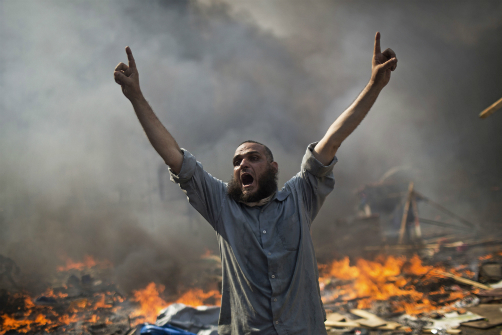
    One year after the massive June 30 demonstrations against the Muslim Brotherhood (MB) and the July 3 ouster of President Mohammad Morsi by the military, the Egyptian MB is facing grave challenges that will shape the group’s future and that of political Islam.

    July 11, 2014

    Religious Pluralism versus Intolerance: Sectarian Violence in Indonesia
  • Analysis
  • Religious Pluralism versus Intolerance: Sectarian Violence in Indonesia

    Religious pluralism has been under threat and sectarianism on the rise during the ten-year (2004-2014) tenure of outgoing president Susilo Bambang Yudhoyono. Carool Kersten explains how local and regional authorities condone (and sometimes even stimulate) intimidation and hate crimes.

    July 8, 2014

    Declaring a Caliphate Doesn't Make One a Caliph
  • Analysis
  • Declaring a Caliphate Doesn't Make One a Caliph

    This article was first posted on the MEI Editor’s Blog.

    Ibrahim al-Badri (also known as Abu Bakr al-Baghdadi) is being presented to the world by his followers as Commander of the Faithful of a new Islamic Caliphate.[1] How much weight can be attached to that move?

    July 2, 2014

    Foreign Fighters in Syria and the Threat of Domestic Terrorism in Europe
  • Analysis
  • Foreign Fighters in Syria and the Threat of Domestic Terrorism in Europe

    Westerners who have joined the ranks of radical groups fighting in Syria have been likened to time bombs—and in May one of them exploded in Brussels. Belgian police released chilling images from surveillance cameras of the lone gunman’s attack on Brussels’ Jewish Museum in Sablon, a neighborhood of genteel antique stores and chocolatiers.

    July 1, 2014

    Egyptian Labor and the State
  • Analysis
  • Egyptian Labor and the State

    Though it was not at the forefront of the pro-democracy movement, Egyptian labor played a decisive role in bringing down the Mubarak regime in 2011. Labor demonstrations had been increasing since late 2004, which helped to foster the atmosphere of protest in which Egyptians took to the streets in the thousands. The labor protests had emerged outside of the state-run Egyptian Trade Union Federation (ETUF), as workers felt that the institution that was supposedly representing their interests was actually defending the interests of the regime. 

    July 1, 2014

    Sectarian Conflict and Grassroots Peacebuilding in Central Java
    Middle East Institute
  • Analysis
  • Sectarian Conflict and Grassroots Peacebuilding in Central Java

    Religiously-inspired anti-pluralist actions, vigilante attacks, Islamist extremism, and terrorism—as well as a spectrum of ethnically, regionally, and religiously-based civilian groupings and paramilitary bands—have figured in Indonesian politics since the downfall of Suharto’s New Order dictatorial regime in 1998. However, not all areas of the country have experienced sectarian violence. Not all Indonesian Muslims are fanatics or zealots, nor are Muslim radicals the only agents of conflict. On the contrary, there are many instructive and inspiring examples across contemporary Indonesia of local leaders and communities that have produced and sustained religious harmony.

    June 27, 2014

    Read the Middle East Journal

    The oldest peer-reviewed publication dedicated to the study of the modern Middle East, MEI’s flagship journal covers politics, society, and culture in the region.