Skip to Content

Research & Commentary

Read in-depth research, analysis, and commentary from MEI’s fellows and experts on the Middle East. 

Trump’s Family Business Deals Risk Further Undermining the Credibility of US Middle East Policy
  • Analysis
  • Trump’s Family Business Deals Risk Further Undermining the Credibility of US Middle East Policy

    President Trump’s family businesses are once again in the spotlight as a new financial disclosure showed they earned $2 billion in income in 2025 — a dramatic increase on the year before, with much of it coming from Gulf entities, raising emoluments concerns. Mounting perceptions of corruption, combined with unresolved crises in Iran and Israel-Palestine, are eroding trust among key partners in the Middle East. With the 2026 midterms approaching, these entanglements could represent a major political vulnerability and further undermine America’s already-strained standing in the region.

    Do the Gulf States Need a New Playbook?
  • Podcast
  • Do the Gulf States Need a New Playbook?

    After the US-Israel-Iran war — and the strikes that followed the cease-fire — the Gulf states find themselves dangerously exposed. Host Alistair Taylor is joined by MEI Associate Fellow Gregory Gause to discuss the war’s impact on the Gulf, their partnership with the United States, and whether the turmoil of recent months will push Gulf leaders to reassess their alliances and international engagement.

    July 2, 2026

    Additional Research & Commentary

    Backgrounders

    The Houthis
  • Backgrounder
  • The Houthis

    The Houthis are a political-military faction and Zaydi religious movement founded in northwestern Yemen in the 1980s. A key member of Iran’s Axis of Resistance with links to other militant organizations in the Arabian Peninsula and the Horn of Africa, the group has continued to pose a threat to Western interests on a global scale.

    May 15, 2026

    The Abraham Accords
    Photo by Alex Wong/Getty Images
  • Backgrounder
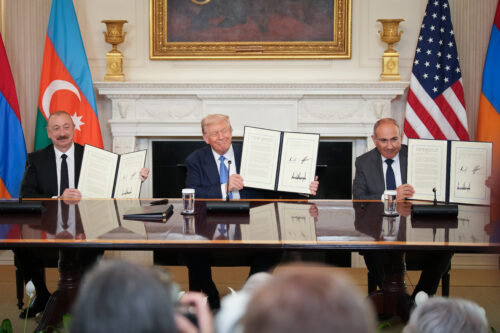
  • The Abraham Accords

    This backgrounder provides an overview of how the Abraham Accords came about, the US interests involved, their economic and strategic consequences, and the prospects for further enlargement going forward.

    November 17, 2025

    Turkish Foreign Policy
  • Backgrounder
  • Turkish Foreign Policy

    After a decade of post-Arab Spring isolation, Turkey’s leaders have recognized that their ambition to position the country as an agenda-setter on the world stage requires active engagement in all directions. President Recep Tayyip Erdoğan’s consolidation of executive authority has centralized foreign policy decision-making and tied it to his domestic political priorities, transforming the country’s revisionist approach to one shaped primarily by personal and pragmatic interests.

    April 23, 2026

    Western Sahara: Why the conflict still matters
  • Video
  • Western Sahara: Why the conflict still matters

    As the Western Sahara conflict reaches its fifth decade, the territorial dispute remains unresolved and largely unknown. MEI’s Intissar Fakir unpacks the Western Sahara’s complex history and the rival claims by Morocco and the Sahrawi Arab Democratic Republic. She examines recent developments, such as President Trump’s recognition of Moroccan sovereignty over the territory and the collapse of a 30-year cease-fire, as well as the core questions that remain unanswered after half a century.

    August 7, 2025

    Podcasts

    Middle East Focus

    MEI’s flagship weekly podcast on US foreign policy and contemporary political and social issues in the Middle East.

    Taking the Edge Off the Middle East

    MEI Senior Fellow Brian Katulis engages friends, colleagues, and policy experts in casual conversations on the most important happenings in the Middle East. 

    Rethinking Democracy

    MEI Senior Fellow Gonul Tol hosts leading scholars and thought leaders on global democracy trends and the state of the liberal international order. 

    Filter by
    8748 Results
    Obstacles to Civilian Control of the Security Sector in Thailand
    Middle East Institute
  • Analysis
  • Obstacles to Civilian Control of the Security Sector in Thailand

    Over 30 military coups and coup attempts have taken place in Thailand since 1932, when absolute monarchy was overthrown, the latest of which was in 2006. Clearly, achieving democratic civilian control over Thai security forces remains a daunting challenge. When we talk about Thai security forces, we are referring to the country’s army, navy, air force, police, and paramilitaries. The army is much larger than the other services, although the police force is also quite sizeable. Soldiers and police have tended to obey elected civilian authorities due to partisan connections or simply because the appearance of compliance is convenient. But in actuality the security forces are generally insulated from the sanction of elected governments.

    March 18, 2014

    Jawad Nabulsi: Egypt’s Urban Activist
  • Analysis
  • Jawad Nabulsi: Egypt’s Urban Activist

    Jawad Nabulsi was looking straight at the policeman the moment he was shot in the face. The black-clad officer raised the barrel of his gun, pointed it directly at Nabulsi’s eyes, and pulled the trigger.

    It was 11pm on January 28, 2011. The “Friday of Rage,” as protesters called it, would later be labeled the bloodiest day in the revolution that toppled autocrat Hosni Mubarak.

    March 18, 2014

    Egypt Needs Bold Economic Leadership
  • Analysis
  • Egypt Needs Bold Economic Leadership

    Coverage of Egypt over the past three years has focused on the dramatic political events, yet it was the dire economic situation that created the pressure for the multiple uprisings. And if economic decline is not reversed over the next few years, Egypt might fall over an economic precipice that risks rendering the country eventually ungovernable. Security and political reform are urgently necessary in their own right, and will have a positive effect on the economy if achieved, but bold structural economic reform is also necessary to reverse Egypt’s downward spiral.

    March 14, 2014

    South Korea’s Immature Professionalism in the Security Sector
    Middle East Institute
  • Analysis
  • South Korea’s Immature Professionalism in the Security Sector

    It is widely accepted that South Korea has successfully consolidated democracy. For example, U.S. President Barack Obama cited South Korea as an exemplary case of economic growth and democracy in his famous speech at Cairo University on June 4, 2009. Two years later, when Egypt underwent a civil uprising that brought to an end the country’s decades-old Mubarak regime, he lauded South Korea’s democracy once again, suggesting that “Egypt could transform itself into a democracy on the model of Indonesia, Chile, or South Korea.” By 2013, however, alleged election fraud in South Korea had damaged the international reputation of its mature democracy. The Democratic Party—the country’s main opposition party—publicly called the 2012 presidential election unfair because the National Intelligence Service (NIS) had manipulated public opinion prior to the election, leaving disparaging comments about opposition party candidate Moon Jae-in on popular websites.

    March 13, 2014

    Libya on the Brink: Insecurity, Localism, and the State Not Back In
    Middle East Institute
  • Analysis
  • Libya on the Brink: Insecurity, Localism, and the State Not Back In

    This essay is part of the Middle East-Asia Project (MAP) series on “’Civilianizing’ the State in the Middle East and Asia Pacific Regions.” The series explores the past and ongoing processes of Security Sector Reform (SSR) in Asia-Pacific countries and examines the steps already taken and still needed in the MENA region. See More

    March 12, 2014

    The Clash of Former Allies: The AKP versus the Gulen Movement
  • Analysis
  • The Clash of Former Allies: The AKP versus the Gulen Movement

    A major political row between Turkish Prime Minister Recep Tayyip Erdogan’s Justice and Development Party (AKP) and preacher Fethullah Gulen’s Islamic movement has been simmering in Turkey. The clash between the two former allies will have important implications at a time when Turkey appears increasingly vulnerable, with a war raging in Syria and the government facing fierce challenges from within. The rift will have an effect on a gamut of issues, from the “Kurdish opening” to upcoming local and presidential elections.

    All Retributive Justice, No Restorative Justice in the Post-Arab Spring Middle East
    Middle East Institute
  • Analysis
  • All Retributive Justice, No Restorative Justice in the Post-Arab Spring Middle East

    In the wake of the revolutionary fervor that has swept the Middle East and North Africa since the beginning of 2011, retributive justice has taken precedence over restorative justice approaches as countries seek to address human rights violations.

    March 6, 2014

    Egypt's Quiet Revolution: Sustainable Agriculture
  • Analysis
  • Egypt's Quiet Revolution: Sustainable Agriculture

    The Egyptian revolutionary motto, “bread, freedom, social justice,” which echoed over 18 days until Hosni Mubarak’s ouster on February 11, 2011, illustrated how restricted access to food had become one of the people’s main grievances. In the aftermath of the revolution, infused by a renewed sense of ownership of their country, many citizens launched environmental initiatives with a focus on sustainable agriculture.

    March 6, 2014

    The Popular Committees of Abyan, Yemen: A Necessary Evil or an Opportunity for Security Reform?
  • Analysis
  • The Popular Committees of Abyan, Yemen: A Necessary Evil or an Opportunity for Security Reform?

    In early 2011, Yemeni youths took to the street to demand the downfall of the regime and much-needed democratic reforms. This eventually led to the removal of former president Ali Abdullah Saleh from power later the same year. The political turmoil associated with the uprising has resulted in an alarming deterioration of the security situation throughout the country, most notably the seizure of two major cities in the southern governorate of Abyan by Ansar al-Shariah (AAS), an offshoot of al-Qa`ida. Backed by the Yemeni government, the Popular Committees (PCs), local armed resistance groups, pushed AAS out of major cities in Abyan.

    Transition to Democracy at the Expense of Justice: The 2-28 Incident and White Terror in Taiwan
    Middle East Institute
  • Analysis
  • Transition to Democracy at the Expense of Justice: The 2-28 Incident and White Terror in Taiwan

    This paper discusses attempts at reconciliation that followed Taiwan’s transition to democracy after four decades (1947–1987) of political repression in which new settlers from the Chinese mainland, known as waishengren (provincial outsiders), suppressed a native population, known as benshengren (provincial natives), that had formerly experienced 50 years (1895–1945) of Japanese colonial rule. As a case study, I draw on field research undertaken between 2004 and 2006 in the village of Luku. I ask to what extent Taiwan has redressed the defining massacre that occurred on February 28, 1947, known as the 2-28 Incident, and the repression that followed, known as the White Terror (1949–1986). To what extent can Taiwan be sure that state terror will not recur? Further, what lessons are there for the “Arab Spring?”

    March 5, 2014

    Sequencing Transitional Justice Mechanisms: Lessons from the Solomon Islands
    Middle East Institute
  • Analysis
  • Sequencing Transitional Justice Mechanisms: Lessons from the Solomon Islands

    Between 1998 and 2003 the Melanesian archipelago state of the Solomon Islands was marked by a violent civil conflict precipitated by a combination of ethnic tensions, economic insecurities, and perceived injustices. Known colloquially as “The Tensions,” the low-intensity conflict left around 200 people dead and more than 11,000 displaced from their homes. In addition, more than 5,700 human rights violations were committed during the conflict, of which at least 1,413 involved torture. Although its transition has not been from authoritarian rule to democracy, the Solomon Islands’ attempts to address the human rights violations that took place during this conflict hold a number of important lessons for the transitional states of the Middle East.

    March 4, 2014

    Read the Middle East Journal

    The oldest peer-reviewed publication dedicated to the study of the modern Middle East, MEI’s flagship journal covers politics, society, and culture in the region.