The Multiple Costs of the US–Iran War – From Hormuz to Europe and South Asia: The Widening Economic and Political Geography of the Conflict
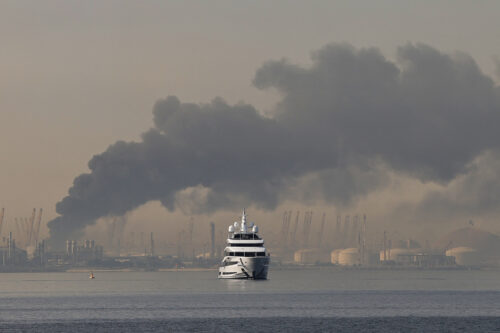
Wars are decided by those who hold military power, but their costs are increasingly borne by those who have little or no voice in the decisions that start them. The US–Iran war shows this imbalance very clearly. Its economic consequences have gone far beyond the battlefield and have disrupted energy markets, trade routes, food supplies, public finances and investment in the Gulf, Europe, Africa and Asia. The most striking feature of the conflict, however, is not only the size of the damage but its very unequal distribution.
In recent weeks, the Iran-backed Houthis have fired missiles and drones deep into Saudi Arabia, striking high-profile targets, including Riyadh’s airport and Aramco’s headquarters. The attacks follow a rapid Houthi offensive in September to seize key parts of Yemen’s Red Sea coast, which Saudi-backed government forces are now trying to roll back. Fatima Abo Alasrar, an affiliated scholar at MEI and non-resident scholar at the Arab Gulf States Institute, joins hosts Alistair Taylor and Matthew Czekaj to unpack the latest phase of the conflict. They discuss what the Houthis want, Riyadh’s calculus and search for allies, and how this campaign ties into Iran’s confrontation with the United States.
Geopolitical influence over trade increasingly rests on controlling the systems that make them work. The Middle East illustrates the stakes. US ports, cable corridors, cloud facilities, artificial intelligence (AI) investments, and maritime routes connect regional economies to global commerce while exposing them to external decisions and disruptions. For the United States, the challenge is to translate technological advantage into resilient networks rather than rely on centrality that can itself become a source of vulnerability and coercion.
Since 1967, Israeli settlements in the West Bank have been a contested feature of the Israeli-Palestinian conflict. The ultimate disposition of the settlements and ongoing activity related to their growth have repeatedly defied agreement in negotiations over a resolution to the conflict.
The Houthis are a political-military faction and Zaydi religious movement founded in northwestern Yemen in the 1980s. A key member of Iran’s Axis of Resistance with links to other militant organizations in the Arabian Peninsula and the Horn of Africa, the group has continued to pose a threat to Western interests on a global scale.
The India-Middle East-Europe Economic Corridor (IMEC) is a proposed multinational infrastructure initiative aimed at upgrading connectivity between the three regions through integrated trade, energy, and digital networks. Announced at the G20 summit in New Delhi in September 2023, IMEC is envisioned partially as a counterweight to China’s international infrastructure project, the Belt and Road Initiative.
After a decade of post-Arab Spring isolation, Turkey’s leaders have recognized that their ambition to position the country as an agenda-setter on the world stage requires active engagement in all directions. President Recep Tayyip Erdoğan’s consolidation of executive authority has centralized foreign policy decision-making and tied it to his domestic political priorities, transforming the country’s revisionist approach to one shaped primarily by personal and pragmatic interests.
MEI Senior Fellow Brian Katulis engages friends, colleagues, and policy experts in casual conversations on the most important happenings in the Middle East.
Welcome, Keynote address – MEI's 4th Annual Conference on Turkey
The Middle East Institute Center for Turkish Studies’ Fourth Annual Conference on Turkey8:45am: WelcomeAmb. Wendy Chamberlin, President, Middle East Institute9:00am-9:45 am: Keynote AddressRep. Ed Whitfield (R-KY), United States House of RepresentativesJune 14, 2013, 8:45am, 9:00am
Malaysia and the GCC Countries: Fertile Ground for Further Expansion of the Takaful Industry
The Takaful industry has expanded rapidly in recent years.[1] In 2011, the industry recorded 19% higher growth than in the previous year. Takaful is generally regarded as a profitable product with ample growth potential. With strong support from industry players, government institutions and increasing awareness among customers, the Takaful industry is expected to develop further in the coming years.
Learning from SIGIR's Final Report on Iraq Reconstruction
The Special Inspector General for Iraq Reconstruction (SIGIR) recently published a final report on U.S. efforts in Iraq from 2003-2012. It provides an impressive level of detail on the thousands of projects and over $60 billion spent over those years. Until recently, when it was surpassed by the ongoing effort in Afghanistan, the U.S. project in Iraq was the single largest reconstruction effort in American history.
Many participants and leaders of the January 25 revolution hoped for a new Egypt to emerge, one that respected freedom of speech and freedom of religion, amongst other liberties. More than two years later, it has become glaringly obvious that such hopes were pipe dreams, and that the “New Egypt” will respect neither, in part thanks to the mounting number of blasphemy cases and trials that have taken place.
Egypt is in trouble. And Egypt’s trouble is bad news both for Egypt and for the United States. With a withering economy, continued political unrest, and poor institutionalization of new and ever-evolving political rules, many Egyptians have lost hope in the ultimate success of the country’s political transformation. Given the sacrifices and optimism associated with the removal of President Hosni Mubarak in 2011, the failure of governance in Egypt, though not entirely unexpected, has the makings of tragedy.
Asia-Gulf Economic Relations in the 21st Century: The Local to Global Transformation
Asia constitutes the hub of the transformation of global economic power today. The Gulf, itself part of Asia, is of increasing importance in this transformation. This book documents the growing interactions between the economies of the Gulf states and those of the rest of Asia. These relationships are critical to how the world economy develops over the next decade, and how economic (and perhaps strategic) power is distributed.
The Middle East Institute is pleased to welcome Sarah Margon of Human Rights Watch and Nancy Okail of Freedom House for a timely discussion about the implications of Egypt’s controversial draft NGO law submitted for vote to the Shura Council last week. The law, which seeks to restrict the funding and operation of non-governmental organizations, is being slammed by human rights groups both inside Egypt and around the world as a blow to the free and full expression of Egyptian civil society.
The Middle East Institute is pleased to welcome Sarah Margon of Human Rights Watch and Nancy Okail of Freedom House for a timely discussion about the implications of Egypt’s controversial draft NGO law submitted for vote to the Shura Council last week. The law, which seeks to restrict the funding and operation of non-governmental organizations, is being slammed by human rights groups both inside Egypt and around the world as a blow to the free and full expression of Egyptian civil society.
The Middle East Institute is pleased to welcome Sarah Margon of Human Rights Watch and Nancy Okail of Freedom House for a timely discussion about the implications of Egypt’s controversial draft NGO law submitted for vote to the Shura Council last week. The law, which seeks to restrict the funding and operation of non-governmental organizations, is being slammed by human rights groups both inside Egypt and around the world as a blow to the free and full expression of Egyptian civil society.
The Middle East Institute is pleased to welcome Sarah Margon of Human Rights Watch and Nancy Okail of Freedom House for a timely discussion about the implications of Egypt’s controversial draft NGO law submitted for vote to the Shura Council last week. The law, which seeks to restrict the funding and operation of non-governmental organizations, is being slammed by human rights groups both inside Egypt and around the world as a blow to the free and full expression of Egyptian civil society.
The Middle East Institute is pleased to welcome Sarah Margon of Human Rights Watch and Nancy Okail of Freedom House for a timely discussion about the implications of Egypt’s controversial draft NGO law submitted for vote to the Shura Council last week. The law, which seeks to restrict the funding and operation of non-governmental organizations, is being slammed by human rights groups both inside Egypt and around the world as a blow to the free and full expression of Egyptian civil society.
Malaysia: A Base for the Growing Asia-Middle East Market?
With the shift in the direction of Gulf Cooperation Council (GCC) countries’ trade from the West to Asia and the emphasis on the “Islamic connection” by Malaysia and many of its Middle Eastern counterparts, Malaysia-GCC economic cooperation appears to be gaining momentum. Malaysia’s strategic location at the center of Southeast Asia and the need for as well as the apparent determination of Malaysia and the GCC countries to diversify their export markets could provide the impetus for this partnership to flourish.
It was with customary gusto that Egyptian President Mohamed Morsi proudly announced that he had submitted his first draft law to the Shura Council under the new constitution that came into effect in December of 2012.
The oldest peer-reviewed publication dedicated to the study of the modern Middle East, MEI’s flagship journal covers politics, society, and culture in the region.