Currency Boards as Political Commitments: Comparative Experience, Gold Reserves, and the Lebanese Case
April 7, 2026
Share
Summary
The following study discusses the role of Lebanon’s gold reserves in the establishment of a currency board and evaluates four policy options: a true currency board, constrained central bank reform, full dollarization, and a unified managed float. Gold reserves are relevant under all four. The conclusion is consistent across them: no monetary framework, however carefully designed and however well backed, can substitute for the prior political decision on who bears Lebanon’s losses and how the state will finance itself sustainably.
Currency boards, defined as a monetary system in which a country’s money supply is fully backed by foreign reserves and its exchange rate is fixed to another currency, are attractive because they seem to solve a political problem through a technical rule. The exchange rate is fixed in law. The monetary base is backed by reserve assets. Monetary discretion is severely constrained. The promise is simple and powerful: if governments cannot be trusted to manage money responsibly, then remove their capacity to misuse it. Tie the currency to something hard, make the commitment visible, and confidence will presumedly return.
This paper argues that such reasoning is only partly correct. Currency boards are not simply technical arrangements with political consequences. They are political commitments expressed in monetary form. Their durability does not depend mainly on the arithmetic of reserve coverage or the elegance of legal design. It depends on whether the surrounding political system is willing and able to absorb the adjustment costs that a hard monetary rule inevitably imposes. Where that willingness exists, currency boards can be highly durable, as the experience of Hong Kong shows. Where it does not, they fail, sometimes abruptly and at very high social cost, as Argentina demonstrated.
The central argument is straightforward. Monetary regimes are embedded in political settlements. They determine who bears adjustment costs, how governments respond to fiscal pressure and banking distress, and what forms of relief remain available in crisis. A currency board can reinforce discipline only where discipline is already politically sustainable. Where distributional conflict is unresolved and institutional trust is limited, hard monetary rules may become a new source of fragility rather than a basis for stability.
Lebanon presents an unusual and important case because of its gold reserves. The country holds approximately 286.8 tons of gold, one of the largest reserve positions per capita among developing countries and the largest in the Arab world. At current market prices, this stock is worth more than $45 billion. This amount dwarfs Lebanon’s accessible foreign exchange reserves and is broadly comparable to the scale of the losses that have paralyzed its banking system since 2019.
This report treats Lebanon’s gold as a serious variable. It is neither a magic solution nor a side issue. It is a real asset that makes a currency board technically more conceivable in Lebanon than in most crisis economies of similar size. It has a form of credibility that reserves built through financial engineering do not possess. It was not created through circular transactions between the central bank and commercial banks. It is finite, tangible, and independent of the creditworthiness of the Lebanese state.
Yet this technical advantage must not be exaggerated. A currency board is credible only if the assets backing the monetary base are themselves credible: liquid, verifiable, legally protected, and unquestionably available to defend convertibility. In many successful currency boards, credibility came from strong foreign exchange reserves in the anchor currency. Lebanon does not have that advantage. Its conventional reserve position has been deeply damaged by years of quasi-fiscal operations, opaque accounting practices, and repeated use of the central bank balance sheet to postpone adjustment. That is precisely why the gold matters. But gold cannot solve the deeper problem. It can improve reserve arithmetic, but it cannot by itself create political commitment, settle losses, or substitute for institutional trust.
Gold is also a political asset. Its value makes it a target. Its custody abroad creates legal and geopolitical complexity. Its symbolic importance in a country where large numbers of depositors have lost access to their savings means that any attempt to ring‑fence it permanently as backing for a currency board would face sustained political challenge. The gold cannot anchor a currency board unless the political system can first anchor the gold.
Comparative experience supports these conclusions. Hong Kong’s Linked Exchange Rate System has endured for decades because the cost of abandoning it would threaten the foundations of its economic model. Estonia and Lithuania used currency boards as instruments of national transformation and external anchoring. Bulgaria emerged from hyperinflation with a rare consensus around discipline and completed its monetary transition with euro adoption in January 2026. Bosnia and Herzegovina shows that even fragmented political systems can sustain a hard rule when the operational core is insulated from day‑to‑day bargaining. Argentina shows the opposite: when fiscal weakness, banking fragility, and political fragmentation collide under a rigid monetary rule, the regime eventually breaks.
Applied to Lebanon, the conclusion is uncomfortable but clear. Lebanon’s crisis is not fundamentally an exchange‑rate problem. It is a crisis of loss allocation, institutional legitimacy, and fiscal unsustainability. Its gold makes a currency board technically conceivable. It does not make it politically viable — at least not yet. A currency board introduced before the distributional conflict is addressed, before banks are restructured, and before the gold is legally and operationally protected would not restore confidence. It would deepen the tragedy of a weakened state, where the absence of a unified monopoly on force risks reproducing the very conflicts that have already eroded trust in Lebanon’s institutions.
The following study evaluates four policy options: a true currency board, constrained central bank reform, full dollarization, and a unified managed float. Gold reserves are relevant under all four. The conclusion is consistent across them: no monetary framework, however carefully designed and however well backed, can substitute for the prior political decision on who bears Lebanon’s losses and how the state will finance itself sustainably.
There is no monetary shortcut to political discipline. Not even $45 billion in gold.
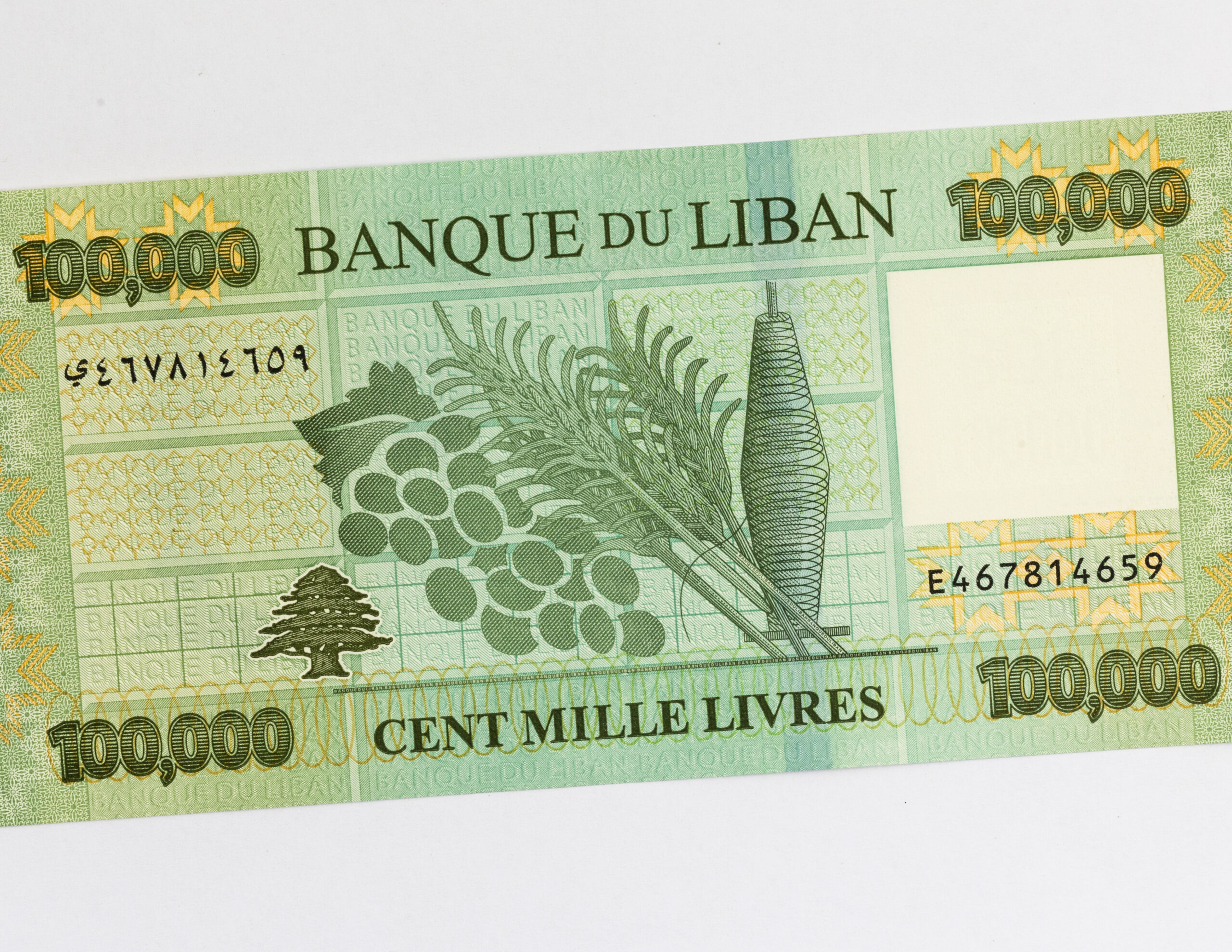
Photo above: Lebanese 100,000 lira bank note. Source: Bilal Photos via Getty Images.
Introduction: The Politics Behind Every Exchange Rate
Exchange‑rate regimes are often discussed as though they were mainly technical choices: fixed or floating, hard or soft, rules‑based or discretionary. The literature on monetary credibility, optimal currency areas, and the constraints of open‑economy macroeconomics is rich and important. But it often carries an implicit simplification. It treats institutions as a given and politics as something external to good policy design. Politics appears as a source of implementation difficulty rather than as a force that defines what is possible in the first place.
In stable, well‑governed countries, that simplification may be manageable. In fragile states, it is deeply misleading. Where institutions are contested, elite bargains are unstable, and the state’s authority is persistently challenged by actors operating beyond its formal remit, the political nature of monetary arrangements is not secondary. It is central. A fixed exchange rate is not only a monetary device. It is also a distribution mechanism. It shapes who bears the burden of external shocks, who gains from capital inflows, who loses when adjustment becomes unavoidable, and which forms of economic pain can be postponed through monetary means.
A currency board is therefore not just a technical rule. It is a political constitution for money. Like any constitution, its durability depends not only on legal wording or institutional design, but on whether the main forces in the political system accept the discipline it imposes. When they do, the rule can become durable and credible. When they do not, the rule may survive for a time but only until stress reveals the absence of underlying consent.
Lebanon’s financial collapse since 2019 illustrates this point with unusual clarity. For more than two decades, the Lebanese lira was formally pegged to the US dollar at 1,507.5 to one. That peg was not merely a monetary arrangement. It sat at the center of a broader political economy. High interest rates attracted remittances and deposits from the Lebanese diaspora and from the wider region. Commercial banks recycled those funds into sovereign exposure and placements at the central bank.[1] The state used these inflows to sustain a model of public finance, patronage, and delayed adjustment that became increasingly fragile over time. Banque du Liban, the central bank, maintained the appearance of stability through financial engineering operations of growing complexity and opacity. The arrangement was celebrated by some as resilience. In reality, it depended on continued inflows, declining transparency, and increasing denial.
When the inflows that had sustained the system for decades began to slow and confidence frayed in 2019, the Lebanese financial system did not unwind smoothly. The long‑standing dollar peg collapsed, giving way to a disorderly and multi‑layered exchange‑rate regime with multiple official and parallel rates. Formal and informal capital controls trapped deposits, and banks severely restricted access to dollar accounts. Inflation accelerated sharply, eroding purchasing power, while households and firms were pushed into a fragmented monetary environment in which law, contract, and economic reality increasingly diverged. The middle class suffered a dramatic destruction of wealth, and public trust in both the banking system and the state was broken.[2]
In this setting, calls for a currency board returned. The appeal is easy to understand. If monetary discretion enabled abuse, remove discretion. If the central bank was used to postpone adjustment and disguise losses, replace it with a mechanical rule. Fix the exchange rate in law, back every unit of base money with reserve assets, and remove the possibility of monetary improvisation. In a system where discretion became synonymous with manipulation, the attraction of a hard rule is obvious.
What makes this discussion more serious in Lebanon than in many other crisis cases is the extraordinary scale and value of its gold reserves. Lebanon holds approximately 286.8 tons of gold, one of the largest sovereign holdings globally relative to its economy. Much of this stock is held abroad in custody — including at the Federal Reserve Bank of New York and the Banque de France — with a smaller portion held domestically. At recent market prices, the notional value of these reserves is roughly $45-47 billion, representing about 130-134% of Lebanon’s nominal GDP, far exceeding the gold‑to‑GDP ratios of most countries and underscoring the exceptional economic and political stakes involved. In late 2022, an independent physical audit of Lebanon’s gold reserves was conducted at the request of the International Monetary Fund (IMF) as part of preliminary discussions on a potential program. The audit confirmed that the physical gold largely matched the amounts reported in the central bank’s accounts, though full transparency remains limited.[3] The scale, liquidity potential, and contested control of this asset have made it a focal point in debates over monetary stability, crisis recovery, and state credibility.[4]
But the real analytical question is not whether the gold is valuable. It plainly is. The real question is whether the existence of the gold can generate the kind of reserve credibility on which a currency board depends. This distinction is crucial. Lebanon’s problem is not only that reserves are scarce. It is that credible reserves are scarce. A monetary framework can survive with less‑than‑ideal reserves if the available assets are trusted, liquid, and legally secure. It cannot survive if the reserves look substantial on paper but are contested, encumbered, operationally hard to mobilize, or institutionally distrusted.
This report argues that Lebanon’s gold materially changes the technical discussion but does not remove the political problem. Gold is what makes a Lebanese currency board thinkable in a way that would otherwise be much harder to defend. It is also what makes the proposal more politically complicated. Even with its extraordinary gold and foreign reserves, the viability of a currency board in Lebanon would face profound challenges. A currency board depends on the central bank’s credibility to maintain a fixed exchange rate, yet Lebanon’s institutions remain contested and political authority is fragmented. Fiscal discipline would be required to prevent deficits from undermining the peg, while banks must be recapitalized and disentangled from sovereign exposures to avoid systemic collapse. Legal clarity on the use of reserves, enforceability of contracts, and loss‑sharing mechanisms would be essential, as would a communication strategy capable of restoring public trust after the 2019 financial collapse. The same assets that could underpin reserve credibility — including gold — could easily become objects of political contestation in a country that has not yet agreed on how to allocate its enormous financial losses. In short, while a currency board could provide a technically credible monetary framework, its success depends as much on political consensus, institutional legitimacy, and social acceptance as on the size of reserves themselves.
The study proceeds by first clarifying the mechanics of currency boards and, crucially, the limits of treating them as purely technical instruments. It then advances a realist framework in which credibility and durability are understood as political outcomes rather than the product of institutional design alone. Building on this foundation, the analysis turns to comparative experience — drawing on cases such as Hong Kong, the Baltic States, Bulgaria, Bosnia and Herzegovina, and Argentina — to illustrate how similar monetary arrangements have yielded markedly different trajectories depending on underlying political conditions.
Against this backdrop, the report examines Lebanon’s gold reserves not simply as a financial asset, but as a nexus of credibility, constraint, and contention — embedded in legal ambiguity and geopolitical exposure. It then situates the currency board debate within Lebanon’s broader political economy, emphasizing the sequencing of reforms and the governance challenges associated with enforcing a rigid monetary rule in a fragmented system. The discussion culminates in a structured evaluation of policy options, before drawing together the central argument: that monetary regimes endure not because they are well designed but because they are politically sustained.
The core claim is simple. A currency board can lock in credibility only when credibility already has a political base. Gold can strengthen that base. It cannot create it.
Currency Boards: Mechanics and Limits
A currency board is a system that keeps a country’s money fixed to another currency to prevent uncontrolled printing of money. Sometimes it exists as a formal institution with officials overseeing the peg, but most of the time it is just a set of rules that automatically enforce the currency link.
The domestic currency is fixed to an anchor currency, usually the US dollar or the euro, at a rate established in law. Every unit of domestic base money must be backed by qualifying reserve assets. The monetary authority cannot finance government deficits, cannot conduct ordinary discretionary monetary policy, and cannot create liquidity freely in response to shocks. Its role is narrow: maintain convertibility, preserve reserve coverage, and apply the rule.
The classical case for a currency board emerges from the problem of time inconsistency in monetary policy.[5] Governments often face a temptation to inflate, whether to reduce the real value of debt, ease unemployment pressures temporarily, or postpone fiscal adjustment. Private actors understand this temptation and adapt their expectations accordingly. Wages, prices, and contracts begin to incorporate inflation risk. The result is not only higher inflation, but also lower credibility and weaker policy effectiveness. A hard rule appears attractive because it removes the instrument of abuse. If policymakers cannot print money freely, then the temptation to inflate is no longer relevant in the same way.
This logic is powerful, but it can easily be overstated. A currency board is not self‑enforcing in any absolute sense. It is a legal and institutional arrangement, and like any such arrangement it can be changed, suspended, or undermined if political pressure becomes strong enough. What makes it different from a conventional peg is not that it is unbreakable, but that breaking it is more visible, more costly, and more reputationally damaging. Those higher costs can generate credibility. But they do not eliminate politics.
The credibility of a currency board depends heavily on reserve backing. Traditional doctrine emphasizes highly liquid foreign exchange reserves denominated in the anchor currency.[6] These assets can be deployed immediately in defense of convertibility. They also carry a clear valuation and can be observed by markets with relative ease. The underlying idea is simple: if the public knows that every unit of base money can in fact be converted at the fixed rate, then panic is less likely and convertibility becomes more believable.
Gold occupies a more ambiguous position. Unlike cash or highly liquid assets such as US Treasury bills, it is not denominated in the anchor currency, its market price fluctuates, and it cannot be converted into the anchor currency as quickly or predictably, making it less immediately usable to defend a currency peg. If it is held abroad, additional operational steps are required before it can become deployable foreign currency. These are real limitations. Any proposal to use gold as substantial backing for a currency board has to address them honestly.
On the other hand, gold has properties that conventional reserve assets do not. It is not someone else’s liability. It does not depend on the solvency of an external borrower. It cannot be fabricated through creative accounting or boosted by circular placements inside a fragile domestic financial system. In environments where public trust in official reserve figures has been badly damaged, these qualities matter greatly.
That is exactly the Lebanese problem. In many successful currency boards, reserve credibility came from liquid foreign exchange assets held in the anchor currency. Lebanon no longer enjoys that position in any robust sense. Its conventional reserves have been eroded by years of quasi‑fiscal financing, support to an unsustainable peg, and opaque interactions between the central bank and the commercial banking system. This is why the gold matters so much. Not because gold is perfect, but because it is one of the few remaining reserve assets that appears both real and independent of the balance‑sheet engineering that discredited the old regime.
The correct conclusion, however, is limited. The presence of gold does not mean Lebanon has a ready‑made currency board. It means only that the reserve discussion is not hopeless in the way it might otherwise be. Without credible reserves, there is no credible currency board. In Lebanon, gold matters because it partly fills that gap. But reserve sufficiency is not the same thing as regime credibility. The reserves must also be legally protected, operationally mobilizable, politically insulated, and trusted by both citizens and markets.
This point matters because discussions of Lebanese monetary reform can easily drift toward false shortcuts. It is tempting to think that because the gold exists and is valuable, it can somehow substitute for a missing political settlement. It cannot. Gold can strengthen a commitment. It cannot create a commitment where the surrounding institutions and political incentives do not support one.
A currency board is therefore best understood not simply as a technical regime, but as a political commitment expressed in monetary form. Its rule is monetary. Its durability is political.
Credibility, Power, and Political Incentives
To understand why some currency boards endure while others fail, it is not enough to study reserve ratios or legal statutes. One must examine the political incentives surrounding the rule. The most useful framework here is a realist one.[7] Rules survive not because they are elegant, but because the actors capable of breaking them decide that preserving them is less costly than abandoning them.
This insight is familiar in the study of international politics, where institutions are often understood as reflecting underlying distributions of power rather than replacing them. But it also applies to domestic monetary regimes. Monetary institutions are not neutral containers. They structure choices, allocate burdens, and privilege some forms of adjustment over others. In Lebanon, the state acts as the referee, enforcing rules and maintaining order, while powerful sectarian parties, influential parliamentary blocs, wealthy financial actors, and armed groups outside formal authority decide whether to respect its authority. The system survives when these actors find it preferable to operate within the state’s discipline. It fails when they judge that the discipline has become intolerable and choose to bypass or ignore it. In Lebanon, the durability of institutions and monetary arrangements depends not only on formal rules, but on the willingness of these actors to recognize and comply with the state’s authority.[8]
Three broad propositions follow.
First, hard exchange‑rate arrangements are usually adopted in contexts of distrust. Governments do not turn to currency boards because ordinary discretion has worked perfectly. They do so because ordinary discretion has failed, or because the institutional channels through which monetary credibility might otherwise be established are no longer believed. A currency board is therefore not a sign that politics has disappeared. It is a sign that politics has become distrusted enough for policymakers to seek a harsher rule.
Second, hard rules endure only when the cost of exit is very high. That cost may be financial, reputational, strategic, or existential. In Hong Kong, abandoning the peg would damage the very basis of its role as a financial center. In the Baltic States, abandoning monetary discipline would once have threatened a much larger geopolitical and institutional project. In these cases, the rule was backed by a broader strategic logic that made departure unattractive.
Third, the quality of reserve assets matters only within this broader political structure. Gold can improve the technical strength of backing. But it does not automatically create the incentive to preserve the rule. Indeed, a very valuable gold stock may have an ambiguous effect. On the one hand, it strengthens confidence by making reserve backing more real. On the other, it creates a tempting asset around which political claims will gather in times of stress. The stronger the gold appears as a reserve, the stronger the temptation to repurpose it when adjustment elsewhere becomes politically difficult.
This ambiguity is central in Lebanon. The country’s gold stock is large enough to change the monetary conversation. But credibility is not simply a matter of asset size. It is a matter of incentives, institutions, and political cost. If the main actors in Lebanon continue to have stronger incentives to avoid transparent loss allocation, to preserve discretionary escape routes, or to mobilize the gold under pressure, then a hard monetary rule will not become durable merely because the reserves exist.
This is why the Lebanese case should be approached with caution. The existence of the gold is analytically significant. It means the proposal for a currency board cannot be dismissed as pure fantasy. But realism cuts both ways. An asset can make a regime technically conceivable and politically combustible at the same time.
In practical terms, the question is not whether Lebanon can mathematically back a substantial monetary base with gold. The question is whether Lebanon can create a political and legal order in which that backing will be defended under stress. If the answer is no, then the reserve arithmetic, however impressive, does not solve the credibility problem. It merely postpones the moment at which politics reasserts itself.
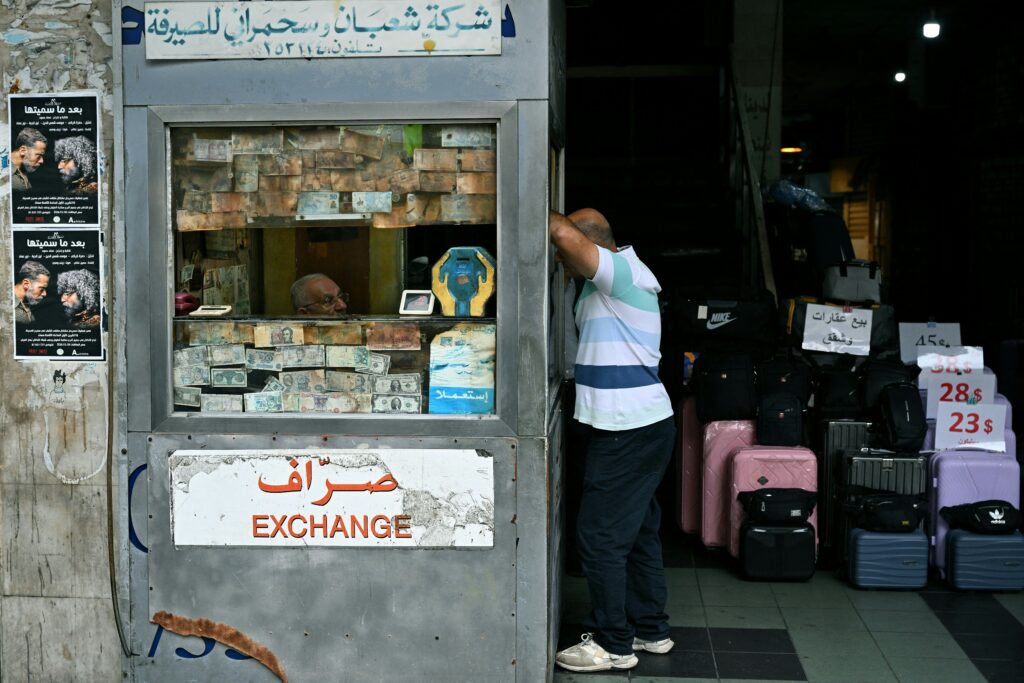
Photo above: A client stands at a currency exchange office in Beirut on November 14, 2025. Source: Photo by Joseph EID / AFP via Getty Images.
Comparative Experience: What Made Currency Boards Last or Fail
The historical experience with currency boards is often invoked in broad and sometimes simplistic ways. Some cite them as proof that hard rules can restore credibility quickly. Others point to failures as proof that such regimes are inherently unstable. Neither reading is sufficient. The more useful lesson from comparative experience is narrower and more demanding: currency boards can work, but only when the political, institutional, and strategic environments make the rule defensible over time.
Hong Kong: Durability Through Institutional Identity
Hong Kong’s Linked Exchange Rate System (LERS) has survived multiple episodes of severe stress, including the Asian financial crisis in 1997, the global financial crisis in 2008, and periods of intense political turmoil.[9] Its endurance is often attributed to strong reserves and institutional competence, and those factors matter. But the deeper source of durability lies elsewhere. Hong Kong’s entire economic model depends on predictability, contractual confidence, and external financial credibility.[10] Abandoning the peg would not simply be a technical adjustment; it would call into question the wider institutional identity on which the territory’s role as a global financial center has long depended.[11]
This means the cost of abandonment is extraordinarily high. The peg is not just one policy among others — it is part of the architecture through which Hong Kong presents itself to the world. That broader logic gives the reserve position its meaning; without it, reserves alone would not explain durability.[12]
For Lebanon, the lesson is not that reserve management can be copied. It is that durable monetary commitments are strongest when they are tied to a broader political and economic project whose abandonment would be deeply damaging. Lebanon does not yet possess that kind of settled project.
Estonia and Lithuania: Discipline as Strategic Transition
In the difficult years after the collapse of Soviet rule, Estonia and Lithuania adopted currency board arrangements as part of broader efforts to stabilize their economies and transition toward functioning market systems. Estonia introduced its currency board in June 1992, as it moved from the ruble zone to its own currency, the kroon, backed by foreign reserves and tied initially to the Deutsche mark, helping anchor price stability and confidence during structural reform. The adoption of the board was deeply intertwined with national efforts to break from Soviet economic legacies and pursue macroeconomic credibility and liberalization. Lithuania followed with its own arrangement in 1994, after a period of floating rates and temporary currencies, embedding currency discipline within the wider context of market reforms and eventual integration into European institutions.
In both cases, the credibility of the currency boards was reinforced not as isolated technical measures but as components of larger national projects aimed at economic transformation and eventual European Union accession, giving short‑term costs political intelligibility and framing monetary discipline as a bridge to a high‑value external anchor. This strategic horizon helped turn hard rules into credible commitments that markets and societies could support, and ultimately both economies successfully pursued deeper integration — including entry into European monetary frameworks — on the foundation of those disciplined monetary regimes.
Lebanon lacks an equivalent external anchor. It is not moving toward membership in a larger institutional and monetary union. That does not make a currency board impossible, but it does mean the domestic political system would have to supply the commitment almost entirely on its own. That is a much harder task.
Bulgaria: Consensus After Collapse
Bulgaria’s currency board, introduced on July 1, 1997, amid hyperinflation and deep financial distress, remains one of the clearest examples of hard monetary discipline taking hold after severe crisis.[13] The board anchored the lev first to the Deutsche mark and, following the euro’s introduction in 1999, to the euro at a fixed rate, with strict rules requiring full backing of domestic money by foreign reserves. While gold reserves contributed to the overall external position, the decisive factor was political memory and social experience of monetary collapse: Bulgarian society had lived through the pain of destabilization and was willing to sustain discipline because the alternative — repeating past monetary chaos — was seen as unacceptable.[14]
This broad willingness mattered more than technical design alone; it allowed the hard rule to become politically sustainable and, over time, supported a wider process of macroeconomic normalization. Crucially, the credibility and stability fostered under the currency board helped Bulgaria meet the Maastricht convergence criteria and pursue deeper integration with European monetary frameworks. After nearly three decades of fixed exchange‑rate discipline and convergence procedures, Bulgaria adopted the euro on January 1, 2026, becoming the 21st member of the eurozone.[15]
The Bulgarian case demonstrates that durable monetary commitments are strongest when they emerge from societal consensus and shared memory of crisis, not merely from technical arrangements.
Lebanon has also experienced a profound collapse, but social suffering there has not automatically produced political consensus. In Bulgaria, crisis was converted into agreement around discipline. In Lebanon, it has so far produced fragmentation, denial, and ongoing conflict over who should bear the losses.
Bosnia and Herzegovina: Hard Rules in a Fragmented System
Bosnia and Herzegovina’s currency board — established in 1997 shortly after the Dayton Peace Agreement — offers one of the most institutionally relevant cases for Lebanon because it shows that a deeply divided political system can nonetheless sustain a hard monetary rule.[16] The operational core of the system was placed beyond day‑to‑day political bargaining: the Central Bank of Bosnia and Herzegovina was designed with institutional independence, and the convertibility rule, which pegs the Bosnian convertible mark (BAM) to the euro, is enshrined in law and insulated from routine negotiation.[17] Communal and political contestation continued elsewhere in the country’s complex governance architecture, but the core rule of convertibility remained operationally autonomous from frequent political interference.[18]
This is highly relevant to Lebanon. It suggests that political pluralism and hard monetary rules are not inherently incompatible when institutional design separates operational enforcement from everyday politics. But it also shows that success depends on institutional mechanisms that protect the monetary rule from being captured by routine bargaining or short‑term factional interests. In Lebanon, where communal bargaining penetrates many state functions, creating such insulation would be both essential and exceptionally difficult.
Argentina: Failure Through Structural Inconsistency
Argentina’s Convertibility Plan — introduced in 1991 under the currency board‑like arrangement that fixed the peso to the US dollar — initially achieved striking gains: inflation collapsed, confidence returned, and the regime appeared to validate the notion that hard rules could restore credibility after repeated policy failure.[19] But underlying fiscal and banking weaknesses were not resolved. As external conditions deteriorated, the rigid rule became harder to sustain, and the political system proved unwilling or unable to bear the adjustment costs needed to preserve convertibility, leading to the regime’s collapse in late 2001.[20]
Argentina’s experience is often presented simply as a warning against hard pegs. The more precise lesson is different: a hard monetary rule can survive unresolved structural weaknesses for a time, particularly when external conditions are favorable. But if fiscal inconsistency, banking fragility, and political fragmentation remain in place, the strain will ultimately fall on the rule itself.
For Lebanon, this lesson is especially important. A currency board imposed on top of unresolved losses, insolvent banks, and an unsustainable fiscal structure would not eliminate those underlying problems; it would simply force them to surface through other channels until the rule itself came under attack.
The Comparative Message
Across these cases, the pattern is consistent. Reserves matter and legal design matters; but neither is enough on its own. Durable currency boards were embedded in political settlements, strategic projects, or institutional identities that made the rule worth preserving. Failed arrangements were those where the rule promised more than the political system was willing to sustain.
Lebanon should read the comparative record in that light. Its gold may improve the reserve side of the equation. It does not remove the need for a credible political foundation.
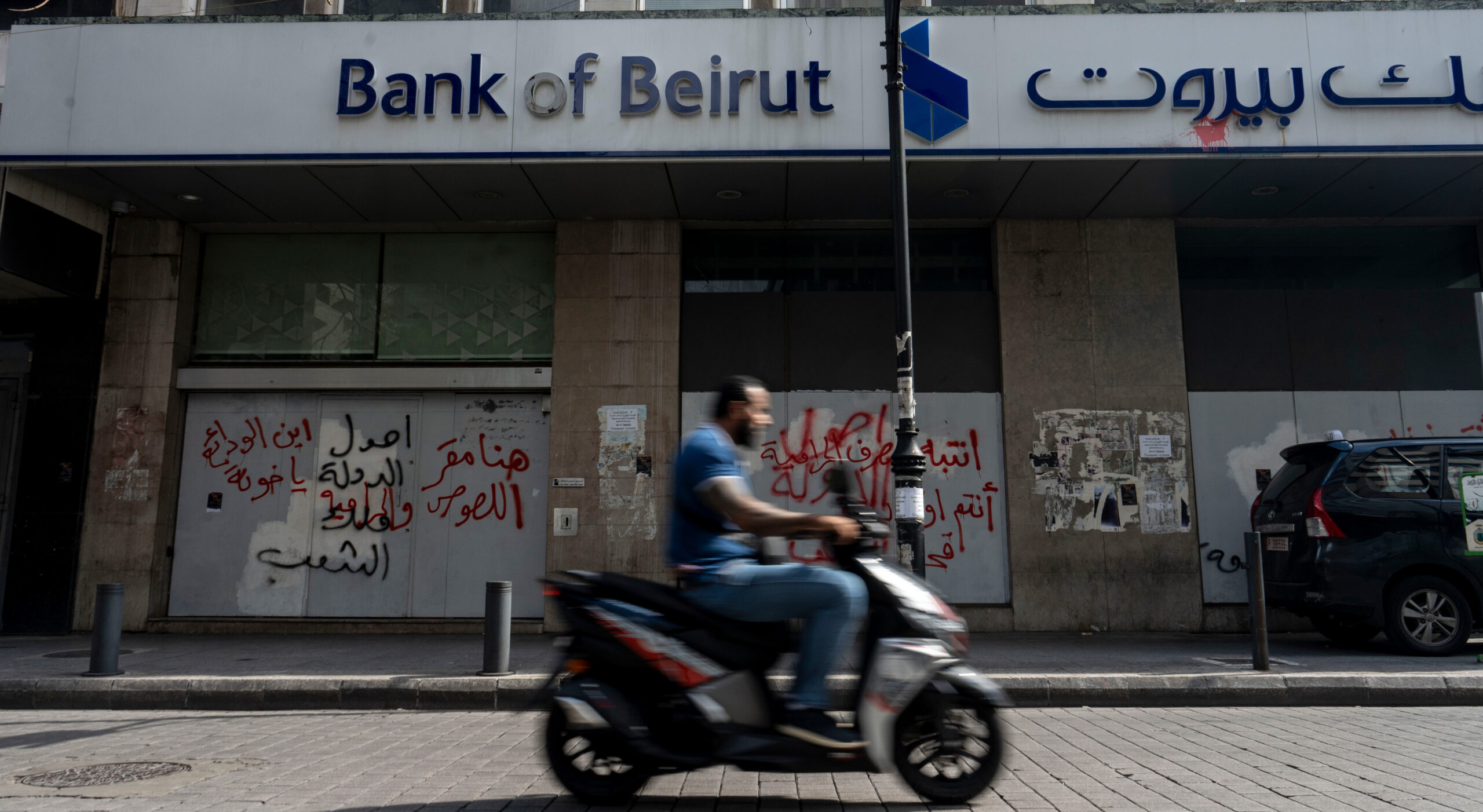
Photo above: A vandalized, shuttered Bank of Beirut branch on Hamra Street in Beirut, Lebanon, on April 30, 2023. Source: Francesca Volpi/Bloomberg via Getty Images.
Lebanon’s Gold: Credibility Asset, Political Constraint, and Strategic Exposure
Lebanon’s gold reserves are one of the few balance‑sheet facts that remain both large and widely recognized. In a financial landscape marked by opacity, dispute, and institutional mistrust, that matters enormously. But gold must be analyzed from several angles if its relevance to a currency board is to be properly understood.
Gold as a Credibility Asset
The first and strongest argument in favor of Lebanon’s gold is that it provides a reserve asset whose credibility does not depend on current Lebanese accounting. Lebanon’s foreign exchange reserves have been weakened not only by depletion but by the loss of trust in what official balance sheets mean. This is a crucial distinction. An impaired institution can sometimes rebuild reserves. It cannot quickly rebuild trust in reserve reporting if that trust has already been broken.
Gold is different. It is tangible. It is finite. It was accumulated largely before the most recent era of monetary distortion. It cannot be generated through circular placements between the central bank and commercial banks. It does not depend on the solvency of the Lebanese sovereign. In a country where the public has experienced the gap between reported reserve strength and actual financial weakness, those features are not cosmetic. They go to the heart of credibility.
This is why the gold is not simply useful in the Lebanese debate. It is foundational to the seriousness of the debate itself. If Lebanon did not hold this gold, the case for a currency board would be far weaker. A proposal based mainly on conventional reserves, after the experience of recent years, would immediately face questions about usability, encumbrance, valuation, and hidden liabilities. The gold changes that starting point. It gives the reserve discussion a degree of solidity that Lebanon’s other reserve assets do not provide.
Yet this advantage has limits. Gold strengthens reserve credibility in an important sense, but it does not fully satisfy all the operational requirements of a currency board. Gold prices fluctuate. Gold cannot always be turned into deployable currency on demand without prior arrangements. And if held abroad, its conversion into immediate liquidity depends on legal and operational channels that must be established in advance. Gold therefore improves reserve credibility, but it does not eliminate the need for careful design.
Gold as a Political Constraint
The second dimension is political. Lebanon’s gold is not just a reserve asset. It is a national symbol and a potential instrument of restitution in the eyes of many citizens. In a country where depositors have lost access to large portions of their savings, the existence of a valuable gold stock held abroad inevitably acquires political meaning. The argument that this asset should be preserved as backing for future monetary stability will collide with the argument that it should help soften the burden of past losses.
This is not a marginal issue. It goes directly to the politics of legitimacy. A currency board that formally ring‑fences the gold would be asking society to accept that one of the country’s last major assets should be used to guarantee a future monetary order rather than to compensate, directly or indirectly, those already harmed by financial collapse. That choice may be defendable in policy terms. But it is not politically neutral.
This creates a deep paradox. The more central the gold becomes to monetary credibility, the more intensely it will be contested. The stronger its role as backing, the greater the pressure to redirect it when fiscal, social, or banking strains intensify. An asset that can stabilize expectations can also destabilize politics.
Gold as Legal and Geopolitical Exposure
The third dimension is legal and geopolitical. Most of Lebanon’s gold is held outside the country. That is not unusual in sovereign reserve management, but it introduces real complications. Gold held in New York or Paris is not the same as cash in a local vault. Its mobilization depends on custody arrangements, legal authority, and operational capacity. In a moment of market stress, these details matter.
There are also broader concerns. What legal protections govern the gold? Could external creditors seek claims against it? Under what precise authority could it be pledged, sold, or swapped? Are there political scenarios in which foreign jurisdiction could complicate access? These questions do not necessarily make the gold unusable. But unresolved legal ambiguity weakens reserve credibility because markets discount assets whose deployment is uncertain.
A credible Lebanese currency board relying substantially on gold would therefore need more than a headline stock figure. It would need clear statutory treatment of the gold, transparent custody arrangements, and prenegotiated liquidity mechanisms allowing reserve assets to become operational when needed.
The Central Lebanese Distinction
These three dimensions together lead to a central distinction. Lebanon does not suffer only from low reserves. It suffers from low credible reserves. The gold matters because it is one of the few reserve assets that citizens and markets may regard as genuinely real. But the credibility of reserve backing is itself a political and legal achievement. The gold becomes a monetary anchor only if the surrounding institutions make clear that it is protected, usable, and not easily reclaimed by political struggle.
This is why the gold changes the technical discussion without removing the political problem. It makes a hard monetary regime thinkable. It does not make it safe.
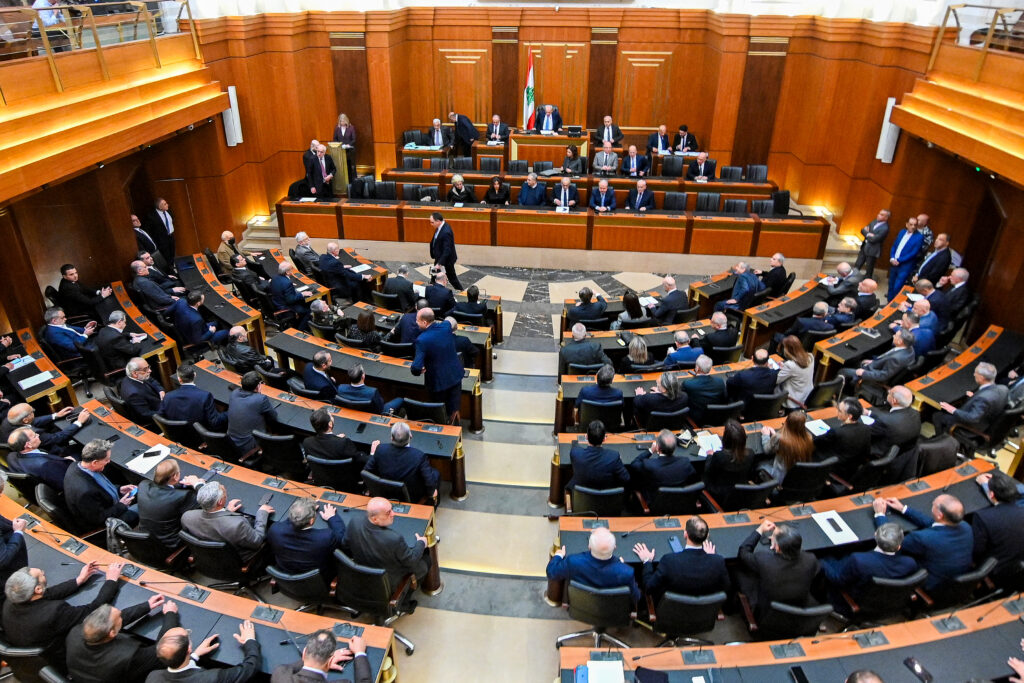
Photo above: Lebanon’s Parliamentary Speaker Nabih Berri heads a session in Lebanon’s parliament in Beirut on March 9, 2026. Source: Fadel Itani/AFP via Getty Images.
Lebanon’s Political Economy and the Problem of Loss Allocation
Any discussion of monetary reform in Lebanon eventually arrives at the same obstacle: the country has not yet decided how to allocate the losses generated by the collapse of its financial model — estimated at tens of billions of dollars in cumulative sovereign, banking, and depositor losses, according to government reform discussions tied to IMF conditionality — and this stalemate is not a technical delay but the heart of the crisis.[21]
The IMF’s 2023 Article IV Consultation documents an “unprecedented sovereign‑banking‑currency crisis” unfolding since 2019, marked by a roughly 40% contraction in output, a roughly 98% loss in the Lebanese lira’s value, triple‑digit inflation, and massive deterioration in economic and financial conditions. While the report does not provide a single consolidated dollar figure, it emphasizes the exceptionally large cumulative losses in the banking sector and Banque du Liban’s balance sheet, and underscores the critical need for credible financial sector restructuring as central to any recovery. Independent reporting on government and IMF‑linked discussions around the draft “financial gap” law places the accumulated deficits and losses of the state, central bank, and commercial banks at around $70 billion, a figure repeatedly cited by officials and in press accounts of IMF negotiations, highlighting both the scale of the crisis and the challenge of reaching agreement on loss allocation.
Lebanon’s political system was constructed to balance communities and prevent domination. Some would say it has failed to achieve that institutional balance. However, that structure has often served important stabilizing functions in a divided society. But it also makes transparent distribution of pain extremely difficult. Every major economic decision quickly becomes a political and confessional question. Banks are linked to networks of power. Large depositors are not politically anonymous. Public finance is tied to patronage and community‑based claims. Under such conditions, explicit loss recognition is not just an accounting exercise. It is a politically explosive act.
Since 2019, the system has largely avoided that act. Losses have been imposed but not formally allocated. They have been absorbed through inflation, exchange‑rate fragmentation, withdrawal restrictions, and unequal access to liquidity. The burden has been real, but the mechanism has remained opaque. This pattern is politically convenient in the short run because it avoids open confrontation over who pays. But it destroys institutional trust and makes durable reform harder.
This matters directly for any currency board proposal. A hard monetary rule does not answer the question of who bears past losses. It answers a different question: by what channels future adjustment will or will not occur. A currency board sharply limits monetary escape routes. It says, in effect, that future fiscal and financial problems cannot be addressed by printing money, by discretionary central bank support, or by quasi‑fiscal monetary engineering. But that does nothing to settle the unresolved burden of the past.
In Lebanon, this is critical. If the banking losses remain unresolved, pressure will eventually fall on whatever reserve assets are seen as available. If the state’s fiscal position remains unstable, the demand for flexibility will return. If the gold is ring‑fenced before there is a political settlement on losses, it will become a focal point of grievance rather than a secure anchor.
This is why a Lebanese currency board cannot be understood merely as a monetary option. It is a political wager. It assumes that the political system is ready to shift from opaque distribution of pain to explicit and rule‑bound adjustment. At present, that assumption is difficult to sustain. The political incentives that enabled the old model have not yet been decisively replaced by incentives compatible with transparent burden‑sharing and hard monetary discipline.
The problem is therefore not only that Lebanon’s politics are fragmented. It is that fragmentation has been used for years to avoid naming and assigning losses. A currency board introduced before this changes would be expected to carry a political burden far larger than a monetary rule can bear.
Sequencing: Why Monetary Hardening Cannot Come First
Reform debates in Lebanon often reveal a strong desire for an anchor that comes before politics rather than after it. This desire is understandable. In a context of institutional exhaustion and public mistrust, the temptation to import credibility through a hard rule is powerful. But this is precisely where sequencing becomes decisive.
The logic long emphasized by the IMF and by analysts of crisis stabilization is clear. Sustainable reform begins with recognition of losses, restructuring of insolvent institutions, credible fiscal adjustment, exchange‑rate unification, and a debt framework consistent with reality. Only after these steps can a durable monetary architecture be chosen and defended.
The IMF’s 2023 Article IV Consultation with Lebanon stresses the need to address upfront the large losses incurred by the central bank and commercial banks, restructure viable banks under time‑bound plans, and modernize governance frameworks as central pillars of restoring viability and economic recovery.[22] It also highlights the importance of unifying exchange rates to remove harmful distortions and strengthen external credibility, and calls for gradual fiscal consolidation supported by medium‑term debt sustainability to create space for priority spending. Similarly, World Bank analyses argue that macro‑financial stabilization and recovery require comprehensive restructuring of the financial sector, credible fiscal adjustment, and medium‑term frameworks that regain confidence in public finances and promote long‑term growth.[23]
The temptation in Lebanon is to reverse that order. Because the country has gold, one may argue, it can announce a gold‑backed currency board, restore confidence quickly, and then use the resulting stability to implement reforms from a stronger starting point. This argument has a surface appeal. But it rests on a misunderstanding of what reserves can and cannot do.
Reserves make convertibility possible. They do not settle political conflict. A currency board introduced before banking restructuring and fiscal stabilization does not create the conditions for reform. It removes key forms of flexibility while leaving the underlying pressures in place. If political actors are not prepared to allocate losses and sustain fiscal adjustment before the board, they are unlikely to become more willing after the board is announced. Instead, the rule may simply force those unresolved tensions to concentrate around the reserve assets, the banking system, or the state budget.
This is especially true in the Lebanese case because of the gold. If gold becomes the core backing of a hard regime before there is a legal settlement on losses and governance, it will immediately attract claims. Depositors will see it as a source of restitution. Political actors will see it as a strategic asset. Fiscal pressures will create pressure for indirect use. In other words, the very reserve that makes the board technically conceivable will become politically unstable unless sequencing is respected.
The same point can be put more directly. A currency board without credible reserves is not a real currency board. But credible reserves are not just assets. They are assets embedded in a legal and political framework that protects them under stress. In Lebanon, the gold cannot become fully credible backing until its legal status, governance, and relation to the wider loss‑allocation process are settled. That is why structural settlement must come before monetary hardening, not after it.
Governing Gold Under a Hard Rule
Suppose, despite all these difficulties, that Lebanon eventually moved toward a currency board or another hard monetary framework in which gold played a central backing role. The governance question would then become decisive. How can an asset of such financial and symbolic importance be protected in a system where major state decisions are usually drawn into communal and factional bargaining?
The answer lies in institutional separation. A credible hard regime would require a distinction between operational management and political oversight.
The operational core would need to be small, professional, and narrowly mandated. Its legal duty would be to maintain convertibility, preserve reserve coverage, publish transparent accounts, and apply predetermined rules. Gold valuation methodology would need to be fixed in statute. Mobilization of the gold would need strict legal conditions. Emergency mechanisms for converting gold into liquid foreign currency would have to be negotiated in advance. Above all, this operational core should not be subject to ordinary political bargaining or confessional vetoes.
At the same time, oversight would need to be visible, representative, and transparent. In Lebanon, legitimacy cannot be ignored. Citizens and political constituencies would demand reassurance that the gold is not being secretly mismanaged, encumbered, or used in ways contrary to public interest. Oversight institutions could therefore include public reporting, independent audit, parliamentary review, and external verification of custody and valuation. The key would be to ensure that representation affects accountability, not day‑to‑day reserve operations.
This distinction is difficult but essential. Monetary rules fail when operations become politically negotiable. But in divided systems, they may also fail when institutions are seen as politically illegitimate. The challenge is therefore not to remove politics entirely, which is impossible, but to structure politics so that legitimacy comes through oversight while credibility comes through operational insulation.
Bosnia and Herzegovina’s experience suggests this can be done. Whether Lebanon can do it depends less on technical drafting than on whether its political actors are willing to leave one strategic domain beyond routine bargaining. That is a demanding test, and one the country has not yet clearly passed.
Four Policy Options for Lebanon
Lebanon does not face a single monetary path. It faces a choice among several. But whichever option is selected, the same underlying political and institutional conditions remain relevant. Monetary design affects how adjustment occurs. It does not eliminate the need for adjustment.
1. A True Currency Board
A genuine currency board, backed materially by Lebanon’s gold and perhaps supplemented by liquid foreign currency assets, would provide the strongest nominal anchor available. It would directly address one of the most damaging features of the post‑2019 crisis: the collapse of confidence in discretionary monetary management. It would also make explicit that future stability cannot rely on the same balance‑sheet engineering that sustained the old peg.
For Lebanon, the gold is what gives this option seriousness. Without it, a currency board proposal would likely appear unconvincing because the country’s conventional reserve position lacks the credibility required for such a regime. The gold therefore is not decorative. It is one of the few assets capable of making reserve backing believable.
But this is also the most demanding option. It would require conservative valuation rules, clear legal ring‑fencing of the gold, operational facilities for liquidity conversion, completed banking restructuring, and a credible fiscal path. It would also require a political settlement strong enough to withstand the almost inevitable pressure to repurpose the gold when new strains emerge. If introduced prematurely, a currency board would not be a symbol of restored discipline. It would be a highly exposed rule waiting to be attacked.
2. Constrained Central Bank Reform
A second option would retain a central bank but sharply reduce its scope for abuse. Monetary financing would be legally prohibited. Transparency and external audits would be mandated. Exchange‑rate policy would operate within strict parameters. Gold would remain a supporting reserve asset on the central bank balance sheet rather than becoming formal backing for a currency board.
This option has practical advantages. It preserves more flexibility in dealing with shocks. It may be politically easier to adopt. It avoids the full rigidity of a currency board while still signaling a break with the worst practices of the past.
Its weakness is obvious. Lebanon’s credibility crisis is deeply tied to the misuse of central bank discretion. A reformed central bank might work in principle, but the question would remain whether citizens and markets would believe that discretion had truly been constrained. In a country where institutions have often said one thing and done another, formal reform may not be enough.
3. Full Dollarization
A third option is full dollarization. Under this framework, Lebanon would cease issuing a meaningful domestic currency and would rely on the US dollar as legal tender. This would eliminate the question of reserve backing for base money and sharply reduce monetary discretion.
Dollarization has the advantage of simplicity. It also avoids the operational complications of building a new hard rule around the domestic currency. But it does nothing to address the underlying losses. Banking insolvency remains. Fiscal unsustainability remains. The political dispute over who bears the cost of adjustment remains. Moreover, under dollarization the gold would no longer be shielded by its role as monetary backing. It could more easily become a general sovereign asset subject to political claims.
4. Unified Managed Float
A fourth option is a unified managed float with a single exchange rate and limited central bank intervention to smooth disorderly movements. This may be the most realistic short‑term path if broader political conditions remain weak. Gold would support reserve adequacy and provide some backstop value, but it would not anchor a hard rule.
The advantage of this option is flexibility. The disadvantage is weak credibility. Without a firm nominal anchor, the exchange rate would continue to absorb the consequences of unresolved fiscal and banking weaknesses. If reform lags, a managed float could become a framework for prolonged erosion rather than stabilization.
The Common Thread
Across all four options, one point remains constant. Gold matters, but it does not govern itself. Its contribution depends on the political and institutional framework around it. It is most powerful in the currency board option but also most politically vulnerable there. It is useful under other options but never decisive by itself.
The real first‑order choice for Lebanon is therefore not purely monetary. It is whether the country is willing to confront losses honestly, restructure failed institutions, and protect strategic assets through credible governance. While the Lebanese government has made initial commitments — including approving a bank restructuring law and a draft “financial gap” law designed to address losses and align with IMF conditions — progress remains contested and incomplete, and no comprehensive political consensus has yet emerged to fully implement these reforms and restore credibility.
Synthesis: Monetary Order Follows Political Order
The analysis in this report converges on a conclusion that is often acknowledged in passing but too rarely placed at the center of debate: monetary regimes are downstream from political settlements. They codify and reinforce bargains that have already, at least minimally, been accepted. They do not create those bargains from nothing.
The comparative record supports this strongly. Hong Kong’s hard regime is durable because it is bound to a wider institutional identity. The Baltic currency boards worked because they served a strategic national transition. Bulgaria’s hard currency board was sustained by a rare consensus forged in crisis, reinforced by the strategic prospect of European Union integration and eventual euro adoption, which made strict monetary discipline politically and socially acceptable.[24] Bosnia’s survived because operations were insulated from day‑to‑day political bargaining. Argentina’s failed because the rule promised more discipline than the political system was willing to sustain.
Gold modifies this logic only in part. In Lebanon, it changes the reserve arithmetic in a serious way. The country’s problem is not only a shortage of reserves. It is a shortage of credible reserves. That is why the gold matters so much. It is one of the few assets that can plausibly support reserve credibility after the collapse of trust in conventional balance‑sheet claims.
But the credibility of reserve backing is itself political. A reserve asset becomes a real monetary anchor only when it is legally secure, operationally usable, and institutionally protected from political reclamation at the first sign of stress. Gold can improve the technical base of a regime. It cannot by itself ensure that the regime will be defended when social and political pressures intensify.
For Lebanon, that means the following. First, losses in the banking system must be explicitly recognized and legally allocated. Second, bank restructuring must produce institutions that are solvent and transparent. Third, fiscal policy must become compatible with a future without monetary improvisation. Fourth, the gold must be protected by a governance framework that is clear, transparent, and durable. Fifth, monetary operations must be insulated from ordinary political bargaining even while broader accountability remains visible.
None of these are monetary acts alone. They are political acts with monetary implications. That is why monetary order will follow political order, not the reverse.
Conclusion: The Gold Is Ready. The Politics Are Not.
Currency boards are not instruments of monetary magic. They do not create confidence by legal proclamation alone. They do not remove the social and political cost of adjustment. They do not settle the conflicts that made previous regimes unsustainable. At best, and only under the right conditions, they formalize a political settlement that already exists and make it harder to violate.
Lebanon’s gold changes the technical feasibility of such an arrangement in ways that are substantial and should not be ignored. It provides a reserve asset of unusual scale and unusual credibility in a country where other reserve claims have lost both transparency and trustworthiness. This is a major advantage. It is the reason the currency board discussion in Lebanon deserves to be taken seriously at all.
But seriousness is not viability. A currency board without credible reserves is not a meaningful currency board. It is only a fixed‑rate promise waiting to be tested. Lebanon’s gold is what makes such a promise technically conceivable. But technical conceivability is not political durability. Unless the gold is embedded in a legal and institutional framework that citizens, depositors, investors, and political actors believe will hold under pressure, it will not generate the confidence required of a true hard regime.
Lebanon’s crisis was not, at its core, caused by the exchange‑rate regime alone. It was caused by a broader political economy that used the financial system to finance patronage, deferred adjustment through monetary engineering, and then distributed the eventual losses in opaque and unequal ways. A currency board introduced into that same political economy without prior reform would not stabilize the country. It would create a new battlefield around one of the last major national assets still seen as real.
The conditions for a durable hard monetary framework are therefore demanding. They include honest and legislated loss allocation, comprehensive bank restructuring, credible fiscal adjustment, robust legal protection of the gold, and truly insulated monetary operations. Without these conditions, a currency board would be less a foundation than a façade.
The same broad conclusion applies, in different ways, to Lebanon’s other monetary options. Whether the country chooses a currency board, constrained central bank reform, dollarization, or a managed float, the underlying question remains unchanged: who bears the losses already incurred, and how will the state finance itself sustainably in the future? Monetary design determines the channels through which that question is expressed. It does not answer the question itself.
Lebanon’s gold is waiting. It is an extraordinary reserve asset in a country that has exhausted much of its financial credibility. If Lebanon eventually makes the necessary political decisions with honesty, clarity, and institutional seriousness, that gold can help make stabilization faster, stronger, and more durable than it would otherwise be.
But the gold cannot make those decisions. It cannot replace political courage. It cannot substitute for institutional reform. And it cannot by itself create trust where trust has been destroyed.
That is the central lesson. The exchange rate can be fixed in law. Reserve coverage can be measured. Gold can be valued. But credibility is not a metal and not a formula. It is a political achievement, dependent on coordinated action by Lebanon’s executive authorities, the cabinet, the finance ministry, and the central bank (Banque du Liban), overseen by parliament and the judiciary, and supported — or constrained — by the country’s major political blocs.
Until these actors accept that fact and act decisively to confront losses, restructure insolvent institutions, and enforce transparent governance, no monetary framework — however sophisticated and well backed — will deliver the stability Lebanon needs.
[6]Atish R. Ghosh, Anne-Marie Gulde, and Holger C. Wolf, “Currency Boards: The Ultimate Fix?” IMF Working Paper 98/8, International Monetary Fund, January 1998.
[7]Hans J. Morgenthau, Politics Among Nations: The Struggle for Power and Peace, Alfred A. Knopf, 1949; John J. Mearsheimer, The Tragedy of Great Power Politics, W. W. Norton, 2001.
[8]Douglass C. North, Institutions, Institutional Change and Economic Performance, Cambridge University Press, 1990.
Ferid Belhaj is a Senior Fellow at the Policy Center for the New South and Adjunct Professor at Mohammed VI Polytechnic University. Previously, he was the Vice President for the Middle East and North Africa at the World Bank from July 2018 to March 2024. He held several positions during his 25-year career at the bank, including Chief of Staff to the President of the World Bank Group and Director for the Middle East (2012-17); Director for the Pacific Department (2009-12); Special Representative to the United Nations in New York; and Senior Counsel and Country Manager for Morocco. Before joining the bank, he served as a Tunisian diplomat, including as Legal Adviser at Tunisia’s Permanent Mission to the United Nations and as Deputy Chief of Mission at the Tunisian Embassy in Washington, DC.
Additional Photos
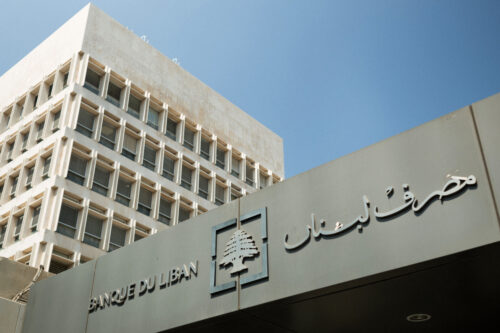
Cover photo:Lebanon’s central bank, also known as Banque du Liban, in Beirut, Lebanon. Source: Patrick Mouzawak/Bloomberg via Getty Images.
Contents photo: Closeup of gold bars. Source: OsakaWayne Photos via Getty Images.
The Middle East Institute (MEI) is an independent, non-partisan, non-for-profit, educational organization. It does not engage in advocacy and its scholars’ opinions are their own. MEI welcomes financial donations, but retains sole editorial control over its work and its publications reflect only the authors’ views. For a listing of MEI donors, please click here.