Skip to Content

Research & Commentary Results

Filter by
490 Results
Lebanon on the Brink: Hizballah, Iran, and the War’s Spillover
  • Podcast
  • Lebanon on the Brink: Hizballah, Iran, and the War’s Spillover

    Hosts Alistair Taylor and Matthew Czekaj are joined by MEI Senior Fellow Fadi Nicholas Nassar to discuss Hizballah’s role in the escalating conflict in the Middle East and the implications for Lebanon. A day after the United States and Israel launched a joint military campaign against Iran, Tehran’s Lebanese proxy fired missiles at northern Israeli territory. Israel responded swiftly and forcefully, and Lebanon’s government and population now fear the Iranian-backed militia is dragging the country back into war. The conversation explores the broader repercussions of Hizballah’s actions against the backdrop of a widening war in Iran and Lebanon’s quickly evolving political climate. Nassar also outlines recommendations for how Lebanon can move forward as a sovereign and effective state.

    March 5, 2026

    Disarmament as a Means, Not an End: A Practical Strategy for Gaza’s Governing Transition
  • Analysis
  • Disarmament as a Means, Not an End: A Practical Strategy for Gaza’s Governing Transition

    Disarmament is necessary in Gaza. It is the only way to realize the goals articulated in the internationally endorsed 20-point plan laid out by the Trump administration. But a policy approach that makes disarmament a prerequisite for action on governance, recovery, freedom of movement for Gazans, and any credible political horizon is structurally and strategically counterproductive.

    After the Iran War: What Is America’s Long Game in the Middle East?
  • Podcast
  • After the Iran War: What Is America’s Long Game in the Middle East?

    Brian is joined by Dana Stroul, Director of Research and Shelly and Michael Kassen Senior Fellow at the Washington Institute for Near East Policy, to examine US objectives in the Middle East in the midst of the ongoing war between the US, Israel, and Iran. Drawing on her extensive experience in US policymaking, most notably as the Pentagon’s top civilian official responsible for the Middle East from 2021 to 2023, Dana offers an insider’s perspective on this strategic moment. Together, Dana and Brian unpack the rapidly developing situation in Iran, the fragility of the ceasefires in Gaza and Lebanon, the shifting landscape in Syria after Assad, and the United States’ role in a region that may be on the cusp of transformation.

    After Khamenei: Iran enters its most uncertain transition since 1979
    Photo by Majid Saeedi/Getty Images
  • Analysis
  • After Khamenei: Iran enters its most uncertain transition since 1979

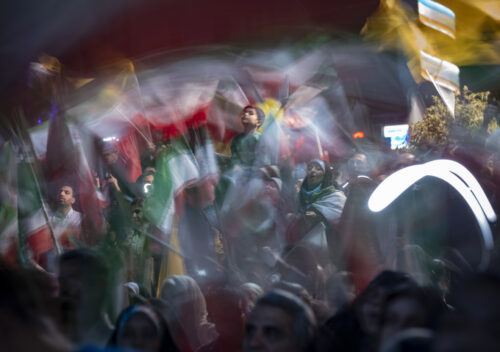
    For nearly four decades, Ayatollah Ali Khamenei embodied the Islamic Republic’s certainty: a singular authority who shaped every major decision on war and peace, repression and reform, economics and ideology. His death, in a coordinated US-Israeli strike on his Tehran command compound on February 28, has ripped that certainty away in the most violent fashion imaginable.

    Is the Regime Doomed? Iran on the Eve of War
  • Podcast
  • Is the Regime Doomed? Iran on the Eve of War

    Against the backdrop of one of the largest US military deployments to the Middle East since 2003, MEI Senior Fellow Alex Vatanka joins hosts Alistair Taylor and Matthew Czekaj to assess the situation inside Iran on the eve of potential war. Weeks after the Islamic Republic’s brutal crackdown on anti-government protesters and as negotiations with the US fail to find common ground, Donald Trump is reportedly weighing options for military action against Iran. Vatanka breaks down the regime’s strategic calculus, the current dynamics of Iran’s opposition movement, and the likely domestic political consequences of a military strike.

    February 26, 2026

    How Iran, China, and Russia Use the Shadow Fleet to Evade US Sanctions
  • Policy Memo
  • How Iran, China, and Russia Use the Shadow Fleet to Evade US Sanctions

    Crude oil legally sanctioned by the United States and its allies today makes up an estimated 18% of global tanker capacity, or 6-7% of total unrefined petroleum flows — shares that have been growing. Increased pressure on Russian exports and US intervention in Venezuela have further constrained Russian flows and temporarily removed Venezuela, the smallest sanctioned producer, from the market. Iranian exports, however, remain largely untouched.

    Riyadh takes the helm in Yemen
  • Analysis
  • Riyadh takes the helm in Yemen

    Saudi Arabia has stepped up its efforts to unify and restructure Yemen’s anti-Houthi forces after the rapid expansion and sudden implosion of the United Arab Emirates-backed secessionist Southern Transitional Council following Abu Dhabi’s military withdrawal from the country.

    February 25, 2026

    Iran looms large over Trump’s address to the nation
  • Commentary
  • Iran looms large over Trump’s address to the nation

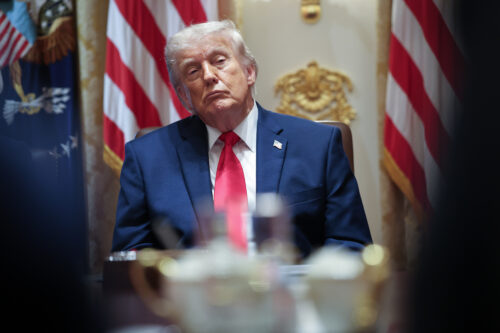
    US President Donald Trump takes to the podium tonight to deliver the first State of the Union address of his second term.

    “It’s going to be a long speech because we have a lot to talk about,” Trump said ahead of the address. The State of the Union—an annual speech delivered by the US president to Congress—typically focuses heavily on domestic policy issues, and that’s likely to be the case with tonight’s speech as well. Concerns about the health of America’s economy and growing public controversy about the Trump administration’s immigration policies are two of the domestic policy issues Trump will likely address.

    Board of Peace Meets as Storm Clouds Gather for Another Possible Middle East War
  • Analysis
  • Board of Peace Meets as Storm Clouds Gather for Another Possible Middle East War

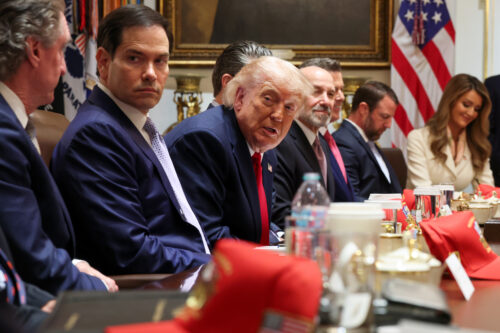
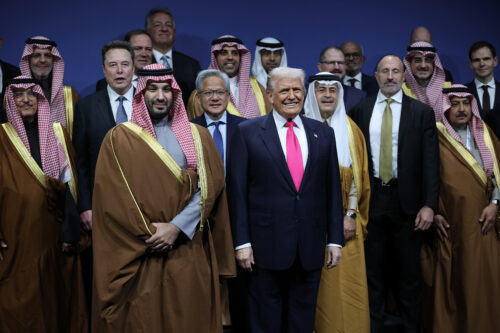
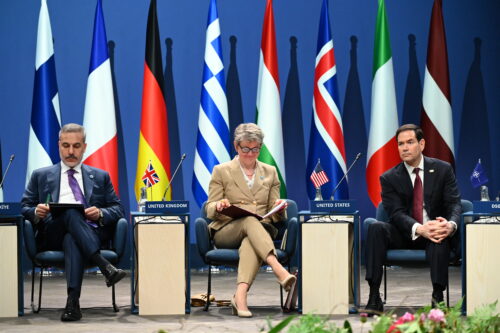
    US President Donald Trump hosted an idiosyncratic gathering of global representatives in Washington on February 19 that included some key Middle East figures meeting under the banner of peace to discuss the next steps in Gaza just as the US was sending more military forces to the region to pressure and possibly target Iran.

    Bibi’s Hail Mary on Iran
  • Podcast
  • Bibi’s Hail Mary on Iran

    Hosts Alistair Taylor and Matthew Czekaj are joined by MEI Senior Fellow Natan Sachs to discuss Israeli Prime Minister Benjamin Netanyahu’s February 11 visit to the White House, Israel’s anxieties surrounding the ongoing US-Iran talks, and the domestic political dynamics Netanyahu is operating under. Taylor, Czekaj, and Sachs unpack what Netanyahu hoped to achieve during the visit, particularly regarding Iran, and what his relationship with President Donald Trump can tell us about the relative coordination and policy alignment between the US and Israel. They also examine Netanyahu’s political standing at home, two and half years since the October 7 attacks, as the 2026 election campaign begins in Israel. Finally, Sachs assesses what lies ahead for Israeli politics.

    February 19, 2026

    Courage Runs in the Iranian People’s DNA
  • Podcast
  • Courage Runs in the Iranian People’s DNA

    Brian sits down with Holly Dagres, Libitzky Family Senior Fellow at the Washington Institute for Near East Policy, to discuss Iranian public opinion and protest movements. Dagres, who was born in Los Angeles and moved to Iran at age thirteen, offers a rare insider perspective on the views and aspirations of the Iranian people. The conversation explores the formative experiences of her teenage years in Iran, the roots of the country’s powerful women’s movements, the power of youth voices, and US policy toward Iran.

    Syria’s Path Toward Stabilization — and How the US Can Help
    Photo by Sally Hayden/SOPA Images/LightRocket via Getty Images
  • Policy Memo
  • Syria’s Path Toward Stabilization — and How the US Can Help

    After more than 50 years of brutal dictatorial rule and 13 years of civil conflict, the first year of Syria’s transition has been complex, imperfect, and fraught with difficulties. However, despite some significant challenges, Syria is clearly stabilizing. To sustain this progress, the United States must remain engaged.