
Saudi Arabia’s intensifying engagement with Somalia represents a notable development in the evolving geopolitics of the Horn of Africa. Riyadh’s Somalia policy suggests a calculated effort to reshape the Red Sea security order by ending Emirati influence, countering Iranian-aligned threats, and safeguarding the maritime and economic foundations of Vision 2030. Somalia is no longer a peripheral concern; it has become a key arena where Gulf rivalry, maritime insecurity, and Saudi ambitions converge.
Gulf Rivalry and the Contest for Political Order:
Saudi Arabia’s Somalia policy is shaped in part by its rivalry with the United Arab Emirates (UAE). The two Gulf monarchies, once close allies, have increasingly found themselves on opposite sides of regional conflicts, notably in Yemen and Sudan. Beginning in the early 2010s, the UAE built a substantial footprint in Somalia and its federal member states, training security forces, securing DP World concessions at Berbera (2016) and Bosaso (2017), and cultivating political ties with authorities in Somaliland and Puntland.
For Riyadh, the issue is not Emirati commercial engagement, but Abu Dhabi’s eagerness to bypass Somalia’s federal government, empower sub-state actors, and normalize arrangements that risk entrenching fragmentation. In response, Saudi Arabia has positioned itself as the principal external champion of Somali sovereignty and territorial integrity, aligning closely with Mogadishu rather than regional authorities. This reflects a broader Saudi effort to assert itself as the defining Gulf actor in the Horn of Africa—one committed, at least rhetorically, to centralized state authority rather than transactional subnational partnerships.
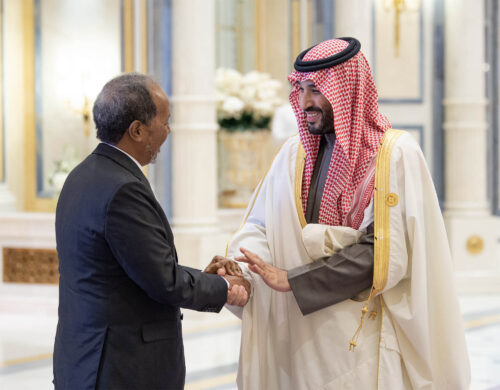
Photo by Royal Court of Saudi Arabia via Getty Images
The Middle East Institute (MEI) is an independent, non-partisan, not-for-profit, educational organization. It does not engage in advocacy and its scholars’ opinions are their own. MEI welcomes financial donations, but retains sole editorial control over its work and its publications reflect only the authors’ views. For a listing of MEI donors, please click here.


The Mecca Joint Défense Agreement: A New Geometry of Middle Eastern Power?
