Please click here for virtual registration.
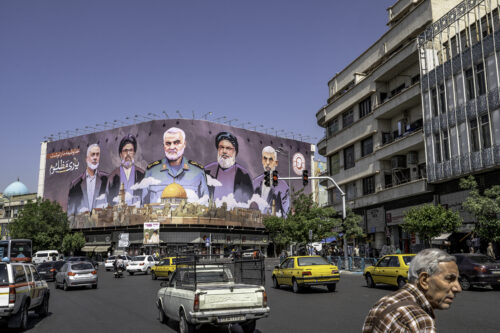
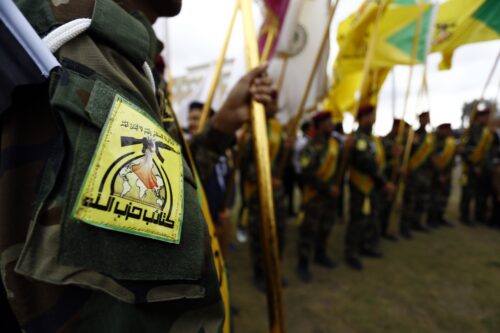
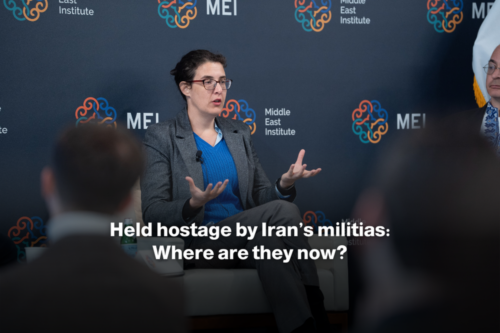
During her PhD field work in Iraq, Elizabeth Tsurkov, Senior Non-Resident Fellow at the New Lines Institute, was kidnapped and held hostage for two and a half years by a pro-Iranian militia. Drawing from her experience in captivity and extensive research, she offers a unique and valuable perspective into the profound transformations reshaping these militias as they grapple with expulsion from Syria, and drastically reduce their “resistance” activities due to fear of US-Israeli retaliation.
Tsurkov also reflected on the circumstances of her release – secured without concessions to her captors – and explore underutilized tools available to US policymakers confronting state‑sponsored hostage‑taking and militia networks.
This in-person panel included opening remarks from MEI President Amb. Stuart Jones and was moderated jointly by Charles Lister, Senior Fellow at the Middle East Institute, and Benjamin Wittes, Senior Fellow in Governance Studies at The Brookings Institution. It concluded with a Q&A period.
Speaker Biographies
Elizabeth Tsurkov
Non-Resident Fellow, New Lines Institute
Benjamin Wittes
Senior Fellow, Brookings Institution
Charles Lister
Senior Fellow, Middle East Institute
Extended Speaker Biographies
Elizabeth Tsurkov is a Non-Resident Fellow at the New Lines Institute, and a Research Fellow at the Forum for Regional Thinking, an Israeli-Palestinian think-tank based in Jersualem. She is also a doctoral student in the Politics department at Princeton University. Her research focuses on the Levant, and particularly, the Syrian uprising and civil war.
Benjamin Wittes is a Senior Fellow in Governance Studies at Brookings. He co-founded and is the editor-in-chief of Lawfare, a non-profit publication that provides national security analysis. He is a contributing writer at The Atlantic and a law analyst at NBC News and MSNBC.
Charles Lister is a Senior Fellow and the Director of the Syria Initiative at the Middle East Institute (MEI), where he focuses on Syria, terrorism, and insurgency across the Levant. His work also covers broader regional security dynamics and the evolution of jihadist movements, including al-Qaeda and the Islamic State (ISIS).