This individual is a guest contributor. MEI is not able to assist with contact requests.
Jean-Pierre Cassarino holds a professorship at the Robert Schuman Center for Advanced Studies (RSCAS/European University Institute, Florence) where he directs the Return migration and Development Platform (http://rsc.eui.eu/RDP/). He is also research associate at the Tunis-based Institut de Recherche sur le Maghreb Contemporain (IRMC). Since the mid-1990s, he has published extensively on international migration, particularly on return migration and has carried out numerous field surveys investigating returnees’ manifold patterns of reintegration. Selected publications include: (ed.) Unbalanced Reciprocities: Cooperation on Readmission in the Euro-Mediterranean Area, The Middle East Institute Press, Washington, 2010; (ed.) “Conditions of Modern Return Migrants”, International Journal on Multicultural Societies, Vol. 10, Issue 2, UNESCO, Paris, 2008; (ed.) Return Migrants to the Maghreb Countries: Reintegration and development challenges, RSCAS, European University Institute, Florence, 2008; Tunisian New Entrepreneurs and their Past Experiences of Migration in Europe: Networks, Resource Mobilisation, and Hidden Disaffection. Ashgate Publishers, Aldershot, 2000. Email: [email protected]
Randa Slim, MEI Scholar and adjunct research fellow at the New America Foundation, discusses the implications of Hezbollah's growing role in Syria for Lebanese politics and Lebanon's Shiite community.
The Middle East Institute is pleased to welcome MEI Scholar Randa Slim for a discussion on the implications of Hezbollah’s growing role in Syria for Lebanese politics and Lebanon’s Shiite community. Recently returned from a trip to the region, Slim will examine Hezbollah’s potential end game in Syria, and whether Lebanon will be able to resist being drawn into the conflict following Hezbollah’s plunge into the Syrian abyss.
The Middle East Institute is pleased to welcome MEI Scholar Randa Slim for a discussion on the implications of Hezbollah’s growing role in Syria for Lebanese politics and Lebanon’s Shiite community. Recently returned from a trip to the region, Slim will examine Hezbollah’s potential end game in Syria, and whether Lebanon will be able to resist being drawn into the conflict following Hezbollah’s plunge into the Syrian abyss.
The Middle East Institute is pleased to welcome MEI Scholar Randa Slim for a discussion on the implications of Hezbollah’s growing role in Syria for Lebanese politics and Lebanon’s Shiite community. Recently returned from a trip to the region, Slim will examine Hezbollah’s potential end game in Syria, and whether Lebanon will be able to resist being drawn into the conflict following Hezbollah’s plunge into the Syrian abyss.
The Middle East Institute is pleased to welcome MEI Scholar Randa Slim for a discussion on the implications of Hezbollah’s growing role in Syria for Lebanese politics and Lebanon’s Shiite community. Recently returned from a trip to the region, Slim will examine Hezbollah’s potential end game in Syria, and whether Lebanon will be able to resist being drawn into the conflict following Hezbollah’s plunge into the Syrian abyss.
The negotiations for a potential loan from the International Monetary Fund (IMF) to Egypt have been one of the most contested issues in the country since the January 2011 revolution.
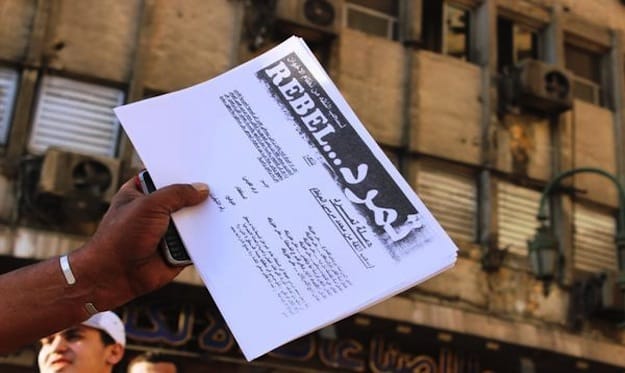
Everyone in Egypt is bracing for June 30. Demonstrations against President Mohamed Morsi on the day marking his first year in office were always expected, but a grassroots campaign has reinvigorated a waning street movement and has provided an initiative embraced by most of the country’s opposition.
Mahmoud Badr, one of Tamarod's five founders and the movement's official spokesperson sits down with MEI to discuss Tamarod's origin, aims, and roadmap for political transition. Badr delves into the current pitfalls of Morsi's regime, his expectations for June 30th, and the reform he sees as central to Egypt's future. A journalist and broadcast media producer by trade, Badr is also a coordinator for the opposition movement Kefaya and was part of Dr. Mohamed El Baradei's "Bid for Change" campaign. Video by Dina Hussein.
In a speech on 23 May 2013, President Obama declared the war on terror over. “We must define our effort not as a boundless ‘global war on terror,’” he said, “but rather as a series of persistent, targeted efforts to dismantle specific networks of violent extremists that threaten America.”[1] He argued that al-Qa`ida is on the run in Afghanistan and Pakistan and no longer threatens the U.S. homeland.