This individual is a guest contributor. MEI is not able to assist with contact requests.
Ragui Assaad is Professor at the Humphrey Institute of Public Affairs at the University of Minnesota. He has written extensively on labor market and youth issues in the Middle East and North Africa. The author acknowledges the able research assistance of Stefan Johansson in the preparation of this essay.
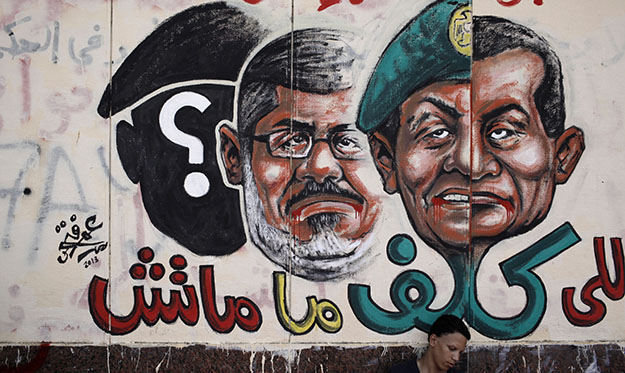
Former Egyptian President Mohamed Morsi addressing violence in Egypt's streets, followed by reaction from political satirist Bassem Youssef. January, 2013.
The Middle East Institute is proud to host Dr. Mona Makram-Ebeid for a discussion about the state of affairs in Egypt in the wake of the overthrow of Muslim Brotherhood President Mohamed Morsi. Dr. Makram-Ebeid is a prominent Egyptian academic and former member of the Shura Council, who recently resigned in support of the Tamarod movement. She will provide a first-hand perspective on the challenges ahead for Egypt following the recent military takeover of the government and the ensuing violence and unrest.
Announcement: Paul Salem Joining as Vice President of Middle East Institute to Lead Initiative on Arab Transitions
WASHINGTON, D.C. – The Middle East Institute (MEI) is pleased to announce that Paul Salem will join the Institute as a vice president in October to direct the Arab Transitions initiative. Dr. Salem comes to MEI after having served as the founding director of the Carnegie Middle East Center in Beirut, Lebanon since 2006.
The sun is beating down and it isn’t even midday. Clutching the all-important paperwork that will get them coveted UN food vouchers, Syrian refugees look harried. The women pull at their children to hurry through the litter-filled yard of the sports club in the town of Bar Elias that serves as a distribution center for the UN’s hard-pressed World Food Program (WFP). Unlike their men, who head for the shade to smoke and exchange news, the women don’t dally, making for the snaking lines into a crowded hall where they will be called in groups by registration numbers.
A white bed sheet had been strung between two trees on a median just opposite the Sayeda Aisha mosque in a working class area of Cairo. Everything had been arranged by volunteers under the protection of Ahmed, a well-known personality in the neighborhood. He helped them pick a spot to set up the projector, screen, and speakers. All that was missing was a functioning street lamp to power the equipment, but those nearby had been disconnected. A generator that was usually rented out to street vendors was used instead.
The Middle East Institute is proud to host Dr. Mona Makram-Ebeid for a discussion about the state of affairs in Egypt in the wake of the overthrow of Muslim Brotherhood President Mohamed Morsi. Dr. Makram-Ebeid is a prominent Egyptian academic and former member of the Shura Council, who recently resigned in support of the Tamarod movement. She will provide a first-hand perspective on the challenges ahead for Egypt following the recent military takeover of the government and the ensuing violence and unrest.Bios:Dr.
The Middle East Institute is proud to host Dr. Mona Makram-Ebeid for a discussion about the state of affairs in Egypt in the wake of the overthrow of Muslim Brotherhood President Mohamed Morsi. Dr. Makram-Ebeid is a prominent Egyptian academic and former member of the Shura Council, who recently resigned in support of the Tamarod movement. She will provide a first-hand perspective on the challenges ahead for Egypt following the recent military takeover of the government and the ensuing violence and unrest.Bios:Dr.
The Middle East Institute is proud to host Dr. Mona Makram-Ebeid for a discussion about the state of affairs in Egypt in the wake of the overthrow of Muslim Brotherhood President Mohamed Morsi. Dr. Makram-Ebeid is a prominent Egyptian academic and former member of the Shura Council, who recently resigned in support of the Tamarod movement. She will provide a first-hand perspective on the challenges ahead for Egypt following the recent military takeover of the government and the ensuing violence and unrest.Bios:Dr.
The Middle East Institute is proud to host Dr. Mona Makram-Ebeid for a discussion about the state of affairs in Egypt in the wake of the overthrow of Muslim Brotherhood President Mohamed Morsi. Dr. Makram-Ebeid is a prominent Egyptian academic and former member of the Shura Council, who recently resigned in support of the Tamarod movement. She will provide a first-hand perspective on the challenges ahead for Egypt following the recent military takeover of the government and the ensuing violence and unrest.Bios:Dr.
The Middle East Institute is proud to host Dr. Mona Makram-Ebeid for a discussion about the state of affairs in Egypt in the wake of the overthrow of Muslim Brotherhood President Mohamed Morsi. Dr. Makram-Ebeid is a prominent Egyptian academic and former member of the Shura Council, who recently resigned in support of the Tamarod movement. She will provide a first-hand perspective on the challenges ahead for Egypt following the recent military takeover of the government and the ensuing violence and unrest.Bios:Dr.
The U.S. Needs to Walk the Walk on Egypt's Human Rights
Originally published July 10, 2013 in U.S. News and World Report
Assertions and opinions in this publication are solely those of the above-mentioned author(s) and do not necessarily reflect the views of the Middle East Institute, which expressly does not take positions on Middle East policy.

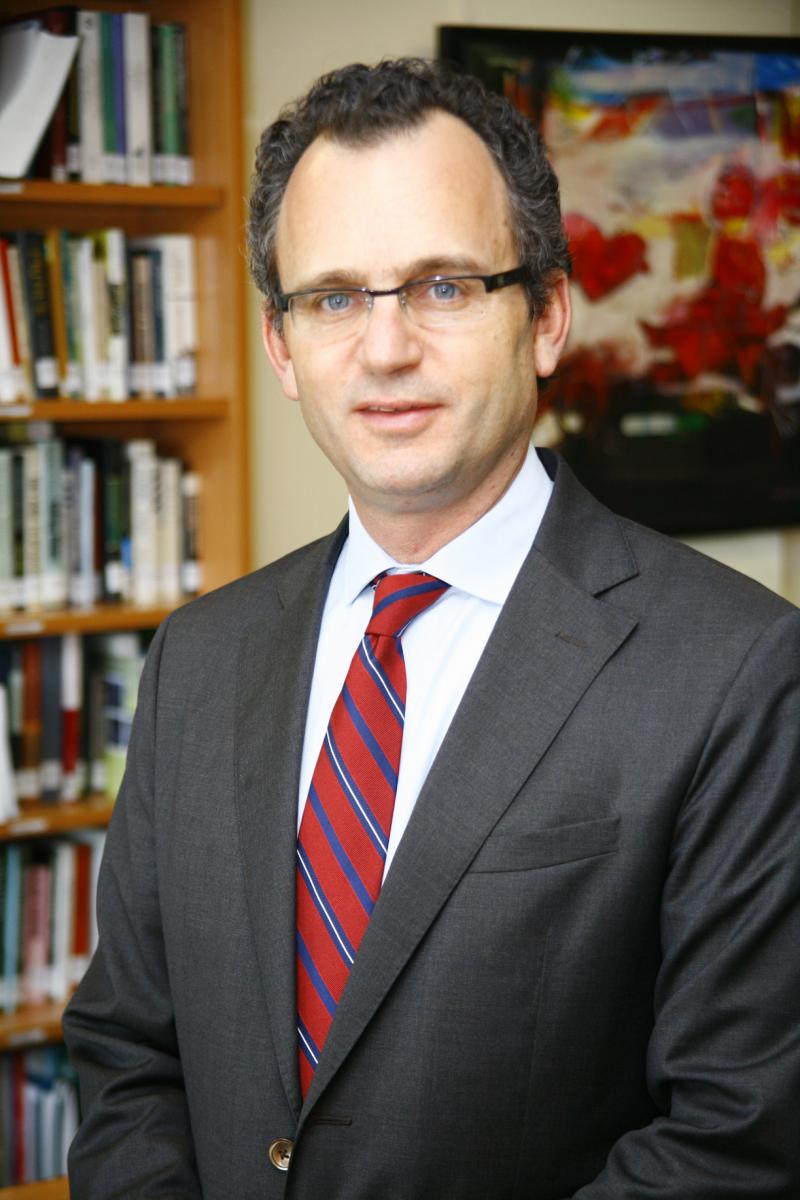 WASHINGTON, D.C. – The Middle East Institute (MEI) is pleased to announce that Paul Salem will join the Institute as a vice president in October to direct the Arab Transitions initiative. Dr. Salem comes to MEI after having served as the founding director of the Carnegie Middle East Center in Beirut, Lebanon since 2006.