Iran Defiant over Its Missile Program despite International Concern
January 31, 2017
Share
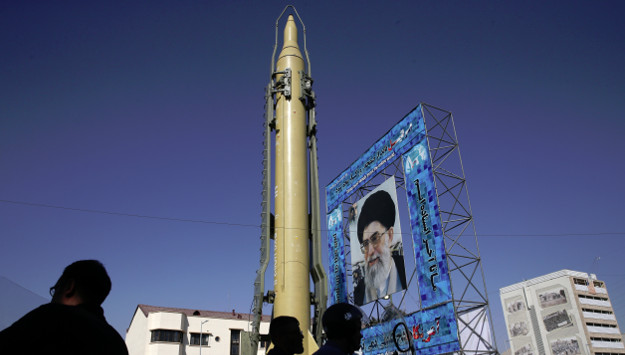
The news of Iran’s latest ballistic missile test has provoked international concern. At the request of the United States, the U.N. Security Council is scheduled today to discuss whether Iran’s apparent test over the weekend violates the U.N. resolution 2231 that prohibits Iran from testing ballistic missiles designed to deliver a nuclear warhead. “When actions are taken that violate or are inconsistent with the resolution, we will act to hold Iran accountable and urge other countries to do so as well,” U.S. State Department Spokesman Mark Toner said. Some U.S. lawmakers and Israeli Prime Minister Benjamin Netanyahu condemned the test and demanded international action to punish Iran.
But Iran, which has not confirmed or denied the test, is defiant.
“Iran had declared from the beginning that it would under no circumstances allow any negotiation over its missile program,” Fars News Agency, an outlet run by the Islamic Revolution Guards Corps (I.R.G.C.), wrote earlier today. “There is no reference to the issue of Iran’s missile capability in the nuclear agreement signed between Iran and six other countries in 2015,” it further argued. According to the Fars article, even if Iran violates the resolution 2231, it will not be in a violation of the nuclear agreement. It also predicts that, similar to another U.N. emergency meeting convened last year after Iran test-fired two ballistic missiles, no significant measures will be adopted by today’s U.N. meeting.
Separately, Iran’s Foreign Minister Javad Zarif said his country’s ballistic missiles are not “designed to carry nuclear warheads.” He also called on the Trump administration not to use the escalating controversy as a “pretext” to impose additional sanctions against Iran.
But Zarif’s assurances will not assuage international concern because the civilian government in Iran has no meaningful oversight of the country’s military activities. It is the Islamic Revolution Guards Corps (I.R.G.C.) that is in charge of Iran’s missile program, and I.R.G.C. leaders have repeatedly threatened neighboring countries in the past. Indeed, when the I.R.G.C. test-fired two ballistic missiles last March, one of them had “Israel should be wiped off the Earth” inscribed on it in Hebrew.
The Middle East Institute (MEI) is an independent, non-partisan, not-for-profit, educational organization. It does not engage in advocacy and its scholars’ opinions are their own. MEI welcomes financial donations, but retains sole editorial control over its work and its publications reflect only the authors’ views. For a listing of MEI donors, please click here.