New Report Warns Iran Will Acquire Advanced Weaponry after U.N. Ban Is Lifted
March 2, 2017
Share
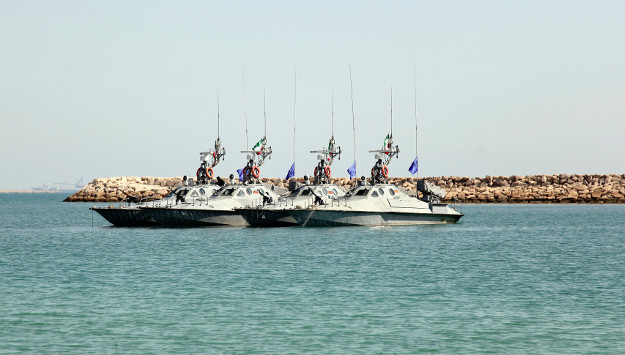
A new report by the U.S. Office of Naval Intelligence says Iran will be able to purchase warships, submarines and advanced missiles to further boost its naval power after 2020, when the U.N. Security Council Resolution 2231 prohibiting Iran from acquiring advanced offensive weaponry is set to expire. “Over the next five years, new weapons will likely include submarine-launched ASCMs, the Hoot supercavitating torpedo, and potentially a supersonic ASCM, which Iran claims is in development. After 2020, Iran may look to foreign acquisitions of ships and submarines with a wide array of weapons suites,” the 42-page study said. The U.S. Navy report suggests three key factors – the status of the Iran nuclear agreement, the price of oil and leadership changes in Tehran – will determine Iran’s naval strategy and acquisitions in the future. It adds: “The main components of Iran’s defense strategy are ballistic missiles, naval forces, and proxies in the region. Each of these potentially provides the means to target Iran’s regional neighbors, or military forces based or operating in the region.”
Comment: The U.S. Navy’s report comes at a critical time when tension between Washington and Tehran over the latter’s controversial missile activity and destabilizing role in the region is escalating. The Trump administration has already put Iran “on notice” and imposed new sanctions against Iranian government entities and individuals involved in the country’s ballistic missile program. Furthermore, the administration is considering designating Iran’s Islamic Revolution Guards Corps (I.R.G.C.) as a terrorist entity and U.S. lawmakers are already working on additional sanctions against Tehran. The findings in the U.S. Navy’s latest report, therefore, may further persuade both the Trump administration and the Congress to impose more comprehensive sanctions against Iran.
The report also revealed that Tehran had already begun negotiations with Moscow to acquire the SS-N-26 Yakhont coastal defense cruise missile. This may be part of a $10 billion arms deal that Tehran and Moscow recently began to negotiate. During his visit to Tehran last November, head of the defense and security committee in Russia’s upper house of parliament, Viktor Ozerov, had announced that the “ negotiations are being carried out… The order book, discussed today, reflects the needs of Tehran and amounts to some $10 billion.”
As the report notes, the Iranian regime has put an increased emphasis on developing its naval capabilities to expand its maritime influence in the region. Last November, Khamenei called for enhancing the Iranian naval forces’ presence in international waters and expanding the Navy’s power. “The power and capability of the Islamic Republic’s Navy should be in line with the merit and level of the Islamic Establishment and the country’s history,” he told a gathering of senior naval commanders. And in the same month, the chief of staff of the Iranian armed forces called for setting up naval bases in Yemen and Syria in the future – triggering alarm in the region about Iran’s expansionist naval agenda in the region.
The Middle East Institute (MEI) is an independent, non-partisan, not-for-profit, educational organization. It does not engage in advocacy and its scholars’ opinions are their own. MEI welcomes financial donations, but retains sole editorial control over its work and its publications reflect only the authors’ views. For a listing of MEI donors, please click here.