Yemen: The Houthis’ Role in the Next Evolution of the Axis of Resistance
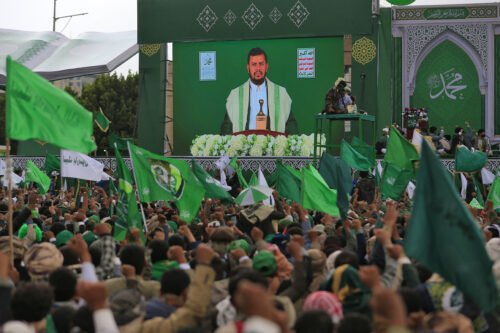
The outbreak of the war with Iran demonstrated the strategic value of maritime chokepoints in the Islamic Republic’s confrontation with the United States. But as Tehran’s strategy of using the Strait of Hormuz to pressure Washington seems to be backfiring, Iran is working with the Houthis to strengthen its leverage over another strategic chokepoint: the Bab el-Mandeb. The recent escalation in Yemen should be viewed within this context.
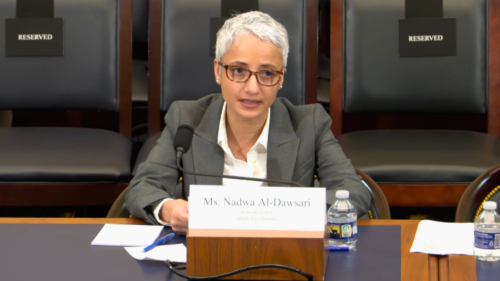
Over the past several weeks, the Houthis have seized the port city of Mokha, Yemen’s western coastline, and several islands in the Bab el-Mandeb Strait, and they are now massing around Marib and Taiz in the first major frontline shift since 2022. MEI Associate Fellow Nadwa Al-Dawsari joins host Matthew Czekaj to unpack the latest developments. Together, they discuss what has allowed the Houthis to advance against Yemeni government forces, the role the militant group plays in Iran’s regional strategy, and what it will take to contain the threat.
The Fall of Amran and the Future of the Islah Party in Yemen
As the world’s attention was riveted on the lightening conquests of the Islamic State in Iraq, Yemen’s al-Huthi movement made an equally stunning but largely unnoticed military advance on Amran Governorate and captured the provincial capital, Amran, in July. The fall of Amran has extraordinary political significance: The al-Huthi advance dislodged the al-Ahmar family’s grip on the leadership of the Hashid tribal confederation, a central political pillar of the Yemeni Republic since 1962, and threatens the survival of the Islah Party itself.
The Popular Committees of Abyan, Yemen: A Necessary Evil or an Opportunity for Security Reform?
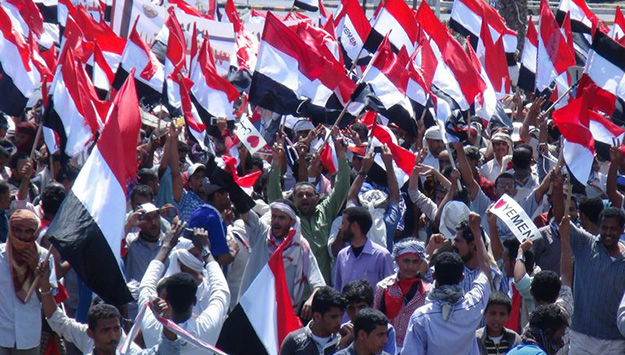
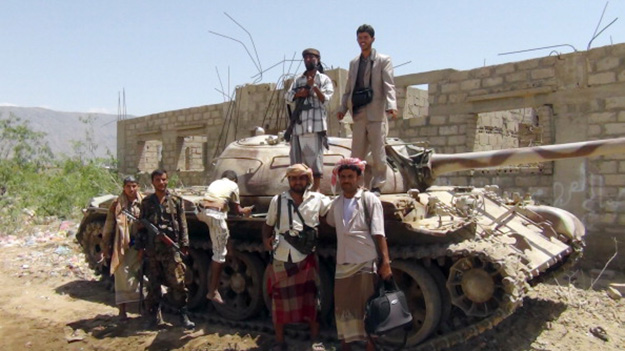
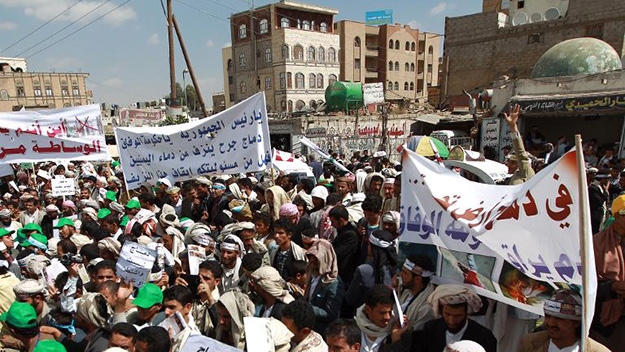
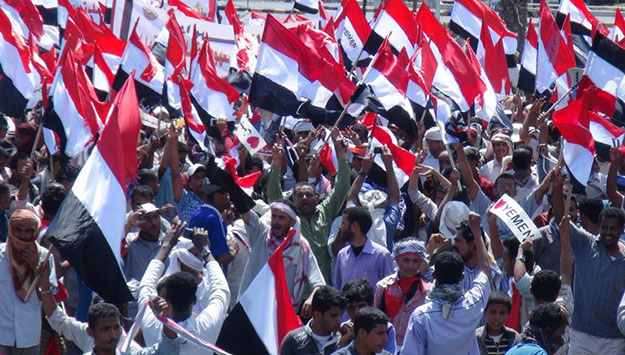
In early 2011, Yemeni youths took to the street to demand the downfall of the regime and much-needed democratic reforms. This eventually led to the removal of former president Ali Abdullah Saleh from power later the same year. The political turmoil associated with the uprising has resulted in an alarming deterioration of the security situation throughout the country, most notably the seizure of two major cities in the southern governorate of Abyan by Ansar al-Shariah (AAS), an offshoot of al-Qa`ida. Backed by the Yemeni government, the Popular Committees (PCs), local armed resistance groups, pushed AAS out of major cities in Abyan.
Yemen’s Contentious Transitional Justice and Fragile Peace
Yemen was not immune to the wave of popular uprisings that swept some countries of the Middle East and North Africa region. However, because of the Yemeni state’s fragility, concurrent zones of conflict, and a power struggle that divided the core military and tribal elites, the international community was afraid that the youth uprising that started in January 2011 might lead to a collapse of the state. Given the consequences of such a collapse on the security of the Gulf states, oil production, and the international war on terror, the Gulf Cooperation Council brokered a deal in November 2011—the Gulf initiative—which laid the foundation for a transitional government. The main aim of the initiative was to secure a peace deal that halted Yemen’s slide into chaos. Peace was sought through the brokering of an inclusive National Dialogue Conference (NDC), but peace did not entail changing the regime or its pattern of politics. While transitional justice has been a part of this process of peaceful reconciliation, it raises questions about the sustainability of this peace and provides a showcase of the precarious state of Yemeni affairs.
The removal of Yemeni President Ali Abdullah Saleh in 2011 has created an existential crisis for Yemen’s Houthis. Like many other armed political groups in Yemen and elsewhere, the Houthis’ survival depends on the continued existence of an enemy. With Saleh gone, their raison d’être has become difficult to define and their armed opposition hard to defend.
The members of the Friends of Yemen, comprising over 30 governments and several international institutions, including the United Nations, World Bank, Arab League, and European Union, gathered for their sixth meeting September 25 in New York on the margins of the UN General Assembly. Chaired by the governments of Yemen, Saudi Arabia, and the United Kingdom, participants praised Yemen’s efforts to implement a political transition through inclusive and comprehensive dialogue and negotiation—a stark contrast to the course of events in better-known Syria and Egypt.
Last week, MEI scholars Allen Keiswetter, a retired Foreign Service officer, David Newton, former ambassador to Yemen, and Roby Barrett, author of Yemen: A Different Political Paradigm in Context(2011), gathered for an informal discussion about Yemen’s National Dialogue Conference (NDC), which began in March.
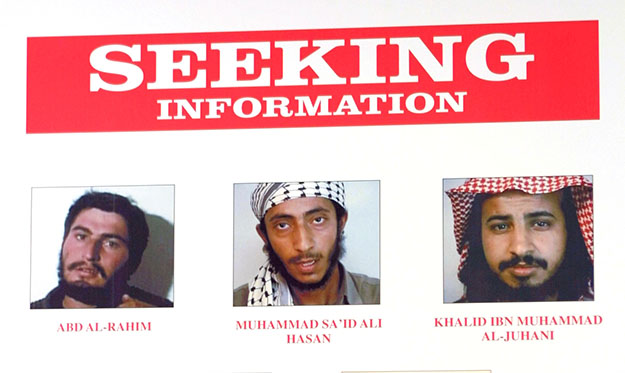
In a speech on 23 May 2013, President Obama declared the war on terror over. “We must define our effort not as a boundless ‘global war on terror,’” he said, “but rather as a series of persistent, targeted efforts to dismantle specific networks of violent extremists that threaten America.”[1] He argued that al-Qa`ida is on the run in Afghanistan and Pakistan and no longer threatens the U.S. homeland.
Interview with Indian Ambassador (ret.) Ranjit Gupta: Cairo, Egypt — The First Posting (1965-1968)
Even before I left India for Cairo, I had the impression that there was a special relationship between India and Egypt. Indeed, within a few weeks of my arrival in Cairo, I found tangible manifestations that it was indeed so and discovered many more in due course.
The Middle East Institute is proud to host MEI Scholar Dr. Charles Schmitz for a discussion about Yemen’s political future. Two years after the start of anti-government protests in Yemen, the country remains torn by political divisions and rivalries. Schmitz will examine the political challenges ahead and whether or not the country’s upcoming National Dialogue holds the key to stabilizing Yemen.
The Middle East Institute is proud to host MEI Scholar Dr. Charles Schmitz for a discussion about Yemen’s political future. Two years after the start of anti-government protests in Yemen, the country remains torn by political divisions and rivalries. Schmitz will examine the political challenges ahead and whether or not the country’s upcoming National Dialogue holds the key to stabilizing Yemen.
The Middle East Institute is proud to host MEI Scholar Dr. Charles Schmitz for a discussion about Yemen’s political future. Two years after the start of anti-government protests in Yemen, the country remains torn by political divisions and rivalries. Schmitz will examine the political challenges ahead and whether or not the country’s upcoming National Dialogue holds the key to stabilizing Yemen.
The Middle East Institute is proud to host MEI Scholar Dr. Charles Schmitz for a discussion about Yemen’s political future. Two years after the start of anti-government protests in Yemen, the country remains torn by political divisions and rivalries. Schmitz will examine the political challenges ahead and whether or not the country’s upcoming National Dialogue holds the key to stabilizing Yemen.
The Middle East Institute is proud to host MEI Scholar Dr. Charles Schmitz for a discussion about Yemen’s political future. Two years after the start of anti-government protests in Yemen, the country remains torn by political divisions and rivalries. Schmitz will examine the political challenges ahead and whether or not the country’s upcoming National Dialogue holds the key to stabilizing Yemen.
The oldest peer-reviewed publication dedicated to the study of the modern Middle East, MEI’s flagship journal covers politics, society, and culture in the region.