One year on, the Trump administration’s 20-point plan for Gaza remains a work in progress, and the debate around it has split into two narratives that rarely meet. Official statements announce breakthroughs, while critics dismiss the plan as a cease-fire in name only. Neither narrative tells a policymaker which commitments are working, which are stalled, who is obliged to take the next step, and what would unlock the process. The central goals of this policy analysis are to answer those questions and suggest a pathway forward into 2027 and beyond.
It measures each of the plan’s 20 points against what has happened, using the plan’s own text, the follow-on implementation steps, and United Nations Resolution 2803, which endorsed it, as the baseline. It applies the same evidentiary test to every point, names the party responsible for each step, and offers tangible evidence informing every status assessment. The aim is not to pass judgement on the plan’s merits but to establish a common factual record from which its second year can be debated.
Key Takeaways
- One year on, the Trump administration’s 20-point plan for Gaza remains a work in progress. Its greatest accomplishment has been the cease-fire, which has mostly, but not entirely, held. It has significantly reduced the killing but not ended it: Gaza’s Ministry of Health reports at least 1,610 Palestinians killed since October 10, 2025; Israel reports at least four of its soldiers killed, with no independent mechanism to adjudicate violations. The plan has not yet brought the parties any closer to a durable settlement of the conflict.
- Only 7 of the plan’s 20 points have been fully or partially delivered, 2 fully and 5 partially. Five are stalled, 6 have not started, and 1 has been reversed; point 7, humanitarian aid, is split. But the points are not all weighted equally: the cease-fire mattered most, many points can only follow others, and some are long-term goals rather than steps with a deadline.
- The plan delivered on critical immediate needs but has so far failed to address the institutional changes on which a lasting political settlement depends. The cease-fire, the return of hostages, and the release of prisoners were largely achieved within weeks. Technocratic governance, a stabilization force, decommissioning, staged withdrawal, and reconstruction have not begun in any meaningful way, and daily life in Gaza has improved little.
- Four design gaps explain the inability to move beyond the initial, short-term gains: sequencing without an impartial referee, obligations without symmetrical verification, announcements standing in for delivery, and a lack of political will among the key powers.
- Security is the first critical step, and the stabilization force as now envisioned cannot provide it. Nothing else in the plan moves without a force able to prevent Hamas from rearming as well as hold territory the Israel Defense Forces withdraw from. Washington should build one that can, around a capable core with US support.
- The year’s most consequential concessions came from Hamas, but the process has not built on them. Hamas dissolved its Gaza government and accepted a decommissioning roadmap. Within days, the Board of Peace reversed that roadmap’s reciprocal sequencing.
- On territory, the plan has moved backward. Israeli control has grown from about 53% of Gaza to an estimated 60-70%.
- The political horizon has receded further. Palestinian elections due in November 2026 have been postponed to September 2027.
- The Board of Peace and Washington have begun pressing Israel. In October, the board asked Israel to let the technocratic committee and the stabilization force into Gaza and to approve a pilot program in an Israeli-held part of Rafah, where both would begin work and displaced Gazans would be sheltered in temporary housing. In November, President Donald Trump asked Prime Minister Benjamin Netanyahu to move ahead with the plan, and Israel reportedly approved the first 250 foreign troops. Most decisions await a new Israeli government.
- The plan remains the only game in town. It is the only framework with UN Security Council endorsement, both parties’ acceptance, and regional buy-in. The United States and other key actors should energize the plan and focus on repairing its mechanics, not replacing it.
- Gaza has slipped down Washington’s agenda. The October 2025 cease-fire remains one of the second Trump administration’s biggest accomplishments, but the 2026 Iran war has overshadowed it.
Introduction: What Was Promised
On September 29, 2025, President Donald Trump stood beside Prime Minister Benjamin Netanyahu at the White House and announced a 20-point plan to end the war in Gaza. Within 10 days, Israel and Hamas had signed an agreement laying out first-phase implementation steps, in Sharm el-Sheikh, Egypt; and on October 10, a cease-fire took effect. On November 17, the United Nations Security Council (UNSC) endorsed the plan in Resolution 2803 by 13 votes to none, with China and Russia abstaining. The resolution welcomed the Board of Peace as Gaza’s transitional administration, authorized an International Stabilization Force (ISF) to maintain security, and set a mandate running to the end of 2027.
| Box 1. The Plan’s 20 Points in Brief
Abridged from the White House text of September 29, 2025. Table 1 tracks the status of each point. |
|
A year later, the debate about the plan has split into two narratives that rarely meet. Official statements announce breakthroughs, such as Hamas’s acceptance of a disarmament roadmap in July or a $2.45 billion recovery plan unveiled at the UN General Assembly in September. Critics dismiss the plan as a cease-fire in name only. Neither narrative tells a policymaker which commitments are working, which are stalled, who is obliged to take the next step, and what would unlock the process.
The central goals of this policy analysis are to answer those questions and suggest a pathway forward into 2027 and beyond. It measures each of the plan’s 20 points against what has happened, using the plan’s own text, the follow-on Sharm el-Sheikh implementation steps, and Resolution 2803 as the baseline. It applies the same evidentiary test to every point, names the party responsible for each step, and offers tangible evidence informing every status assessment. The aim is not to pass judgement on the plan’s merits but to establish a common factual record from which its second year can be debated.
Status Report: Twenty Points, One Year
The status of each point is assessed on a five-step scale. Delivered means the commitment has been met in substance. Partially delivered means some elements have been met, with a material shortfall against the text. Stalled means a framework, body, or plan exists, but implementation on the ground has not begun or is negligible. Not started means there is neither a framework nor implementation. Reversed means conditions have moved away from the commitment since October 2025.
Every rating rests at least in part on primary data, where such sourcing exists: the Board’s report to the Security Council, briefings by its High Representative, UN agency data, official statements of the parties, and the like. Where statistics or other information are contested, this study presents the competing figures and attributes them. The same test applies to the obligations of every party, whether Israel, Hamas, the Board of Peace, the United States, the mediators, or the Palestinian Authority (PA). Where a point contains several commitments, the rating reflects the balance of the evidence.
The ratings should not be read as if every point carries equal weight or could have been met within a year. The cease-fire (point 3) mattered more than any other point, and it has saved lives. The points also fall into four categories, marked in Table 1. Immediate points (3, 4, 5, 7, 8, 12, and 14) were owed from the start. Foundational points (9, 13, 15, and 16) set up the governance and security arrangements on which the rest depends, and security comes first among them: without a stabilization force able to keep Hamas from regrouping and to take over ground from the Israel Defense Forces (IDF), little else can move. Sequential points (2, 6, 10, 11, 17, and 19) can only follow progress on the foundational ones. Long-term points (1, 18, and 20) describe end states or open-ended processes rather than steps with a deadline. A sequential point that has not started is therefore less a failure in its own right than a symptom of stalled foundations.
Overall, an assessment of the implementation of the 20-point Gaza plan one year on finds a tendency by the parties to pursue quick, visible wins on easier issues and to let harder ones drift. Delivery is concentrated in the plan’s first phase: the exchange of hostages, prisoners, and remains (points 4 and 5). Partial delivery is concentrated in obligations that require sustained actions and conduct, such as the cease-fire, aid, and freedom of movement. Stalling is concentrated in governance and security, where new institutions had to be built and a sequence enforced. The political track that was meant to give Palestinians a reason to invest in the rest of the plan (points 19 and 20) is the least developed of all. Without clarity on the end state or the steps toward it, the rest of the plan risks continued stasis and a possible eventual collapse.
Two cautions apply to this record. First, as noted above, many stalled points are waiting on others, so a stalled rating is not always a judgment on the party charged with that point. Second, the plan’s later points take on problems that no US administration, and no other outside actor, has resolved in decades of trying: Hamas’s disarmament, the future governance of Gaza, and a political settlement between Israelis and Palestinians. It would be unreasonable to expect any administration to settle them in a single year, whatever claims were made when the plan was launched. The fairer test of year one is whether the foundations on which those outcomes depend, above all security, have been laid. On that test, the record is thin.
What Worked, and Why
The plan’s first phase achieved what two previous cease-fires had not: the return of every living hostage and, by January 2026, the remains of every deceased hostage, in exchange for the release of 250 Palestinians serving life or extended sentences and about 1,718 detainees from Gaza. Four factors made that possible.
Presidential Attention Used as Leverage
President Donald Trump has devoted more personal time to Israeli-Palestinian issues than any US president since Barack Obama in 2009. His willingness to press Israel as well as Hamas in late September and early October 2025, including publicly urging Israel to stop bombing so that hostages could be released, applied pressure that both parties judged too costly to defy. The Israeli strike on Hamas negotiators in Doha in September 2025, which threatened a Gulf partner central to US interests, appears to have sharpened Trump’s willingness to stay engaged and keep up that pressure.
Regional Pressure on Hamas
Egypt, Qatar, and Turkey mediated the agreement and joined the United States in the task force created to monitor its implementation. Their pressure, combined with the scale of destruction in Gaza and growing public anger there, moved Hamas to accept terms it had long rejected: releasing all hostages without a guaranteed end-state, and handing administration to a technocratic body.
Direct US Engagement With Hamas
US envoys have dealt directly with Hamas representatives, breaking a long-standing taboo. The conflict-prevention watchdog International Crisis Group reports that Hamas officials valued being able to make their case directly to Washington. The July 2026 roadmap, accepted by Hamas, was in part the product of that channel. US officials additionally credited the inclusion of Qatar and Turkey on the Board of Peace — a move criticized in Israel — with making the agreement possible.
Multilateral Cover
UN Resolution 2803 gave the September 2025 Gaza plan a legal foundation and drew in states that would not otherwise have engaged. Arab and Muslim governments urged Security Council members to adopt the US text rather than lose momentum. The resolution also created the semiannual reporting cycle that now gives the UNSC a regular point of leverage.
These factors have worked best for discrete, high-visibility transactions that can be concluded under concentrated pressure. However, they are less suited to the slow, technical, and reciprocal work that the plan’s second phase requires. And it is far from clear that, unlike in the first phase, the second phase will benefit from equally prolonged or concentrated attention from senior US leadership, let alone the intense personal engagement with regional leaders that President Trump devoted to the issue in the fall of 2025.
Where It Stalled
Most of the plan sits here. Five points are stalled and six have not started, and the rehabilitation half of point 7 has stalled with them. They fall into three general areas, discussed below: governance on the ground, security and decommissioning, and the board’s own finances and architecture. The common thread is that each required new institutions to be built and a sequence to be agreed, with no referee to settle disputes over either.
Governance on the Ground
The September 2025 plan entrusts the day-to-day administration of Gaza to a “technocratic, apolitical Palestinian committee” under the Board of Peace’s supervision. This body came to be called the National Committee for the Administration of Gaza (NCAG). Originally announced in January 2026, it is chaired by Ali Shaath, a civil engineer and former senior official in PA ministries. The committee’s members were negotiated among the Palestinian factions through Egyptian mediation and vetted by Israel. Ten months later, the committee still works from Cairo. It has not entered Gaza or assumed any governing function.
The obstacles the NCAG faces are layered. The Board of Peace’s May 2026 report to the UNSC names three conditions for entry: that the committee operate without parallel authorities, that it be adequately funded, and that it be able to function across all of Gaza. The report additionally describes Hamas’s refusal at that time to accept verified decommissioning of its weapons as “the principal obstacle to full implementation.” Since then, Hamas has shifted its position, at least on paper. On July 6, it dissolved the body that had governed Gaza since 2007. It directed Gaza’s roughly 40,000 public employees, including about 10,000 police officers, to cooperate with the NCAG. On July 30, it accepted a roadmap transferring “all civilian governance and security functions” to the committee. Nevertheless, the roadmap’s 14-day deadline for the committee to enter Gaza passed without entry.
The result is a circular dependency: a series of questions about sequencing and what comes first. The NCAG cannot enter without security arrangements and money. Donors will not commit money without the decommissioning of Hamas’s weapons. Under the roadmap, decommissioning is to be administered by the committee, which must therefore already be present. Meanwhile, Gaza’s 2.1 million people depend on a battered network of municipalities, ministries, and aid groups that the committee was meant to support.
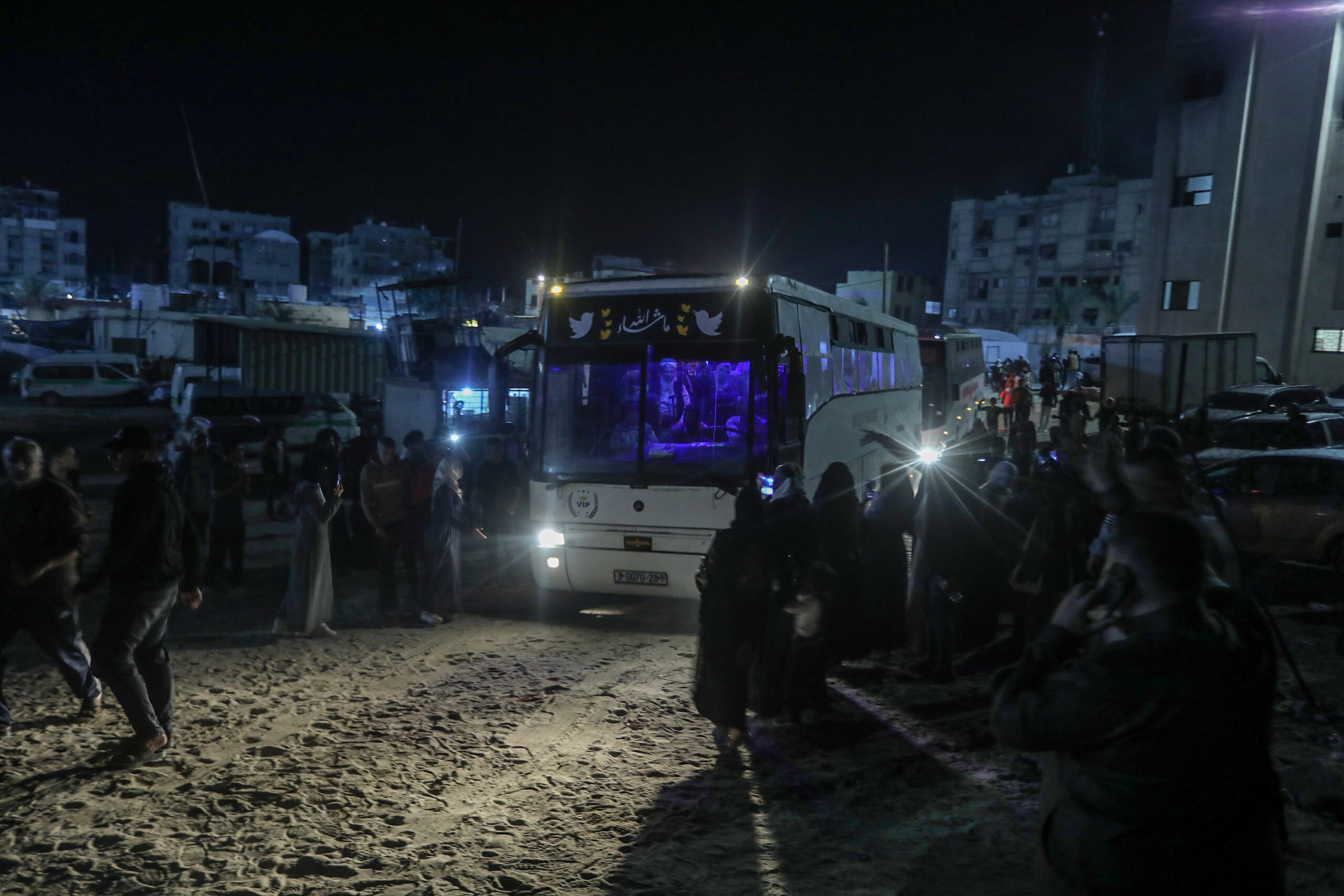
Humanitarian access is hampered by this impasse. The Board of Peace reports that aid diversion has fallen to about 1% and that the number of people receiving food assistance rose to roughly 2 million. Yet whether aid reaches agreed levels cannot be settled with current data. The Coordinator of Government Activities in the Territories (COGAT), the Israeli defense ministry unit tasked with overseeing civilian policy in the West Bank and coordinating Israel-Gaza logistical activities, reported in December 2025 that 600 to 800 humanitarian trucks were entering the strip daily. Palestinian crossings data for early October record between 829 and 1,446 trucks a week in total, or roughly 118 to 207 a day, most of them commercial. In the week of October 9-15, 955 trucks entered, 530 of them carrying aid. In the week of October 23-29, 746 trucks entered, 400 of them commercial and 296 carrying aid. The figures tabulate different things, and no body is mandated to reconcile them. Composition matters too. On October 2, the World Health Organization (WHO) representative for the Palestinian Territories said that no hospital in Gaza was fully functional and that medical supplies faced a median wait of 74 days for Israeli clearance. Israel states that its restrictions keep items with potential military use from Hamas.
| Box 2. The Dual-Use List in Practice |
| Israel restricts the entry into Gaza of goods it classifies as “dual use”: civilian items it says Hamas could put to military use. The operative list is not published in full, changes frequently, and, aid groups say, is applied inconsistently. Items held up or barred have ranged from generators and metal pallets to prosthetics and, according to aid workers, goods as ordinary as shampoo and diapers.
Clearance is slow and unpredictable. Medical supplies wait a median of 74 days for Israeli approval. Most medicines are eventually approved, by WHO’s count almost 87% of requests, with just over 1% rejected (WHO did not say how many of the rest were still pending), but one shipment of prosthetics was rejected four times in six months. The system is also asymmetric. Commercial traders authorized by Israel have been able to bring in some items barred to humanitarian organizations, paying coordination fees that traders put at tens of thousands of dollars per truck, costs passed on to Gaza’s consumers. Israel says the restrictions keep material from reaching Hamas and that it offers aid groups alternatives to restricted items. For policymakers, three practical questions follow: whether the list can be published, whether clearance can be bound to fixed timelines, and whether rejected items can be appealed through a transparent process. |
In mid-October, the Board of Peace’s public posture shifted in a more assertive direction vis-à-vis Israel. On October 14, COGAT suspended coordination of private-sector goods after Gaza merchants stopped coordinating shipments, citing Hamas’s alleged imposition of a fee of 10,000 shekels per incoming truck and a demand that part of their sales be made in cash. Hamas said the payment was a voluntary contribution and denied coercing merchants. The board’s high representative for Gaza, Nickolay Mladenov, called the intimidation of merchants “unacceptable.” In a letter to the head of COGAT on October 18, he also asked Israel to “immediately allow” the technocratic committee and the stabilization force into Gaza, to approve a pilot administrative and housing project in a part of Rafah under Israeli control with no Hamas presence, and to work with the Board of Peace on a new mechanism for commercial goods. The pilot, which the board approved in July, would shelter tens of thousands of displaced Palestinians in temporary housing near Rafah, with everyone entering subject to a security screening. The stabilization force and Israeli-vetted Palestinian police would provide security, and the NCAG would help run it, as a test of arrangements that could later extend to the rest of Gaza. The same report notes that only eight merchants have been allowed to apply to bring goods into Gaza since the cease-fire, against about 1,500 before the war. On October 19, COGAT announced that coordination would resume gradually, with tighter oversight of payments. The episode showed both the cost of the NCAG’s absence and a Board of Peace more willing than before to press Israel in public.
Security and Decommissioning
The roadmap of July 30 was the most important attempt yet to break the deadlock over disarmament. Hamas and most other factions accepted it, though Palestinian Islamic Jihad voiced reservations. Under its terms, heavy weapons, production sites, depots, and tunnels are to be decommissioned by the NCAG in stages linked to a phased Israeli withdrawal. Personal weapons are to be registered under Palestinian law. No weapons are to be handed to Israel, and an International Verification Committee is meant to certify each step. Critically, the text leaves open whether “decommissioning” means controlled storage inside Gaza or removal from it. Nonetheless, on August 26, High Representative Mladenov told the UNSC that the factions had for the first time agreed, in principle, to surrender their weapons and transfer civilian and security authority.
The supposed breakthrough had in fact already been deteriorating for weeks. Israel rejected the roadmap in early August, insisting on complete disarmament before any withdrawal. That objection has a real basis. Israel has little reason to take a Hamas pledge on trust, and a tunnel network that Hamas itself put at about 500 kilometers before the war, and whose full extent Israeli forces have yet to establish, makes any decommissioning exceptionally hard to verify or enforce. On August 3, after Mladenov met with Prime Minister Netanyahu, the Board of Peace stated that Israeli withdrawal beyond the Yellow Line, the line to which Israeli forces pulled back when the October 2025 cease-fire took effect, would take place “only once decommissioning is complete.” The roadmap promised reciprocity, but the board had instead adopted the sequencing of one party. On August 17, US Special Envoy Jared Kushner said Gaza would not be rebuilt before Hamas’s demilitarization and gave the militant group 60 to 90 days to begin surrendering weapons and tunnels. That window ran from mid-October to mid-November and has closed with no handover of weapons publicly reported. On November 9, the board said Israeli delays had “significantly delayed the start of the decommissioning of weapons,” while also faulting Hamas for failing to lay down its arms and relinquish authority. Israel asserts Hamas is rearming and has intensified strikes on its commanders, killing at least 20 Hamas members in September. Hamas denies rearming. On October 3, the Israeli military said it had targeted Ali al-Amoudi, the deputy head of Hamas’s political bureau in Gaza, in a strike in Gaza City; the result was not confirmed.
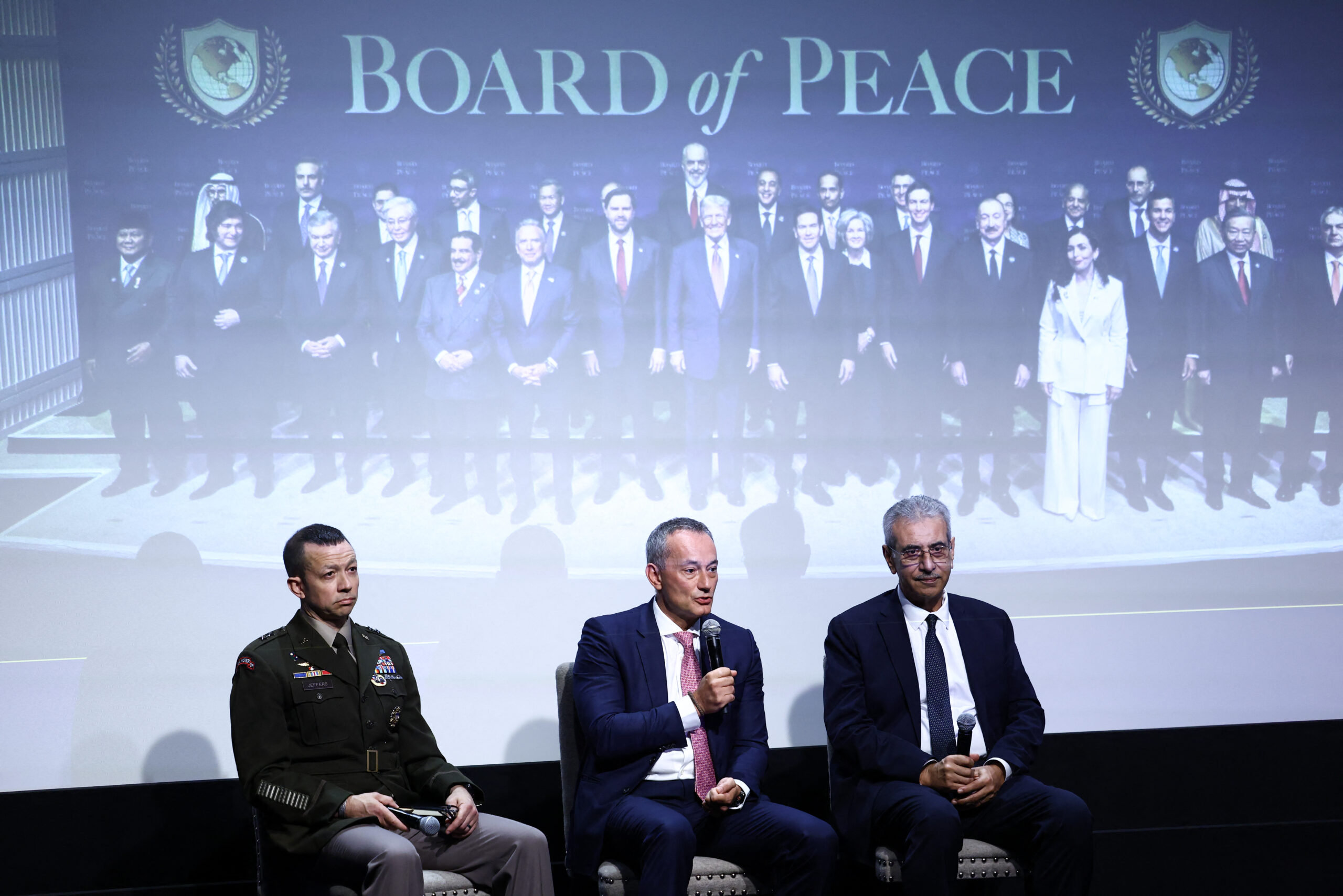
The ISF has not deployed. Its US commander, Major General Jasper Jeffers, was appointed in January. At the Board of Peace’s first meeting in February, Indonesia, Morocco, Kazakhstan, Kosovo, and Albania pledged troops, with deployment planned first in Rafah and an eventual strength of about 20,000. Indonesia, the largest prospective contributor, paused its deployment of up to 8,000 personnel on March 17, citing escalating regional security risks. Uganda has since joined the list of contributors, and an initial contingent of about 500 troops from Morocco and Kosovo is planned; reportedly, an unspecified number of Moroccan personnel have already received US-led training. The board’s May 15 report to the UNSC ties deployment to decommissioning; the roadmap limits the force to a buffer role and excludes it from policing. Israel’s security cabinet approved the limited entry of the force for a pilot project in Rafah on July 26, reportedly for up to 200 troops from “friendly countries.” Yet by August 20, the prime minister’s office said the political echelon had not approved the force’s entry and that there would be no reconstruction before Hamas was fully disarmed. In mid-October it emerged that Israel had not allowed a US contractor, hired by the Board of Peace in August, to begin building a base for about 150 international troops; board officials expect a decision now that the Israeli election is over. Israel has also barred Palestinian police recruits it had vetted, about 16,500 according to officials, from leaving Gaza to train in Egypt. On November 9, Israeli media reported that the government had authorized the United States to deploy an initial multinational force of about 250 foreign troops and that an Israeli base near the border had been handed over to US forces and converted into a secured facility. But these international forces have yet to deploy inside Gaza.
Security is not the only thing that matters in Gaza, but it is the first critical step, and nothing else in the plan moves without it. The NCAG cannot govern, donors will not rebuild, and Israel will not withdraw unless a force on the ground can prevent Hamas from rearming and reasserting control, and can hold the ground the IDF hands over. The ISF as currently envisioned cannot do that. US officials have said it will not fight Hamas, and the roadmap confines it to a buffer role. Contributors have set limits of their own: Pakistan has said that disarming Hamas would not be its role, and Azerbaijan stepped back rather than risk its soldiers on demilitarization. A force built of light contingents from Morocco, Kosovo, Albania, Kazakhstan, Uganda, and, if it returns, Indonesia would be asked to stand between a battle-tested militia with hidden stockpiles and an Israeli military that does not trust it. Even the United States, which leads the effort, has kept its own troops out of Gaza, stationing about 200 at a coordination center in Israel.
This is a flaw in the plan’s design as much as in its implementation. The plan assumed a stabilization force credible enough to make reciprocal steps safe for Israel, without committing the troops and equipment that would make it credible. Asking Israel to withdraw on the strength of such a force requires a leap of faith that no Israeli government, the outgoing one or the next, is likely to make. And few governments will commit troops to a mandate whose core task, separating forces during a phased withdrawal, depends on a sequence that one party has rejected. Meanwhile, there is no plan for a coalition or a Palestinian force to take over the policing role Hamas played on Gaza’s streets for nearly two decades, and the IDF continues to dominate Gaza’s perimeter and to strike inside it.
The Board, the Money, and Washington’s Architecture
The Board of Peace was conceived as a transitional authority for Gaza. Yet within weeks of Resolution 2803, it was recast as something larger. At the World Economic Forum, in Davos, on January 22, 2026, President Trump signed a charter turning the board into a standing international organization with a global remit. Under the charter, he serves as chairman with wide personal authority, including over the executive board that controls budgets and disbursements. Many governments, including several European ones, saw the expanded board as a potential rival to the United Nations. For Gaza, the expansion has diluted focus. International Crisis Group describes day-to-day decision-making concentrated in a small US team reporting to envoys who also carry the Iran and Ukraine files. Nor can that team draw on much of the expertise Washington once had on Gaza. The US Agency for International Development (USAID), which ran US assistance in Gaza for decades, formally closed on July 1, 2025, and the State Department dismissed more than 1,300 employees later that month. Both losses have reduced America’s capacity to manage a complex, long-term implementation effort.
The Board of Peace suffers from a gap between its objectives and the available financing to achieve them. Moreover, both fall short of Gaza’s needs: the United Nations, the European Union, and the World Bank estimate Gaza’s recovery and reconstruction will cost $71.4 billion over the next decade. At the board’s first meeting, on February 19, President Trump announced a US contribution of $10 billion, and members pledged further sums for a total of about $17 billion. By September 23, about $280 million had been transferred. The World Bank-administered trust fund envisaged in Resolution 2803 was reported in May to have received no deposits, with contributions pouring instead into a board account at JPMorgan. A source familiar with the board’s operations attributed part of the shortfall to the war with Iran, which “has affected everything.” The United Arab Emirates was among the few to deliver, reportedly sending $100 million for police training. In August, the Trump administration told Congress it was sending more than $206 million for the stabilization force.
The board additionally displays an accountability gap, operating largely outside the normal channels of oversight in Washington. The State Department notified Congress in April of a $50 million transfer for the board’s operating expenses. In June, the ranking member of the Senate Foreign Relations Committee, Senator Jeanne Shaheen, wrote that the department could not say whether standard monitoring would apply to US funds directed to the Board of Peace, and that Congress had “remained largely in the dark.” The board’s designation as a public international organization by executive order, without a treaty or an act of Congress, has raised legal questions. So has the absence of published audit, oversight, and conflict-of-interest rules. In a June 3 hearing of the Senate Foreign Relations Committee, Secretary of State Marco Rubio said the board “is now built out as an international non-governmental organization” and that the $50 million transfer had been reversed. The administration has thus described the board in two incompatible ways: by executive order, as a public international organization, a status that carries legal immunities; and before Congress, as a non-governmental organization. That it has not settled which the board is, is itself evidence of the accountability gap.
Where It Reversed or Fell Short
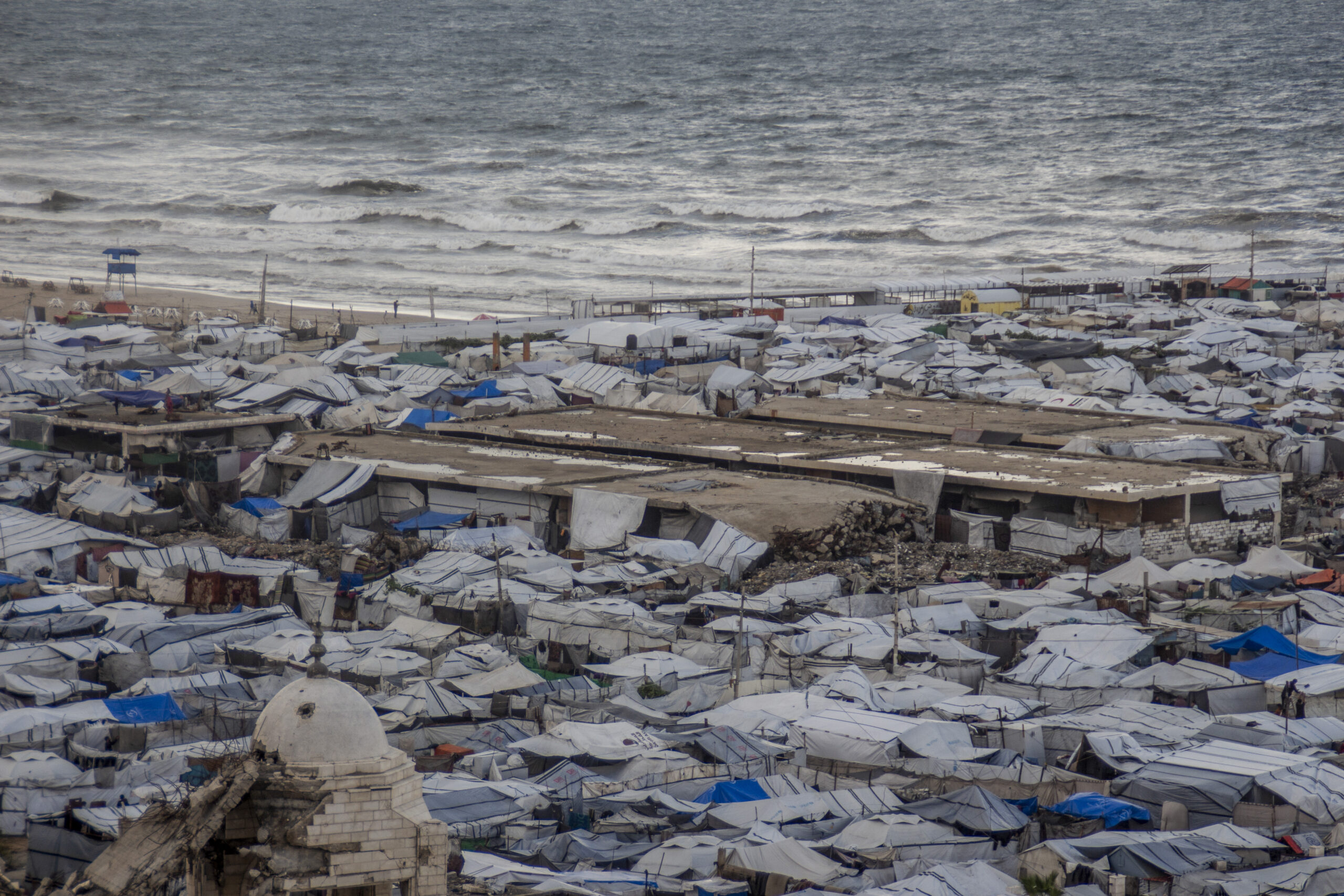
The plan’s most explicit commitment on territory is that “Israel will not occupy or annex Gaza” and that Israeli forces will withdraw “based on standards, milestones, and timeframes linked to demilitarization.” The first-phase line, known as the Yellow Line, left about 53% of Gaza under Israeli military control when the cease-fire began. But seven months later, on May 28, the Israeli prime minister directed the IDF to expand that control to 70%. Estimates of current Israeli control now range from about 60% to 70% of pre-war Gazan territory. The UN Office of the Coordinator for Humanitarian Affairs (OCHA) describes access-restricted areas covering about 65% of the strip, and the International Crisis Group estimated Israeli control at 65-70% in August. Nearly all of Gaza’s population is concentrated in the remaining third. The standards, milestones, and timeframes for Israel’s withdrawal have not been published.
Two commitments rated partially delivered, the cease-fire (point 3) and freedom of movement (points 8 and 12), have not reversed, but both fall well short of the text. The cease-fire has held as a framework but not as a cessation of violence. On November 7, the Gaza Ministry of Health reported at least 1,610 Palestinians killed and 5,819 injured since October 10, 2025; the UN Relief and Works Agency for Palestine Refugees in the Near East (UNRWA) put the figure at 1,394 on September 24. Most were killed in airstrikes or in shootings near the Yellow Line. The Israeli military reports at least four of its soldiers killed in the same period and attributes its strikes to Hamas violations of the truce. Both sides accuse the other of violations; no independent mechanism adjudicates them.
Movement out of Gaza remains minimal. The Rafah crossing reopened for people on February 2, 2026, and has operated intermittently since, mostly to enable the treatment of medical cases. It was closed to passengers from October 2 to 15. It was open to passengers on two days out of seven during the week of October 23-29; and on November 3, Israel turned back travelers and halted aid and commercial trucks entering from Egypt, citing alleged smuggling. The board itself has also said that it will not work with UNRWA, the largest UN operational presence in Gaza.
The Missing Political Track
Palestinian Politics
The 20-point plan conditions a “credible pathway to Palestinian self-determination and statehood” on reform of the PA and on Gaza’s redevelopment. The PA took several steps in this direction in 2026. Its president received a draft interim constitution in February, signed a new election law in June, and decreed legislative elections for November 28, the first since 2006. The election law required candidates to accept the Palestine Liberation Organization’s (PLO) political program, including the recognition of Israel, which made Hamas’s participation uncertain. In late September, Hamas, Palestinian Islamic Jihad, and the Democratic Reform Current of Mohammed Dahlan, the exiled former Fatah security chief in Gaza, were reported to be forming an electoral alliance around a list of independent candidates. Islamic Jihad confirmed the alliance; Dahlan’s spokesman neither confirmed nor denied it. Had it materialized, it would have marked a significant realignment of Palestinian politics.
On October 10, Palestinian President Mahmoud Abbas postponed the legislative elections to September 11, 2027, to be held together with a presidential vote. The PLO Executive Committee cited Israeli restrictions on election materials and observers in Gaza and East Jerusalem, military operations and settler violence in the West Bank, withheld tax revenues, and the lack of progress on reconstruction and the ISF. Israel’s foreign minister accused the Palestinian leadership of misleading the international community. Palestinian politicians, including Mustafa Barghouti, secretary-general of the Palestinian National Initiative and a long-standing advocate of elections, voiced deep disappointment. Restarting the process will need pressure in three directions: from Washington on Israel, to allow election materials and observers into Gaza and East Jerusalem; from the European and Arab donors who fund the PA, to hold to the September 2027 date; and from Egypt and Qatar on Hamas, to accept the terms of the election law or stand aside.
Hamas’s dissolution of its governing committee, even as Gaza’s ministries and their staff continue to operate pending a handover, and its acceptance of a decommissioning roadmap reflect a movement under severe pressure militarily, financially, and with its own public. A process able to verify and reward reciprocal steps could have turned those concessions into irreversible facts. Instead, the about-turn of the roadmap’s sequencing and the absence of a referee allowed both Hamas and its adversaries to keep alive a narrative of its continued strength. That narrative serves those who prefer the status quo, and it leaves Palestinians in Gaza without either governance or a political future.
The relationship between the PA and the NCAG remains undefined in the public texts. The roadmap requires the committee to operate under “Palestinian laws,” and its members have deep ties to PA ministries. But no published arrangement connects the committee in Gaza to the government in Ramallah, or either to an electoral calendar.
Developments in the West Bank bear directly on whether the PA could take over Gaza. The Palestinian administrative body is close to fiscal collapse. Israel has withheld all transfers of the clearance revenues it collects on the PA’s behalf, which make up about two-thirds of its income, since May 2025; the PA puts the withheld total at about $6 billion, and in April public employees were paid only part of their January salaries. Violence and displacement have risen. The UN documented more than 1,430 settler incidents causing casualties or damage in 2026 by early August, and Israeli planning authorities advanced or approved about 12,360 settlement housing units, steps the UN says are “advancing de-facto annexation.” More than 33,000 residents of the Jenin, Tulkarm, and Nur Shams refugee camps remain displaced by an Israeli military operation launched in January 2025, which Israel contends targets armed groups. A Palestinian Authority that cannot pay its staff or protect its communities is poorly placed to take on Gaza, whatever reforms it adopts on paper.
Ultimately, the lack of a clear pathway toward a final end state that gives a stronger voice to the Palestinian people in Gaza, the West Bank, and East Jerusalem hampers efforts to build a new future where Palestinians are ruled by a government that is transparent, accountable, and responsive to its citizens.
The Regional Horizon
The plan’s 20th point commits the United States to establish a dialogue between Israel and the Palestinians on a “political horizon.” That dialogue has not been convened. Its absence matters beyond Gaza. Saudi Arabia has made clear that normalization with Israel requires a credible pathway to Palestinian statehood. But the fundamental challenge for the Trump administration as it moves closer to the start of its third year in office is that its actions in the 2026 Iran war have drained time, resources, and attention away from other priorities in the Middle East, including the efforts to follow through on its own vision outlined in the Board of Peace. At the same time, US engagement on Syria’s transition and on Israel-Lebanon talks has been among the more promising strands of regional policy. In particular, US efforts in Lebanon in the first two years of the Trump administration offer some possible lessons learned that could be useful for following through on the plan for Gaza in Trump’s two remaining years in office: the need to boost credible institutions that have some degree of popular support and legitimacy combined with pragmatic steps to improve security conditions on the ground. The June 26, 2026, trilateral framework established by the United States, Israel, and Lebanon is one example, at least on paper. It commits the parties to a “reciprocal, sequenced process,” in which areas cleared of Hizballah fighters and weapons are verified by mutually agreed third parties and handed to the Lebanese army as Israeli forces redeploy in stages. Its implementation has since stalled over the same sequencing dispute that froze Gaza’s roadmap: Israel conditions withdrawal on Hizballah’s disarmament, and Hizballah conditions disarmament on withdrawal. But the framework at least writes down the verified reciprocity that Gaza’s roadmap promised, and talks under it continued in October.
The lesson for Gaza is narrower: sustained, technically grounded diplomacy is necessary but not sufficient. It can write down a reciprocal sequence, as in Lebanon, but without a referee and leverage over both parties it cannot make that sequence happen. Without a political horizon, the plan asks Palestinians to accept security and governance arrangements whose end-state is undefined, and it asks Arab partners to fund reconstruction that could be destroyed in the next war.
What Year Two Requires
The Gaza plan does not need to be replaced. It needs an engine in the form of sustained senior US attention as well as a stabilization force that can provide security, a referee, a calendar, and a budget. Political change in Israel and the United States may make these easier to secure.
Shifting Political Tides in Israel and America
The October 27 elections in Israel and the November 3 midterm elections in the United States could create an opportunity for progress in Gaza, as could the lapse, in mid-November, of the Kushner window for decommissioning Hamas’s arms. The change in the composition of Congress, with Democrats having won control of both the House and the Senate, is very likely to usher in, from January 2027, a period of increased scrutiny of the Trump administration’s handling of the situation in Gaza and broader questions about the US-Israeli relationship. One issue worthy of further Congressional focus is sharper oversight of US financing for the Board of Peace and the opaque frameworks of that organization’s management, funding, and decision-making processes.
Israel’s October 27 election produced no majority for either leading electoral bloc. Sixty-seven members of the Knesset, a Jewish-led bloc of 48 and Arab-led parties with 19, recommended Gadi Eisenkot for prime minister, against 46 for Benjamin Netanyahu. On November 8, President Isaac Herzog formally gave Eisenkot the mandate, with up to six weeks to form a government. Eisenkot has made recognizing Hamas as a terrorist organization and committing to its destruction a condition for coalition partners. On November 11, he said Israel should not return to war in the coming weeks unless it faced an immediate threat. In the meantime, Washington has pressed the caretaker government: in a call on November 5, President Trump asked Netanyahu to move ahead with the Gaza plan, and four days later Israeli media reported approval of the first foreign troops. A change of government could reopen questions that the outgoing coalition treated as settled. Neither change, in Washington or in Jerusalem, would alter the 20-point Gaza plan’s basic architecture, but both would change the leverage available to implement it.
التوصيات
The following recommendations set out what each of the key stakeholders can do.
For the US Administration
- Build a stabilization force that can do the job. The ISF must be able to deter Hamas from rearming, to support decommissioning, including by force where agreed procedures fail, and to hold ground handed over by the IDF. That requires a capable lead nation or core group willing to accept those risks, ideally NATO members or partners with proven militaries, alongside Arab and Muslim contingents that give the force legitimacy with Palestinians; a mandate and rules of engagement written for that task; and US command, intelligence, surveillance, tunnel-detection, engineering, and logistics support. Washington should be prepared to put some of those enablers inside Gaza. Few states will take risks that the United States will not share, and Israel is unlikely to entrust its security to a force that Washington will not stand behind.
- Restore reciprocity. Return to the roadmap’s original logic, in which each verified step of decommissioning Hamas’s weapons triggers a verified step of IDF withdrawal, with the ISF taking over each area the IDF leaves, and publish the “standards, milestones, and timeframes” for withdrawal that the plan and Resolution 2803 require.
- Hold both parties to first-phase obligations. Aid volumes, the cessation of military operations, and access through Rafah are owed now and should not be held hostage to second-phase disputes, as the roadmap itself provides.
- Concentrate accountability. Designate a single senior official with the authority and staff to manage implementation day to day, rather than relying on envoys who carry several global files at once.
- Use the post-election window. Press the incoming Israeli government to allow the NCAG into Gaza and to approve the Rafah pilot, the first ISF base, and the exit of vetted Gazan police recruits for training as the first verifiable steps of year two.
For the Board of Peace
- Constitute the International Verification Committee. Establish an independent technical secretariat and publish its findings on the obligations of all parties.
- Prepare the NCAG to enter Gaza. Once Israel agrees, the NCAG should begin operations in Rafah within 90 days, with a funded first-100-days package and a working link to PA ministries and Gaza’s existing civil service.
- Open the books. Publish pledges against transfers and route funds through the World Bank-administered trust fund.
- Build a coercion-free supply channel. Agree with Israel and the NCAG on a goods mechanism that widens licensing beyond a handful of merchants and protects traders from coercion by any party.
For Mediators and Regional Partners
- Make the regional guarantee binding. Point 14 commits regional partners to guarantee that Hamas and the other factions meet their obligations and that Gaza poses no threat to its neighbors. Turn that guarantee into a written instrument tied to verification findings, and broker agreed categories for decommissioning weapons stocks before implementation begins.
- Let money follow progress. Condition reconstruction funding on verified steps rather than on completion of the whole sequence.
- Create a coalition for Palestinian statehood. Bring together regional governments and international partners in support of a pathway that leads to a two-state solution. In 2025, Saudi Arabia and France co-chaired a UN conference whose New York Declaration the General Assembly endorsed by 142 votes, and the United Kingdom, Canada, Australia, and France, among others, recognized a State of Palestine. But these steps provided little practical benefit to the Palestinian people.
For Congress
- Exercise oversight of US participation in the Board of Peace. Stricter Congressional scrutiny of Washington’s role in the board should cover the legal basis for the organization’s designation, audit and conflict-of-interest standards, and the use of US funds as a condition of further appropriations.
- Require regular reporting. The State Department should regularly inform Congress and the public on the implementation of the Gaza plan against defined benchmarks covering all parties.
For the Palestinian Leadership
- Clarify the links between the NCAG and the PA. Use the period to September 2027 to agree, through the national dialogue, on the relationship between the NCAG and PA institutions. Additionally, establish an electoral framework that can be implemented in Gaza, the West Bank, and East Jerusalem.
Three Scenarios to the End of 2027
The Board of Peace’s authorization under UN Resolution 2803 expires on December 31, 2027. Three broad trajectories are possible before then.
Managed Stalemate
The cease-fire framework persists. Israel holds most of the Gaza Strip, and Hamas holds the populated remainder. The NCAG stays in Cairo, and periodic strikes continue. Reconstruction remains confined to pilot projects in Israeli-held areas. Indicators that this scenario is underway would include no ISF deployment by early 2027; financial transfers to the Board of Peace remaining below $1 billion; and the board’s mandate renewal being debated without benchmarks. On current trends, this is the default.
Repaired Implementation
The verification committee is constituted, and a first reciprocal tranche is completed in the Rafah sector: weapons are registered and handed over, territory is transferred to an initial ISF contingent, and the NCAG enters to run services. Money begins to follow verified steps. Indicators of this scenario would include Israeli approval of the Rafah pilot and the first ISF base once a new Israeli government is formed; a published implementation calendar; NCAG’s presence in Gaza; and the first independently certified decommissioning of Hamas’s arms.
Return to Major War
With the decommissioning window lapsed and no progress, Israel resumes large-scale operations with US backing. Indicators of this scenario would include a US or Israeli declaration that the deadline has passed without a verified first step; renewed mass evacuation orders; and the suspension of Board of Peace activities or the withdrawal of the mediators.
Which trajectory prevails will depend less on new announcements than on whether the 20-point Gaza plan acquires the mechanics it has lacked: a force able to provide security, a referee trusted by both sides, a calendar that binds both sides, and a budget that is spent rather than pledged.
Conclusion
The Gaza plan put forward last year by the Trump administration ended the most destructive phase of the war and brought every hostage home. Those were real achievements, delivered through presidential attention and regional pressure. But the plan was written to achieve a transactional deal at a particular moment in time, and the hopes it also raised for a more fundamental transition that improves the lives of ordinary Palestinians in Gaza have not been realized. A year on, the institutions that were meant to carry Gaza from cease-fire to recovery exist mainly on paper, the territory under Israeli control has grown, and the Palestinian political horizon has receded. Above all, there is still no force able to provide the security on which every other step depends. The question for year two is not whether the plan survives but whether the political will and leadership that produced the significant accomplishment of the October 2025 cease-fire can be marshaled to follow through on the vision outlined at the outset, when the Board of Peace and its associated institutions were created.
Jaser AbuMousa and Brian Katulis are Senior Fellows at the Middle East Institute.
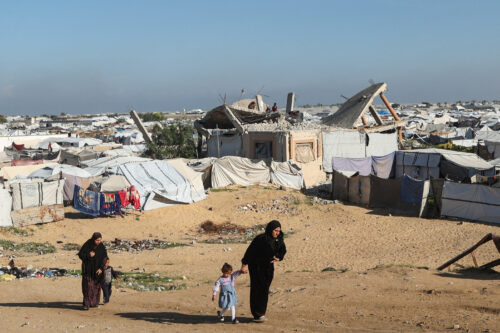
Main photo above: Palestinians walk past the rubble of destroyed buildings and displacement tents in Khan Yunis in the southern Gaza Strip on November 17, 2026. By Eyad Baba/AFP via Getty Images.
Acknowledgements
The authors would like to thank colleagues and peers who took time to review a draft of this report and offer comments, including Matthew Czekaj, Lucy Kurtzer-Ellenbogen, Yael Lempert, Kenneth Pollack, Natan Sachs, Alistair Taylor, and Rebekah Wharton.
الاستقلال الفكري
The Middle East Institute maintains strict intellectual independence in all of its projects and publications. MEI as an organization does not adopt or advocate positions on particular issues, nor does it accept funding that seeks to influence the opinions or conclusions of its scholars. Instead, it serves as a convener and forum for discussion and debate, and it regularly publishes and presents a variety of views. All work produced or published by MEI represents solely the opinions and views of its scholars. The views in this paper are reflective only of the authors’ analysis and perspective and do not necessarily represent the views of MEI.

The Human Story Behind Gaza: Jaser AbuMousa on the Costs of Survival for Palestinians

