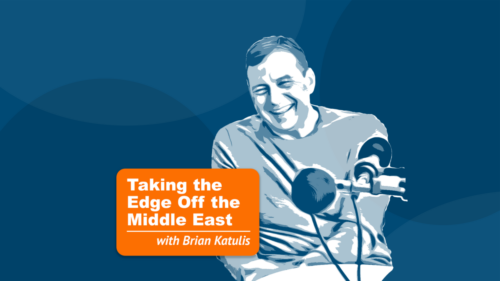
MEI Senior Fellow Brian Katulis engages friends, colleagues, and policy experts in casual conversations on the most important happenings in the Middle East.
Shiraz Maher – Co-Director of the International Centre for the Study of Radicalisation (ICSR) – and Charles Lister – Director of MEI’s Syria and Countering Terrorism and Extremism Programs – speak to MEI Editor in Chief Alistair Taylor about ISIS and the detainee dilemma. What is the international community to do with the tens of thousands of foreign ISIS detainees and their families, including children, held in makeshift facilities in northeastern Syria under the control of the Syrian Democratic Forces?
On this week’s episode, Director of MEI’s Syria and Countering Terrorism and Extremism Programs Charles Lister speaks with MEI Editor-in-Chief Alistair Taylor on the resurgence of the Islamic State, or ISIS, in Syria and Iraq. This episode is the first in a several-part series looking at where the terrorist group stands today and its international footprint 10 years on from the founding of the 87-country Global Coalition to Defeat ISIS.
Israeli Strikes and the Risk of Regional Escalation
This week’s episode looks at the dramatic regional developments of the past 24 hours, including the Israeli strike on a top Hezbollah commander in Beirut and the assassination of Hamas political leader Ismail Haniyeh in Tehran. The strikes mark a significant escalation, and are expected to provoke retaliation from Iran and Hezbollah that could potentially ignite a wider regional conflict.
Rethinking Democracy Ep. 3: Economic Conditions and Support for Democracy with Daron Acemoglu and Tamara Cofman Wittes
Authoritarian populism is on the rise around the world. Political scientists and policymakers are debating what’s driving this trend. Is it economic inequality, or a cultural backlash against social change that erodes trust in democratic institutions? Dr. Daron Acemoglu and Dr. Tamara Cofman Wittes join Gonul Tol to discuss the relationship between changing economic conditions and support for democracy.
On the Eve of the Washington Summit: Shoring up NATO’s Vulnerable Flanks
On July 9-11, Washington will host the leaders of NATO’s 32 member states for a special anniversary summit, celebrating 75 years since the Alliance’s founding. But the NATO heads of state and government are unlikely to spend much time reminiscing. Their agenda will be full, spanning from Ukraine, Russia, wars in the Middle East, China, terrorism, cyber threats, NATO enlargement, boosting Allied capabilities, freedom of navigation around the world, nuclear deterrence, and more.
Alex Vatanka (Director, MEI’s Iran Program) and Ali Afshari (Iranian political analyst and pro-democracy activist) discuss Iran’s snap presidential elections, set to be held on June 28th, following the sudden death of President Ebrahim Raisi in a helicopter crash last month. The 63-year-old regime loyalist was widely viewed as a leading potential successor to the Islamic Republic’s 85-year-old supreme leader, Ayatollah Ali Khamenei. The elections come as Iran faces a number of challenges both at home and abroad, ranging from long-running domestic economic troubles and preparations for an eventual leadership transition to the regional reverberations of the ongoing war in Gaza and the tit-for-tat exchange of missile and drone strikes with Israel in April.
Migration in North Africa: EU Engagement & Policies
MEI’s North Africa & the Sahel Program Director Intissar Fakir and Guillaume Soto-Mayor discuss Soto-Mayor’s paper “Libya, Tunisia, and Niger as Case Studies for Counter-Productive Anti-Migration Policies” – including how EU policies reinforce criminal patterns and empower illicit networks in these areas.
American Diplomacy Toward Lebanon With Amb. David Hale
Ambassador David Hale joins MEI’s US-Lebanon Fellow Fadi Nicholas Nassar to discuss his book American Diplomacy Toward Lebanon: Lessons in Foreign Policy and the Middle East. They cover takeaways from his time as ambassador and the state of US-Lebanon and regional diplomacy following the Gaza war.
Deterrence Reasserted? Debating Iran's Missile Capabilities and Willingness to Use Force
On this week’s episode, David DesRoches and Abdolrasool (Farzam) Divsallar, a Non-Resident Scholar with MEI’s Iran Program, speak to MEI Managing Editor Matthew Czekaj on Iran’s April 13 missile and drone attack on Israel and what it reveals about both countries’ attack and deterrence capabilities.
On this week’s episode, Jehanne Henry, Mirette Mabrouk, and MEI Editor-In-Chief Alistair Taylor discuss Sudan’s civil war and its regional impact. The conflict began on April 15th, 2023, when fighting broke out in Sudan’s capital of Khartoum between the Sudanese Armed Forces (SAF) under Gen. Abdel Fattah al-Burhan and the paramilitary Rapid Support Forces (RSF) under Mohamed Hamdan Dagalo (known as “Hemedti”). More than a year on, the fighting continues to rage and there seems to be no end in sight to the conflict.
Rethinking Democracy Ep. 2: What is the Rule of Law? With Thomas Carothers and Vali Nasr
According to the World Justice Project, 2023 was the sixth year in a row in which the rule of law has declined in most countries. The rule of law is a cornerstone of democratic societies – promoting fairness and ensuring accountability. Thomas Carothers and Vali Nasr join Gonul Tol to answer the questions: What is the relationship between the rule of law and democracy? Why is the rule of law challenged in places like the Middle East, and can the West help advance it?
Opposition Upset Victory in Turkey's Local Elections
On this week’s episode, Murat Somer – Professor of Political Science and International Relations at Istanbul’s Ozyegin University – and MEI Turkey Program Director Gonul Tol join MEI Editor-in-Chief Alistair Taylor to discuss the main opposition party’s surprising victory in Turkey’s March 31 local elections. In what some are calling a “red wave,” the Republican People’s Party (or CHP) notched up victories in both major cities and smaller towns and villages, winning control of Turkey’s 5 largest metropolitan areas and 35 of its 81 provincial municipalities.
Rethinking Democracy, Ep. 1: Why Does Democracy Flourish? With Francis Fukuyama and Paul Salem
The world’s oldest democracy is in trouble. According to a study by the Public Religion Research Institute and the Brookings Institution, 75% of Americans believe that “the future of American democracy is at risk in the 2024 presidential election.” We often debate why democracies die because we assume that authoritarian power is the exception and democracy is the norm. But history says otherwise. Francis Fukuyama and Paul Salem join Gonul Tol to answer the question: Why has democracy flourished in certain countries and regions and not in others?
The Evolving Conflict Between Hezbollah and Israel
MEI’s US-Lebanon Fellow Fadi Nicholas Nassar and Emile Hokayem – Director of Regional Security at the International Institute for Strategic Studies – discuss the changing and uncertain rules of engagement between Hezbollah and Israel, and the potential for war between the two following Oct. 7.
Interview With Rashid Al Khalifa – Bahraini Artist, Collector And Founder of RAK Art Foundation
Director of MEI’s Arts & Culture Center Lyne Sneige interviews HH Sheik Rashid Al Khalifa – artist, collector and founder of the RAK Art Foundation and a participating artist in MEI’s current exhibition “The Sea of Life: Modern and Contemporary Art from The Kingdom of Bahrain”