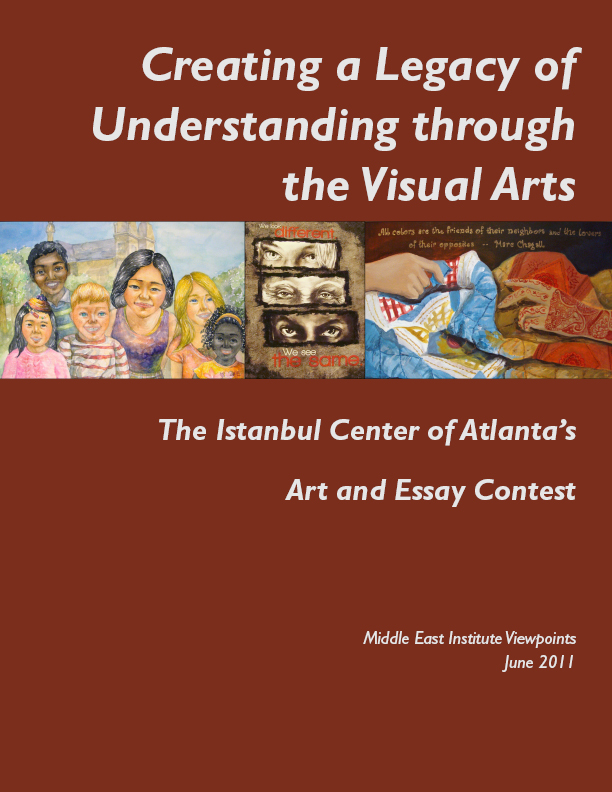
Creating a Legacy of Understanding through the Visual Arts: The Istanbul Center of Atlanta's Art and Essay Contest
This volume has been prepared for the Middle East Institute’s Viewpoints collection. Several stakeholders in the Istanbul Center of Atlanta’s Annual Art and Essay Contest have been involved in the composition of this text. Our goal is to provide a history of this successful program, as well as to define a model for the recreation of such an outreach project for other regions.
In the early 1970s, I taught art classes in three elementary schools in Phoenix, New York. After enduring long snowy and cold winters for ten years, I moved to the Atlanta, Georgia area where the sun shines almost every day. There, I re-entered the field of education, teaching art for Cobb County Schools for 17. During this time, I shared original programs and curriculum in workshops and lectures held at international, national, and state conferences.
Cooperation over Nile Waters: Needed More under Climate Change, More Attainable after the "Arab Spring"?
2011 marks the beginning of a new era for both Egypt and Sudan, opening new possibilities to overcome the decade-old Nile water conflict. After the revolution in Egypt, many hope for a reorientation of the country’s foreign policy towards Africa and a potential new approach to negotiations on allocation of the Nile waters.
Environment and Sustainable Development in the Maghreb
The Maghreb extends about 2,000 kilometers on either side of the Greenwich meridian (-13° West from Cabo Jubi and 11.08° East to Kelibia) and is located on the same longitude as Europe. Although the Maghreb forms a single climatologic and geographical unit, it is a diverse landscape of mountains, fertile areas, and steppes. Nevertheless, the similarity of climate, geography, and culture in the Maghreb provides a solid foundation for developing a common environmental strategy.
Middle East Revolutions: An Environmental Perspective
Most of the numerous articles written about the ongoing revolutions in the Middle East have focused on their political and/or economic causes and likely consequences. However, environmental and natural resource-related issues, which are also at the center of these revolutions, have received little or no attention.