The Jordan Valley is a lush, wetland ecosystem that is the biological heart of the Middle East region at large. As the meeting point of the Asian, African, and European continents, the valley is at the crossroads of biodiversity. In addition to the unique flora and fauna, the valley is one of the world’s most important migratory pathways for birds. Over 500 million birds migrate from Europe to Africa twice a year, dependent on the Jordan Valley as a stopping ground on their long journey.
US Relations with Pakistan: The Need for a Strategic Shift
Originally posted May 2008
Pakistan has come to reflect and affect many of the critical issues in South Asia that worry the US foreign policy establishment, the media, and the public. But US officials are crafting policy responses to deal with Pakistan that are focused excessively narrowly on a single issue — the war on terrorism. In addition to exacerbating Pakistan’s own problems, these efforts have undermined Pakistan’s capacity and political will to fight this war. As a consequence neither America’s nor Pakistan’s best interests are being served.
Within a mere few years after World War II the Middle East was remade. The creation of the State of Israel in 1948 and its consequences helped propel that part of the world to what seems to be a permanent and unenviable spot on any list of world crises.
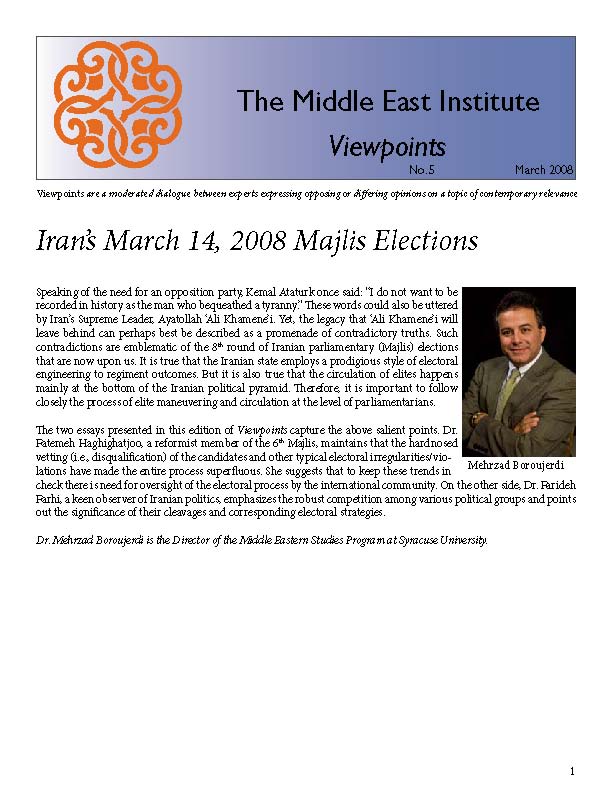
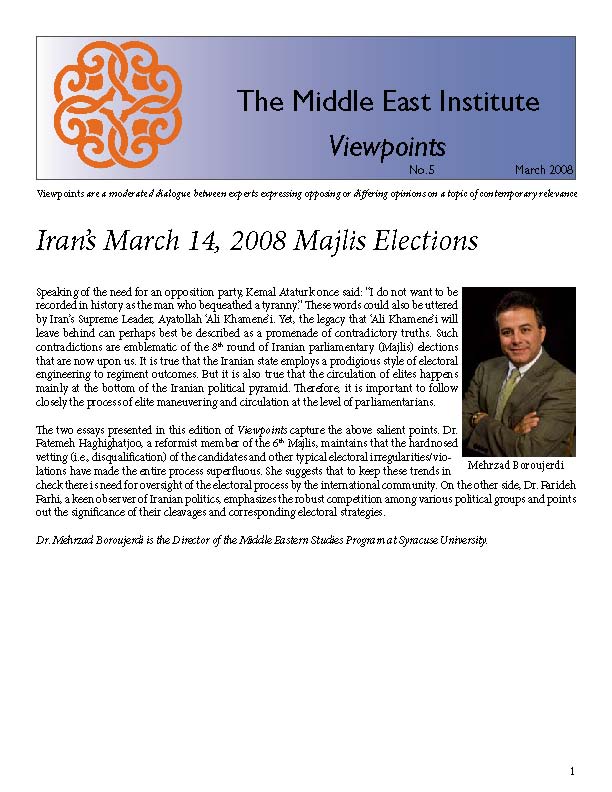
One of the strangest features of contemporary Iranian politics must surely be the reality that despite the concerted and successful effort to narrow the range of candidates allowed to run for various political offices, competition among individuals and groups has not only remained unabated, it has intensified. The elite jockeying that has taken place in the past few months, leading to the upcoming March 14 Majlis elections, is a good example of the competitive intensity that had come to characterize Iranian politics.
On January 3, 2008, Iran’s supreme leader, Ayatollah ‘Ali Khamene’i once again sought to remind domestic and foreign audiences about his stature in Tehran. Stating that “cutting off relations with the US” was one of the “principal policies” of the Iranian government, but that he would be the “first person to endorse these relations” if it benefited the Iranian people, Khamene’i secured news headlines.[1]
Many Americans, Israelis, and Palestinians are convinced that the Israeli-Palestinian conflict is intractable because neither side has abandoned the goal of defeating the other, and neither really believes in compromise. This is a myth.
Even the most skeptical of us would have to concede that things are better now than they were a few months ago, as they hasten to add that we have been here before and that this too shall pass.
Yes, things are better: Palestinian and Israeli officials are talking, and not about the weather. Final status issues are being discussed, though they are not being resolved.
Last month, I spent seven days in an Israeli living room, sitting “shiva” with my family to mourn the loss of a relative. Hundreds of people came to visit. Hundreds of conversations unfolded on almost any topic imaginable. One of the purposes of the shiva is to distract mourners from their loss through engagement with the living in conversations on the mundane.
Many Americans, Israelis, and Palestinians are convinced that the Israeli-Palestinian conflict is intractable because neither side has abandoned the goal of defeating the other, and neither really believes in compromise. This is a myth.