Hezbollah and the Next War with Israel
Audio recording from Hezbollah and the Next War with Israel
Audio recording from Human Rights and Zionism in Israel
Audio recording from An Exploration of Egyptian Sufi Musical Traditions
The Middle East Institute is pleased to host Egyptian journalist Ashraf
Khalil for a discussion of his new book, Liberation Square: Inside the
Egyptian Revolution and the Rebirth of a Nation, and the political
landscape in Egypt on the first anniversary of the revolution. This
book is the first account of the Tahrir Square uprisings from someone
who was on the ground and witnessed the protests firsthand. Ashraf
Khalil will analyze the status quo in Egypt today and reasons for both
Podcast for “Egypt’s Unfinished Revolution: One Year Later”
Ashraf Khali
10 Feb, 2012
The Israeli Peace Initiative (IPI) calls upon the Israeli government to
present a framework for the conclusion of the Israeli-Arab conflict as
a comprehensive response to the 2002 Arab Peace Initiative.
The Israeli Peace Initiative (IPI) calls upon the Israeli government to present a framework for the conclusion of the Israeli-Arab conflict as a comprehensive response to the 2002 Arab Peace Initiative. Israeli Peace Initiative signatories include former Israeli Defense Forces chiefs of staff Amnon Lipkin-Shahak and Amram Mitzna; former Shin Bet directors Jacob Perry and Ami Ayalon; Ha'aretz correspondent Akiva Eldar; Members of the Knesset (MKs) Dalia Rabin and Colette Avital; and many other distinguished Israelis. Mr.
Ilan Peleg and Dov Waxman, authors of the book Israel's Palestinians:The Conflict Within (Cambridge, 2011), discuss their findings. One in five citizens of Israel are Palestinian. Often overlooked by outside observers, the challenges facing the Palestinian minority in Israel are an inseparable part of the Israeli-Palestinian conflict. Resolving this conflict – a central concern of U.S. foreign policy and current international diplomacy – requires more than the establishment of a Palestinian state. The demands of Palestinian citizens of Israel must also be addressed.
MEI Annual Banquet
Wednesday, November 16, 2010
6:00 pm to 10:00 pm
Award Recipient – Issam M. Fares Award for Excellence
H.E. Amb. Lakhdar Brahimi
The Arab Spring: Implications for US Policy and Interests
*This Opinion first appeared in the Huffington Post on December 13, 2011
The first free and by all accounts fair elections in Egypt mark a major turning point in the country's long history. In what is likely to be a tenuous and trying transition to democracy, Egypt's Islamists won a resounding victory, gaining two-thirds of the vote in the first round of Egypt's parliamentary elections. While many in the West fear that the Islamist victory in this first election will radicalize Egypt, in reality, the situation is far more complex and nuanced.
This Opinion first appeared in the Huffington Post on November 11, 2011
On November 28th, millions of Egyptians will finally breathe a deep sigh of relief as they gather at the polls to vote in the first phase of parliamentary elections following the ousting of the Mubarak regime.
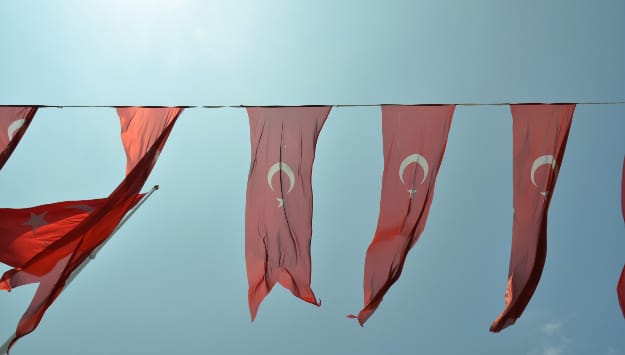
The trilateral relationship between Turkey, Israel and the United States has deteriorated in recent years as Israel's and Turkey's foreign policy goals in the Middle East continue to diverge. Despite repeated attempts, the United States has failed to reconcile these two important regional allies since the divisive Mavi Marmara incident in May 2010. MEI and The Stimson Center held a discussion of this critical yet troubled trilateral relationship in a time of unprecedented change in the Middle East featuring Prof. William B. Quandt, Edward R.
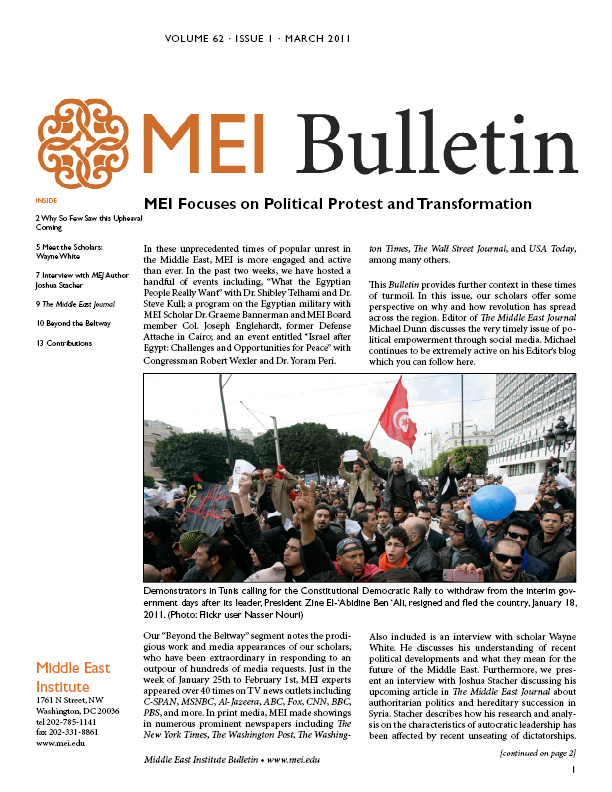
Amidst the historic turmoil sweeping across the Arab world, in the March 2011 Bulletin, MEJ editor Michael Dunn addresses political empowerment through social media, scholar Wayne White is interviewed on recent political developments, and Joshua Stacher previews his forthcoming article on authoritarian politics and hereditary succession in Syria.