This text has been translated by AI and may contain errors.
Skip to Content

Research & Commentary Results

Filter by
8738 Results
And now what? A realistic approach to the Israeli-Palestinian impasse
Thousands of protesters gather at Al-Manara Square to protest against U.S. President Donald Trump's Middle East plan, in Ramallah, West Bank on February 11, 2020.
  • Analysis
  • And now what? A realistic approach to the Israeli-Palestinian impasse

    The announcement of Donald Trump’s “deal of the century” was a rude shock, roundly condemned by almost everyone concerned with peace and justice between Israelis and Palestinians. But it also presents an urgent challenge for all those who reject it because they realize the dire implications of what it portends for the future of any peaceful negotiated solution. If a genuine two-state solution is truly dead, and an equitable one-state solution is even harder to achieve, then where does that leave us? What is, or should be, the agenda for the foreseeable future for those concerned with the Israeli-Palestinian issue.

    March 2, 2020

    Syria: What the US could do
    A Turkish soldier stands in front of a military vehicles convoy east of Idlib city in northwestern Syria on February 20, 2020 amid ongoing regime offensive on the last major rebel bastion in the country's northwest.
  • Commentary
  • Syria: What the US could do

    Turkey is running out of options in Idlib Province and in Syria. Aggressively taking on a task that is beyond its capabilities, the government in Ankara now is faced with doubling down on a high-risk gamble, hoping someone, somewhere will believe its bluff, or saving Turkey and the area from worse destruction. There are two things the U.S could do, working together with the EU, NATO, and the UN.

    Battered Survivor: Hezbollah at Home and Abroad
    Supporters shout slogans during a rally for Qassem Soleimani in southern suburbs of Beirut, Lebanon, on Jan. 5, 2020. Hezbollah leader Sayyed Hassan Nasrallah urged on Sunday its fighters to attack U.S. soldiers in the region in retaliation for the assassination of Iranian top commander Qassem Soleimani by the United States. (Photo by Bilal Jawich/Xinhua via Getty) (Xinhua/ via Getty Images)
  • Analysis
  • Battered Survivor: Hezbollah at Home and Abroad

    The past decade and a half have been a real whirlwind for Hezbollah, but the group seems to have weathered all of these storms, at least for now. However, it’s one thing for Hezbollah to survive and another altogether for it to thrive. In a special roundtable report from MEI, renowned Hezbollah analysts offer their perspectives on a series of key questions about the major upcoming challenges facing the group. This report includes contributions from Bilal Y. Saab, Nicholas Blanford, Nizar Hamzeh, Matthew Levitt, Magnus Ranstorp, Bruce Riedel, Randa Slim, and Michael Young.

    February 28, 2020

    “People can’t even afford to buy bulgur”: Discontent is on the rise as Syria’s economic crisis worsens
    Shoppers walk through the Bzourieh market in the centre of the Syrian capital Damascus on September 11, 2019.
  • Analysis
  • “People can’t even afford to buy bulgur”: Discontent is on the rise as Syria’s economic crisis worsens

    The latest economic crisis in Syria is hitting the population hard. Syrians have been beset by currency depreciation, soaring prices for basic goods, and energy shortages that have left people to freeze in the harsh winter, leading to growing and increasingly vocal discontent.

    February 28, 2020

    A wake-up call: The Idlib crisis and its effects look set only to worsen
     Irregular migrants escaped from civil war in Syria, who want to proceed to Europe, are seen after they came with a boat at a shore in Lesbos Island on Greece on February 28, 2020.
  • Analysis
  • A wake-up call: The Idlib crisis and its effects look set only to worsen

    The death of at least 33 Turkish soldiers and wounding of 60 more in Syria’s Idlib on Thursday night was a game-changing development. The crisis there and its effects represent an existential threat to Turkish President Recep Tayyip Erdogan and for now, it appears likely that Turkey will remain alone in dealing with the crisis. That presents us with two possible scenarios, both bleak. If the world wants to avoid a true nightmare from becoming reality, it needs to wake up and get engaged.

    Will Iran replace its presidency with a parliamentary system?
    Iran's President Hassan Rouhani delivers a speech presenting the Islamic republic's new budget for the financial year starting late March 2020 in Tehran on December 8, 2019.
  • Analysis
  • Will Iran replace its presidency with a parliamentary system?

    The results of Iran’s recent elections and preparations for the succession of Ayatollah Khamenei as supreme leader could mean that the topic of replacing Iran’s presidential system with a parliamentary one may very well be up for discussion again.

    February 27, 2020

    Regional security from the ground up
    Middle East map
  • Analysis
  • Regional security from the ground up

    U.S. Middle East policy tends to elicit the most heated debates in Washington. But if there’s one issue on which there’s near unanimous consensus it is that the region is in desperate need of a new security architecture that ideally would generate stability but more realistically reduce tensions and the risk of hostilities and escalation. Even regional antagonists agree that the time to form such an architecture is now.

    February 27, 2020

    Geopolitics and propaganda: Lessons from the Black Sea
    The Triumphal arch opposite the Government House in central Chisina, the capital of Moldova.
  • Analysis
  • Geopolitics and propaganda: Lessons from the Black Sea

    Since Russia’s 2014 annexation of Crimea, malign foreign influence within EU countries has been the subject of considerable scrutiny. What lessons can be learned from comparing EU and NATO members Romania and Bulgaria with partner countries Moldova and Georgia?

    If the West leaves Idlib to Russia and Assad, it won’t be only Syrians who pay the price
     Syrian child poses at a camp hosting Syrian families, who have been forced to displace due to the attacks carried out by Assad regime and Russia, in Idlib, Syria on January 10, 2020.
  • Analysis
  • If the West leaves Idlib to Russia and Assad, it won’t be only Syrians who pay the price

    If Assad and the Russians are not reined in and are instead allowed to conquer Idlib — and the more than three million people trapped there — the results could be catastrophic, leading to massive displacement and loss of life.

    February 27, 2020

    Russia’s Middle East: You probe with bayonets. If you find mush, you proceed …
    Mural of Vladimir Lenin
  • Analysis
  • Russia’s Middle East: You probe with bayonets. If you find mush, you proceed …

    This paper looks at the 2018 U.S. National Defense Strategy (NDS), and the Irregular Warfare Annex (IWA) to that guiding document, with recommendations on how to better implement the strategy. It also analyzes the current Russian way of conducting irregular warfare by reviewing their actions in Ukraine, Syria, and Libya.

    Algeria's National Protest Movement
    Middle East Institute
  • Podcast
  • Algeria's National Protest Movement

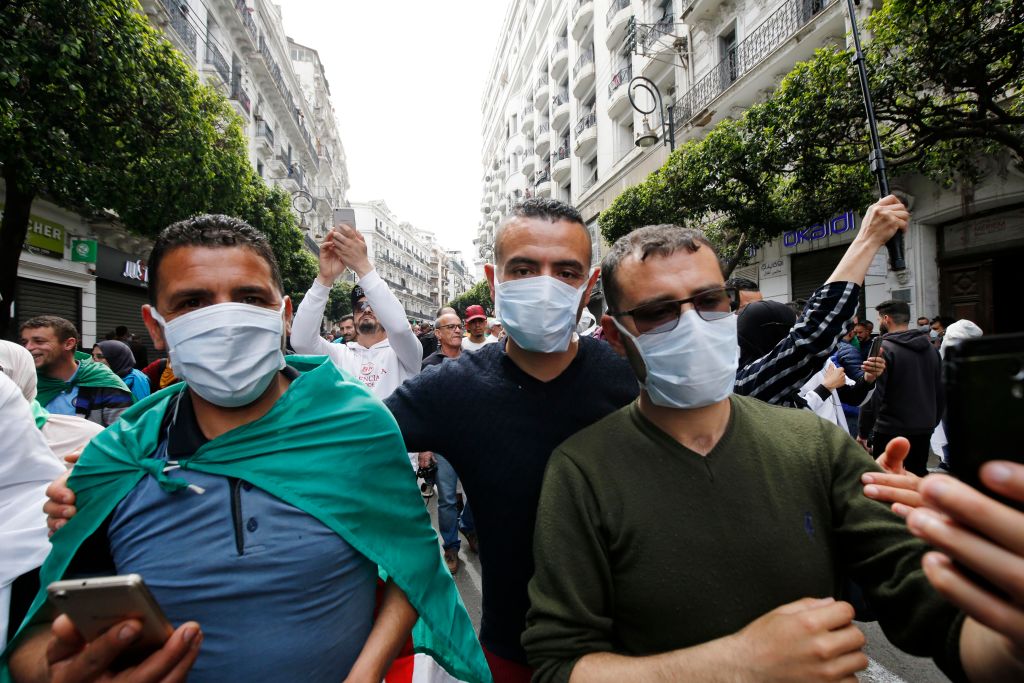
    Amel Boubekeur, Robert S. Ford, and Dalia Ghanem join host Alistair Taylor to discuss the huge national protest movement, known in Arabic as “Hirak,” that has brought millions of Algerians to the streets over the past year. The movement has pushed for sweeping reforms of the political system and a change in the ruling elite, leading to the resignation of long-time President Abdelaziz Bouteflika in April 2019.

    February 26, 2020

    Community Policing in the Middle East and Africa: A Matter of Context?
    (AWAD AWAD/AFP via Getty Images)
  • Analysis
  • Community Policing in the Middle East and Africa: A Matter of Context?

    This article explores some of the challenges associated with introducing what is, in effect, a “Westernized” community policing concept to the Middle East and Africa. The authors are practitioners in this area from Northern Ireland and Jordan having in excess of 50 years policing experience between them. They have advised upon, trained and implemented programs on “Community Policing and Engagement” in the Middle East (Jordan, Qatar, Lebanon) as well as in the Horn and South East Africa, Central Asia, Eastern Europe and the Balkans. They argue that more attention needs to be paid to basic context setting and understanding of the perceptions of the beneficiary state and communities therein on, what can be, an alien concept of Community Policing/Engagement and Outreach. They further argue that problem solving and informal justice/dispute resolution mechanisms in the Middle East, Horn and Sub-Saharan Africa can form part of a new and bespoke package “fit for purpose” in these contexts. 

    February 26, 2020

    The UAE may have withdrawn from Yemen, but its influence remains strong
    Fighters with the UAE-trained Security Belt Forces loyal to the pro-independence Southern Transitional Council (STC) man a checkpoint near the south-central coastal city of Zinjibar in south-central Yemen, in the Abyan Governorate, on August 21, 2019.
  • Analysis
  • The UAE may have withdrawn from Yemen, but its influence remains strong

    On Feb. 9, 2020, after five years of involvement in Yemen’s civil war as part of the Saudi-led coalition, the UAE’s leadership celebrated the completion of its phased military withdrawal from the country in a ceremony at Zayed Military City. Although the UAE’s withdrawal has provided an exit strategy from the stalemate in Yemen, it neither suspends Abu Dhabi’s role in the coalition nor curtails Emirati influence on the ground.

    February 25, 2020

    Obstacles to the implementation of the Riyadh Agreement
    Yemeni Deputy Prime Minister Ahmed Saeed al-Khanbashi (R) and Southern Transitional Council (STC) representative Nasser al-Habci (L) are seen during a signing ceremony of 'Riyadh Agreement' between the Yemeni government and the United Arab Emirates (UAE)-backed separatist forces, Southern Transitional Council (STC) in Riyadh, Saudi Arabia on November 05, 2019.
  • Commentary
  • Obstacles to the implementation of the Riyadh Agreement

    Now that all of the implementation deadlines have come and gone, where do things stand with the Riyadh Agreement, signed in late 2019 by Yemen’s Hadi government and the Southern Transitional Council?

    February 24, 2020