This text has been translated by AI and may contain errors.
Skip to Content

Research & Commentary Results

Filter by
8738 Results
Sustainable development: An unavoidable path for Egypt’s future
A picture taken on December 12, 2017 shows an elevated view of al-Attaba district on the edge of downtown Cairo, Egypt. Egypt is the most populated coutry in the Arab world with some 96 million inhabitants and the numbers are rising by 1.6 million every year.
  • Analysis
  • Sustainable development: An unavoidable path for Egypt’s future

    Egypt has realized a significant number of changes in healthcare, education, and economic reform policy over the past decade. It is also increasingly looking toward policy for development that emphasizes cohesive problem solving, in line with its Vision 2030 strategy, which highlights the need for positive knock-on effects from investments in human development

    January 28, 2020

    The day after Soleimani: Israel contemplates “success leveraging”
     A file photo dated September 18, 2016 shows Iranian Revolutionary Guards' Quds Force commander Qasem Soleimani during Iranian Supreme Leader Ayatollah Ali Khamenei's meeting with Revolutionary Guards, in Tehran, Iran.
  • Analysis
  • The day after Soleimani: Israel contemplates “success leveraging”

    Iranian Gen. Qassem Soleimani was on Israel’s “most wanted” list for more than a decade. Israeli intelligence identified him as a looming threat early in his career, and with time he outperformed even the graver threat predictions, as he systematically built the Islamic Revolutionary Guard Corps’ (IRGC) Quds Force into a formidable regional stealth operation. Soleimani was a highly sophisticated executioner of Iran’s long-term strategy, which can be described as an effort to build a “double crescent.”

    The real cost of US-Iran escalation in Iraq
    Iraqi Anti-government demonstrators protest in Tahrir Square in the capital Baghdad, on January 10, 2020.
  • Analysis
  • The real cost of US-Iran escalation in Iraq

    As an Iraqi American who lived through the 1991 Gulf War and 2003 U.S.-led invasion to bring about regime change, I have witnessed firsthand how U.S. wars in the region can break out when Baghdad and Washington fail to understand each other’s intentions and motives.

    January 27, 2020

    Trump’s “peace plan” aims to bury the two-state solution
    A picture taken on January 27, 2020 shows Israel's controversial concrete barrier (C) separating the Jewish settlement of Neve Yaakov (foreground) in the northern part of east Jerusalem and the Palestinian area of al-Ram (background) in the occupied West Bank.
  • Commentary
  • Trump’s “peace plan” aims to bury the two-state solution

    The notion that an American president, in consultation with two Israeli leaders, could decide on the future of Palestinians without any Palestinian involvement seems to epitomize Trump’s overall approach to the conflict.

    January 27, 2020

    Iraq: Sadr withdraws support for protests in a political power play
    Thousands of Iraqis demonstrate in the heart of Baghdad on January 24, 2020 to demand the ouster of US troops from the country.
  • Commentary
  • Iraq: Sadr withdraws support for protests in a political power play

    So far, disproportionate violence by security forces against the civilian protesters has led to the exact opposite of what they sought to achieve, causing protesters’ numbers to swell.

    January 27, 2020

    It’s shameful to use Palestinians as props in Israel’s election
    U.S. President Donald Trump and Prime Minister of Israel Benjamin Netanyahu shake hands while walking through the colonnade prior to an Oval Office meeting at the White House March 25, 2019 in Washington, DC.
  • Analysis
  • It’s shameful to use Palestinians as props in Israel’s election

    The upcoming visit to the White House by Israel’s caretaker prime minister has nothing to do with the Middle East conflict and everything to do with giving yet another political favor to Benyamin Netanyahu. While the Jan. 28 visit may be all about the Israeli elections, it is shameful and dangerous for American officials to be giving time and space for discussions that affect the Palestinian people without their involvement.

    January 27, 2020

    The ties that bind: The South Caucasus and the Middle East
    Turkish Foreign Affairs Minister Mevlut Cavusoglu (C), Minister of Foreign Affairs of Iran, Javad Zarif (R) and Azerbaijani Minister of Foreign Affairs, Elmar Mammadyarov (L) pose for a photo prior the tripartite meeting of foreign ministers of Turkey, Azerbaijan and Iran in Istanbul, Turkey on October 30, 2018.
  • Analysis
  • The ties that bind: The South Caucasus and the Middle East

    As neighboring regions, the South Caucasus and the Middle East are inextricably intertwined — so much so that the former is sometimes even considered part of the Greater Middle East. While geographical proximity is the strongest driver of interconnectivity between the two regions, geopolitics, business ties, and energy interests also link countries from the South Caucasus and the Middle East and form the basis for important bilateral and regional relationships.

    January 24, 2020

    Lebanon's New "Shadow Government"
    Middle East Institute
  • Podcast
  • Lebanon's New "Shadow Government"

    Against the backdrop of a massive economic and financial crisis and a now three-month-old nationwide protest movement, Lebanon swore in a new government on Tuesday — a technocratic cabinet that is widely seen as a “shadow government” for Hezbollah and other entrenched political leaders. MEI’s Paul Salem, Randa Slim, and Bilal Saab join host Alistair Taylor to discuss what lies ahead.

    January 23, 2020

    Iran’s “harsh revenge”: Is blocking the Strait of Hormuz really a plausible option?
    Iranian soldiers take part in the
  • Analysis
  • Iran’s “harsh revenge”: Is blocking the Strait of Hormuz really a plausible option?

    In the immediate aftermath of the assassination of Gen. Qassem Soleimani, head of the Islamic Revolutionary Guard Corps – Quds Force, on Jan. 3, Ayatollah Ali Khamenei warned the U.S. of Iran’s “harsh revenge.” There has been much speculation around the timing, location, and the type (or form) of Iran’s promised revenge. Amin Mohseni-Cheraghlou takes a closer look at the impact of the widely discussed strategy of blocking the Strait of Hormuz.

    January 23, 2020

    Why Iran will keep defying US and EU pressure
    Iranian Supreme Leader Ayatollah Ali Khamenei gives his first Friday sermon after eight years in the Imam Khomeini Musalla, in Tehran, Iran on January 17, 2020.
  • Analysis
  • Why Iran will keep defying US and EU pressure

    On Jan. 5, shortly after Qassem Soleimani was assassinated in Iraq by an American drone strike, Tehran announced that it would no longer remain committed to the enrichment restrictions laid out under the 2015 nuclear deal. Even though European diplomats have rushed to assuage Iranian concerns about the possible resumption of international sanctions, Tehran perceives this as an extension of the U.S. “maximum pressure” campaign and is very unlikely to back down or substantially change its defiant behavior — domestically promoted as a counterpolicy of “maximum resistance” — even if punitive UNSC resolutions against it are reinstated. 

    January 22, 2020

    Can the new Lebanese government survive?
    A handout picture provided by the Lebanese photo agency Dalati and Nohra shows Lebanon's Parliament Speaker Nabih Berri (C-L) and President Michel Aoun (C) and prime minister designate Hassan Diab (C-R) posing for a group photo with the newly formed government at the presidential palace in Baabda, east of the capital Beirut, on January 22, 2020.
  • Analysis
  • Can the new Lebanese government survive?

    No amount of analytical nuance or ingenuity can challenge the conclusion that the newly formed government in Lebanon is Hezbollah’s creation. The only question left to answer is: why did Hezbollah do it?

    January 22, 2020

    Yemen’s Stockholm Agreement one year on: Imaginary progress?
    Yemen's foreign minister Khaled al-Yamani (L) and the head orebel negotiator Mohammed Abdelsalam (R) shake hands under the eyes of United Nations Secretary General Antonio Guterres (C), during peace consultations taking place at Johannesberg Castle in Rimbo, north of Stockholm, Sweden, on December 13, 2018.
  • Analysis
  • Yemen’s Stockholm Agreement one year on: Imaginary progress?

    Just over a year ago, the international community rejoiced in the revival of the UN-led Yemen peace process with the conclusion of the Stockholm Agreement between the Yemeni government and the Houthi insurgency (Ansar Allah), brokered by UN Special Envoy Martin Griffiths. Although the deal marked the first political breakthrough in the peace process since the collapse of Geneva and Kuwait talks under Griffith’s predecessor, the ensuing hurdles in implementation meant that hopes for its success were short-lived. In evaluating the progress on the agreement’s three key components — covering prisoner exchange, Hodeida, and Taiz — it quickly becomes clear that the truism that implementing peace agreements is far more important, and difficult, than concluding them still rings true.

    January 22, 2020

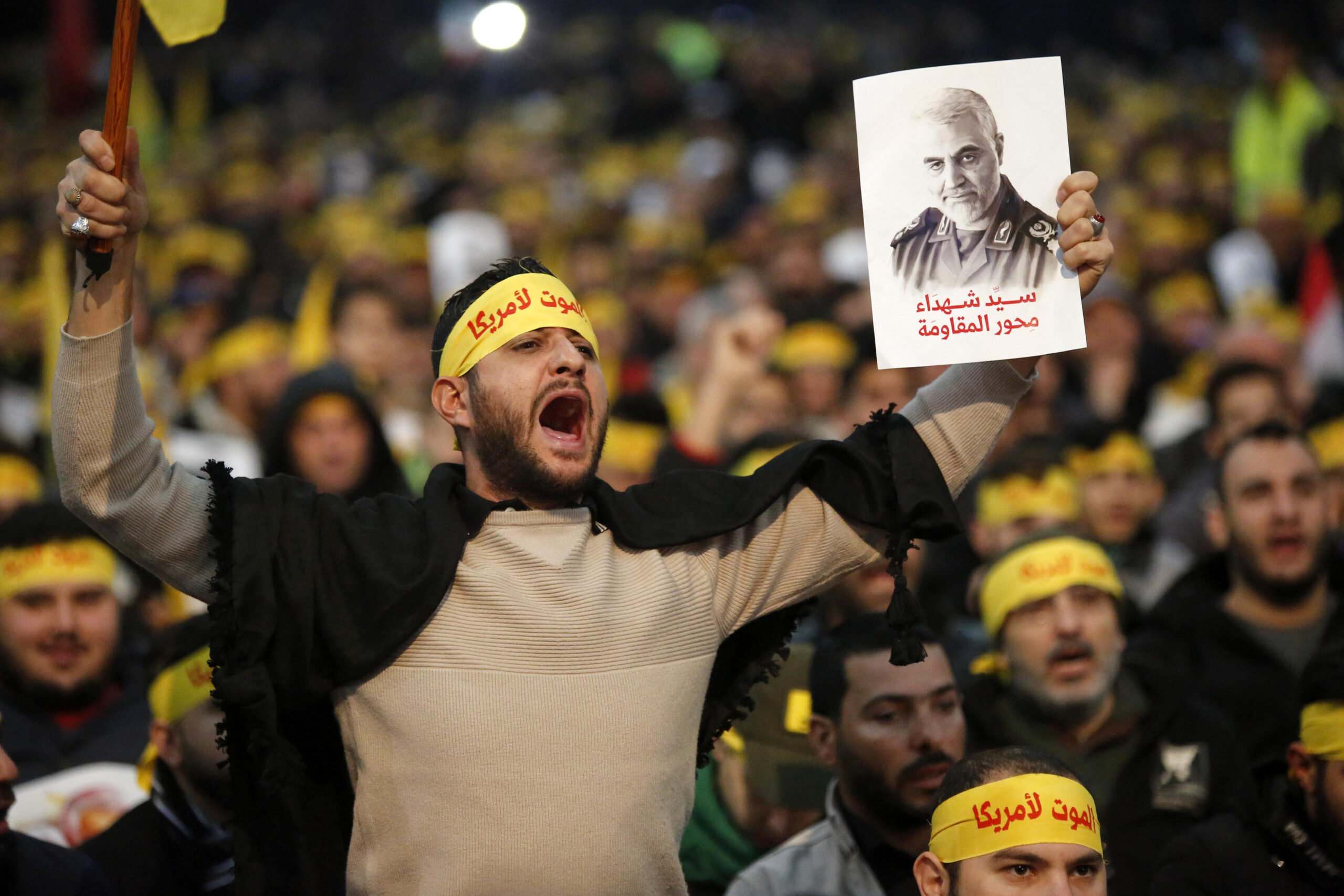
    Qassem Soleimani’s reign may be over, but his legacy in Syria will endure
    yrians take part in a protest against the United States and in support of Iranian general Qassem Soleimani at the Saadallah al-Jabiri Square in Aleppo, northern Syria, on Jan. 7, 2020.
  • Analysis
  • Qassem Soleimani’s reign may be over, but his legacy in Syria will endure

    The U.S. assassination of Iranian Gen. Qassem Soleimani came as a seismic shock to the Middle East, not least to the embattled political system in Damascus that has reaped the benefits of Iran’s military involvement across the region. While his death will be a severe blow, it will not necessarily translate into a decline in Iran’s influence or military presence in Syria. Soleimani’s army of militias and supporters will outlast him, possibly by decades.