This text has been translated by AI and may contain errors.
Skip to Content

Research & Commentary Results

Filter by
8738 Results
Syria tops the agenda as Erdogan heads to Washington
US President Donald Trump shakes hands with Turkish President Recep Tayyip Erdogan as he arrives for meetings at the White House in Washington, DC, May 16, 2017.
  • Commentary
  • Syria tops the agenda as Erdogan heads to Washington

    Turkish President Recep Tayyip Erdogan is set to meet with his U.S. counterpart, Donald Trump, in Washington on Wednesday. While there are doubtless other items for discussion on the agenda, at the top of the list is, at least on Turkey’s side, Syria — or more specifically, what U.S. policy is and should be in Syria.

    November 11, 2019

    Lebanon’s revolution will be deeper and longer
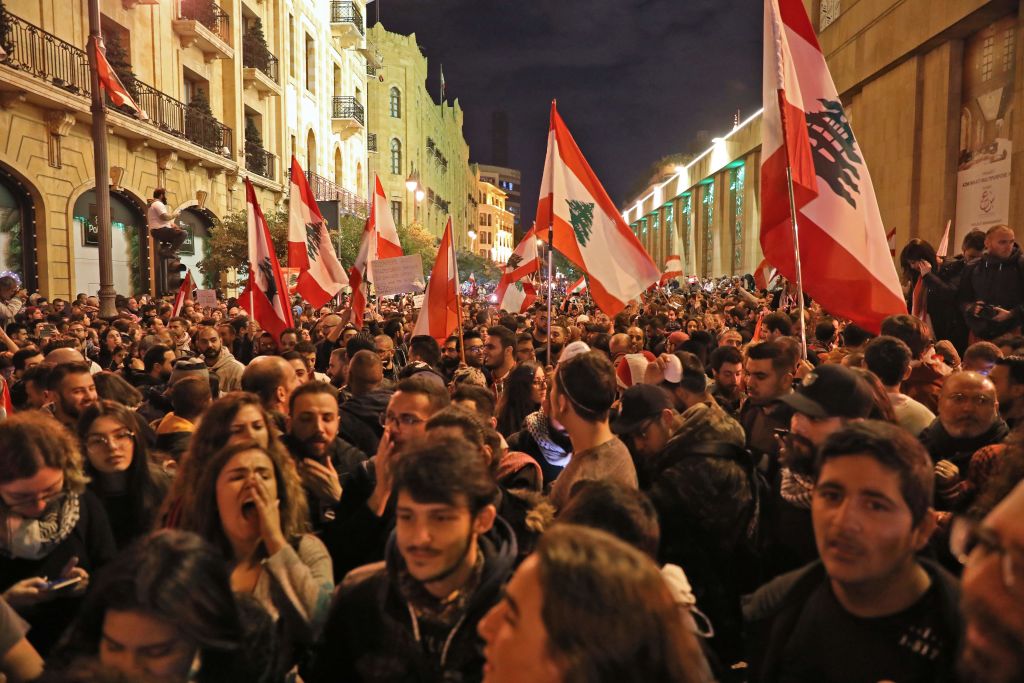
    People gather stage an anti government protest in Beirut, Lebanon on November 10, 2019.
  • Commentary
  • Lebanon’s revolution will be deeper and longer

    Lebanon’s popular uprising seems to be moving into a long and painful standoff between, on the one hand, a new generation along with a wide spectrum of the population demanding wholesale accountability and profound change, and on the other a ruling class mired in an interdependent web of corruption, intent on protecting its interests and waiting out the populace.

    November 11, 2019

    Pakistan’s anti-government protests put Khan in a bind
    Activists and supporters of Islamic political party Jamiat Ulema-e-Islam (JUI-F) attend an anti-government
  • Analysis
  • Pakistan’s anti-government protests put Khan in a bind

    Pakistan’s capital, Islamabad, has been paralyzed in recent days by supporters of Maulana Fazlur Rehman and his Jamiat-Ulema-e-Islam (JUI-F), a well-entrenched Islamist party. The protestors are seeking the resignation of the military-backed Prime Minister Imran Khan and fresh elections, and the demonstration has emerged as an existential problem for Khan.

    November 9, 2019

    Despite the hurdles, an opportunity for de-escalation in Yemen
    ) Yemeni Deputy Prime Minister Ahmed Saeed al-Khanbashi (R) and Southern Transitional Council (STC) representative Nasser al-Habci (L) are seen during a signing ceremony of 'Riyadh Agreement' between the Yemeni government and the United Arab Emirates (UAE)-backed separatist forces, Southern Transitional Council (STC) in Riyadh, Saudi Arabia on November 05, 2019.
  • Analysis
  • Despite the hurdles, an opportunity for de-escalation in Yemen

    After more than two months of Saudi-mediated indirect talks between the Republic of Yemen Government (ROYG) and the UAE-backed Southern Transitional Council (STC), the two sides finally reached a deal on Nov. 5. The Saudi effort, which culminated in the signing of the Riyadh Agreement, is aimed at resolving the conflict within the Arab coalition-backed front and uniting the two parties in the fight against the Iranian-backed Houthi militias. The agreement, which spans political, economic, security, and military arrangements, involves restructuring the executive, military, and security branches of the ROYG, partial disarmament of STC-loyal forces, and the demilitarization of Aden — all of which will be phased in over the next three months.

    November 8, 2019

    Perpetual Identities: Interview with Katya Traboulsi
  • Podcast
  • Perpetual Identities: Interview with Katya Traboulsi

    Lebanese artist Katya Traboulsi joins guest host Lyne Sneige to discuss her art exhibition, Perpetual Identities, which consists of 22 hand-crafted replicas of bombshells used in the Lebanese civil war, each adorned with designs and iconography associated with the artistic traditions of 22 featured countries. 

    November 7, 2019

    Seized Russian-printed dinars highlight an opportunity to reform Libya’s civil war economy
     Libyans gather during the funeral of fighters loyal to the Government of National Accord (GNA) in the capital Tripoli, on April 24, 2019, after they were reportedly killed during clashes with forces loyal to strongman Khalifa Haftar in al-Hira region, about 70 kilometres south of Tripoli.
  • Analysis
  • Seized Russian-printed dinars highlight an opportunity to reform Libya’s civil war economy

    The Nov. 1 seizure by Malta of two 2000-cubic-foot containers full of Libyan currency printed by the Russian state printer, Goznak, that was intended for delivery to Libya’s non-internationally recognized eastern government, highlights the continuing importance of the economic aspects of Libya’s ongoing civil war.

    The fall of the other wall
    The US Department of State building is seen in Washington, DC, on July 22, 2019.
  • Analysis
  • The fall of the other wall

    With the fall of the Berlin Wall 30 years ago, ties between Western and Eastern Europe were renewed. In the same period, another wall crumbled — between the Middle East and the former Soviet states. And yet, to this day, U.S. national security institutions continue to view these two regions through a Cold War lens, separating how they are handled. This approach needs to change; integrating research and policy toward the Middle East and the bordering states of the former Soviet Union would improve analytical understanding and help identify new policy options.

    Is the Turkey-Qatar alliance really under threat?
    Turkish President Recep Tayyip Erdogan (R) shakes hands with Qatari Prime Minister Sheikh Abdullah bin Nasser bin Khalifa Al Thani (L) following their meeting at the Presidential Complex in Ankara, Turkey on October 30, 2019.
  • Analysis
  • Is the Turkey-Qatar alliance really under threat?

    On Nov. 4 Daily Sabah, a strongly pro-government English-language daily in Turkey, published a scathing editorial with a title that says it all: “Al Jazeera English: A threat against the Turkey-Qatar alliance.” According to the editorial, Al Jazeera English slandered Turkey over its recent military incursion into northern Syria, and thus jeopardized the future of the Turkey-Qatar alliance. Given the close relationship between the Turkish government and Daily Sabah — and indeed the broader media environment in Turkey — it is highly unlikely that such a fiery editorial, which directly threatens Qatar, would have been published without a green light from “the palace.”

    November 6, 2019

    Transnational Shi’ism in Southern China and the Party-state’s “Hawza” Diplomacy
    Haopan Mosque | Guangzhou, China
  • Analysis
  • Transnational Shi’ism in Southern China and the Party-state’s “Hawza” Diplomacy

    This article seeks to transcend the Sunni-centered narratives that often inform the discussions on Islamicate interactions with China. Following a cursory historical view of Shi’ism’s influences on Chinese expressions of Islam, the article presents a rough sketch of the contemporary transnational Shi’ite communities that have emerged over the past few decades in southern China, most notably those of Guangzhou (Guangdong) and Yiwu (Zhejiang). It then considers the simultaneous and closely-linked phenomenon, dubbed “hawza diplomacy,” of the Chinese party-state’s growing engagement with the custodial authorities of the Shi’ite shrines of Iraq.

    November 5, 2019

    Washington Should Back, Not Punish, the Lebanese Military
  • Analysis
  • Washington Should Back, Not Punish, the Lebanese Military

    With ongoing protests, potential sectarian clashes, and threats of terrorism in the region looming, the country’s armed forces need propping up now more than ever.

    November 5, 2019

    Women and women’s rights are central to Lebanon’s protest movement
    BEIRUT, LEBANON - NOVEMBER 03: People gather at Bechara El-Khoury Avenue to call protesters for them to continue the demonstrations until a new government formed as they march from Martyrs Square and Riyadh al-Solh Square in Beirut, Lebanon on November 03, 2019. (Photo by Mahmut Geldi/Anadolu Agency via Getty Images)
  • Analysis
  • Women and women’s rights are central to Lebanon’s protest movement

    On Oct. 29, Prime Minister Saad Hariri submitted his resignation and that of the government, a move that has been hailed as an important victory for the protestors who have taken to the streets across the country for nearly three weeks now. Heralded as al-thawra, or revolution in Arabic, Lebanon is witnessing the rise of an inclusive, decentralized, and grassroots movement that transcends geography, sect, and traditional loyalties to political dynasties and parties.

    Sochi summit highlights growing Russia-Egypt ties
    Russian President Vladimir Putin (R) meets with his Egyptian counterpart Abdel Fattah el-Sisi on the sidelines of the 2019 Russia-Africa Summit in Sochi on October 23, 2019. (Photo by Mikhail METZEL / SPUTNIK / AFP) (Photo by MIKHAIL METZEL/SPUTNIK/AFP via Getty Images)
  • Analysis
  • Sochi summit highlights growing Russia-Egypt ties

    On Oct. 23-24, Russian President Vladimir Putin co-chaired the Russia-Africa Economic Forum in Sochi with his Egyptian counterpart Abdel-Fattah el-Sisi. At the conclusion of the summit, which brought 43 African heads of state to the Black Sea resort town, Sisi emphasized the importance of strengthening Egypt’s partnership with Russia, and Putin described Egypt as a “pillar for security and stability in the Middle East and Africa.”

    November 5, 2019