Addressing the Crisis in Yemen: Strategies and Solutions
The Middle East Institute is proud to host two former Ambassadors to Yemen, Thomas Krajeski and David Newton, for a discussion about Yemen and the role of US foreign policy in a country some political analysts characterize as a failed state. As Yemen grapples with multiple crises, including the growing influence of Al Qaeda, a Houthi Rebellion in the north, a secessionist movement in the south and severe economic woes, what should the US do to help stabilize and secure one of the Arab world’s poorest countries?
How Salafism Came to Yemen: An Unknown Legacy of Juhayman al-'Utaybi 30 Years On
Since it emerged in Yemen around three decades ago, the country’s Salafi movement has maintained complex, if not tense links with Saudi Arabia.[1] Before establishing a Yemeni manifestation of Salafism with its own features and clerics,
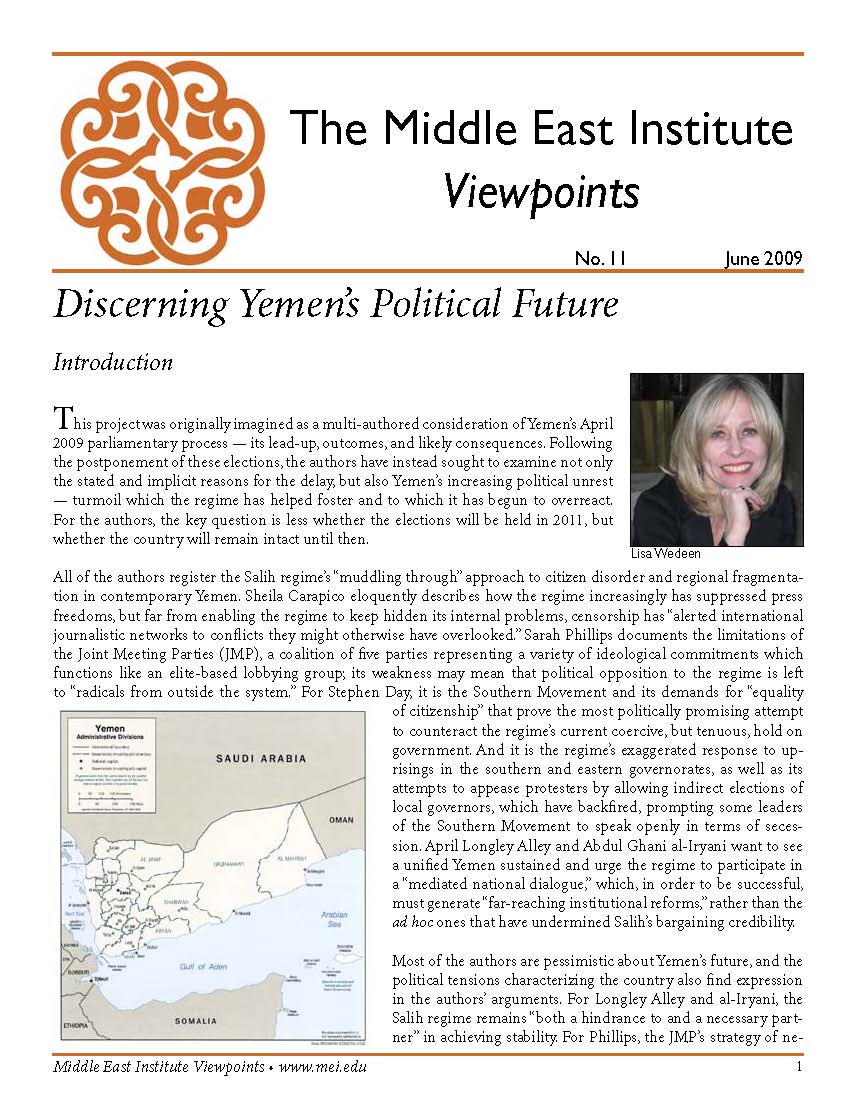
This project was originally imagined as a multi-authored consideration of Yemen’s April 2009 parliamentary process — its lead-up, outcomes, and likely consequences. Following the postponement of these elections, the authors have instead sought to examine not only the stated and implicit reasons for the delay, but also Yemen’s increasing political unrest — turmoil which the regime has helped foster and to which it has begun to overreact. For the authors, the key question is less whether the elections will be held in 2011, but whether the country will remain intact until then.
The Arab world, especially the Gulf countries, face many environmental threats and problems such as desertification, biodiversity loss, marine and coastal areas pollution, air pollution, and water scarcity and quality. Beside these traditional environmental threats, various other environmental problems have begun to emerge in the last few years, related to military conflicts, construction and demolition debris, and climate change.
Climate Change Threats, Opportunities, and the GCC Countries
Originally posted April 2008
Oil and gas revenues for GCC countries have enabled exceptional and accelerated development in all aspects of life. These countries have become a hub of intense activity in many spheres—geopolitical, military, economic, industrial, construction, and tourism, to name a few. However, the scale of oil and gas production and use has also led to severe environmental problems.
Introducation to Iran's March 14, 2008 Majlis Elections
Speaking of the need for an opposition party, Kemal Ataturk once said: “I do not want to be recorded in history as the man who bequeathed a tyranny.” These words could also be uttered by Iran’s Supreme Leader, Ayatollah ‘Ali Khamene’i. Yet, the legacy that ‘Ali Khamene’i will leave behind can perhaps best be described as a promenade of contradictory truths. Such contradictions are emblematic of the 8th round of Iranian parliamentary (Majlis) elections that are now upon us. It is true that the Iranian state employs a prodigious style of electoral engineering to regiment outcomes.