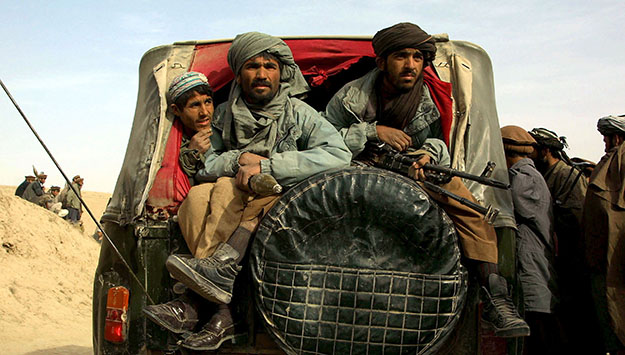
Assessing the Past, Informing the Future: U.S. Aid Policy in Afghanistan & Pakistan
Thu, 9/19/2013 12:00 pm to 1:30 pmThe Middle East Institute is pleased to welcome Vanda Felbab-Brown, senior fellow with the Center for 21st Century Security and Intelligence in the Foreign Policy program at Brookings, independent consultant Polly Nayak, Amb. Robin Raphel, U.S. Coordinator for Non-Military Assistance to Pakistan, and Alex Thier, assistant to the Administrator for Policy, Planning, and Learning at USAID, for a panel discussion examining how the US can contribute to the stability of post-2014 Afghanistan and Pakistan through economic and development assistance.
Assessing the Past, Informing the Future: U.S. Aid Policy in Afghanistan & Pakistan
Thu, 9/19/2013 12:00 pm to 1:30 pmThe Middle East Institute is pleased to welcome Vanda Felbab-Brown, senior fellow with the Center for 21st Century Security and Intelligence in the Foreign Policy program at Brookings, independent consultant Polly Nayak, Amb. Robin Raphel, U.S. Coordinator for Non-Military Assistance to Pakistan, and Alex Thier, assistant to the Administrator for Policy, Planning, and Learning at USAID, for a panel discussion examining how the US can contribute to the stability of post-2014 Afghanistan and Pakistan through economic and development assistance.
Gulf Governments Offer Financing for U.S. Strike on Syria
Like pieces fitting together in a jigsaw puzzle, Arab governments – presumably from the oil-rich Gulf Cooperation Council – offered to finance a U.S. military strike on Syria, according to comments made by Secretary of State John Kerry during testimony September 4 with the House Foreign Affairs Committee. In an exchange with Representative Ileana Ros-Lehtinen (R-FL) on the potential cost of U.S. military action in Syria, Kerry said,
Since the 1970s oil boom, the Gulf region has been one of the principal destinations for workers from South Asia, with the result that today Indians constitute a large percentage of the non-nationals living in the region. Indeed, at five million out of an estimated 15 million people, the Indian community forms the largest expatriate group in each of the Gulf countries. Most Indian immigrants are from the south Indian state of Kerala, while many of the rest originate from Tamil Nadu, Punjab, Uttar Pradesh, and Bihar.
When the young Shaykh Tamim bin Hamad al-Thani became ruler of Qatar last month after his father stepped aside in a seamless transition, one of his first official acts was to seal the generational shift by appointing a new prime minister.
Withdrawal from Afghanistan: Next Steps and Challenges
Wed, 3/20/2013 12:00 pm to 1:30 pmLocation: The SEIU Building1800 Massachusetts Avenue, NWWashingtonDistrict of Columbia20 036 The Middle East Institute is proud to host Lieutenant General (Ret.) David W. Barno and Dr. Michael E.
Withdrawal from Afghanistan: Next Steps and Challenges
Wed, 3/20/2013 12:00 pm to 1:30 pmLocation: The SEIU Building1800 Massachusetts Avenue, NWWashingtonDistrict of Columbia20 036 The Middle East Institute is proud to host Lieutenant General (Ret.) David W. Barno and Dr. Michael E.
Withdrawal from Afghanistan: Next Steps and Challenges
Wed, 3/20/2013 12:00 pm to 1:30 pmLocation: The SEIU Building1800 Massachusetts Avenue, NWWashingtonDistrict of Columbia20 036 The Middle East Institute is proud to host Lieutenant General (Ret.) David W. Barno and Dr. Michael E.
Withdrawal from Afghanistan: Next Steps and Challenges
Wed, 3/20/2013 12:00 pm to 1:30 pmLocation: The SEIU Building1800 Massachusetts Avenue, NWWashingtonDistrict of Columbia20 036 The Middle East Institute is proud to host Lieutenant General (Ret.) David W. Barno and Dr. Michael E.
Withdrawal from Afghanistan: Next Steps and Challenges
Wed, 3/20/2013 12:00 pm to 1:30 pmLocation: The SEIU Building1800 Massachusetts Avenue, NWWashingtonDistrict of Columbia20 036 The Middle East Institute is proud to host Lieutenant General (Ret.) David W. Barno and Dr. Michael E.
This piece was originally published by Foreign Policy Blogs on December 20, 2012
Assertions and opinions in this publication are solely those of the above-mentioned author(s) and do not necessarily reflect the views of the Middle East Institute, which expressly does not take positions on Middle East policy.