The Arab world, especially the Gulf countries, face many environmental threats and problems such as desertification, biodiversity loss, marine and coastal areas pollution, air pollution, and water scarcity and quality. Beside these traditional environmental threats, various other environmental problems have begun to emerge in the last few years, related to military conflicts, construction and demolition debris, and climate change.
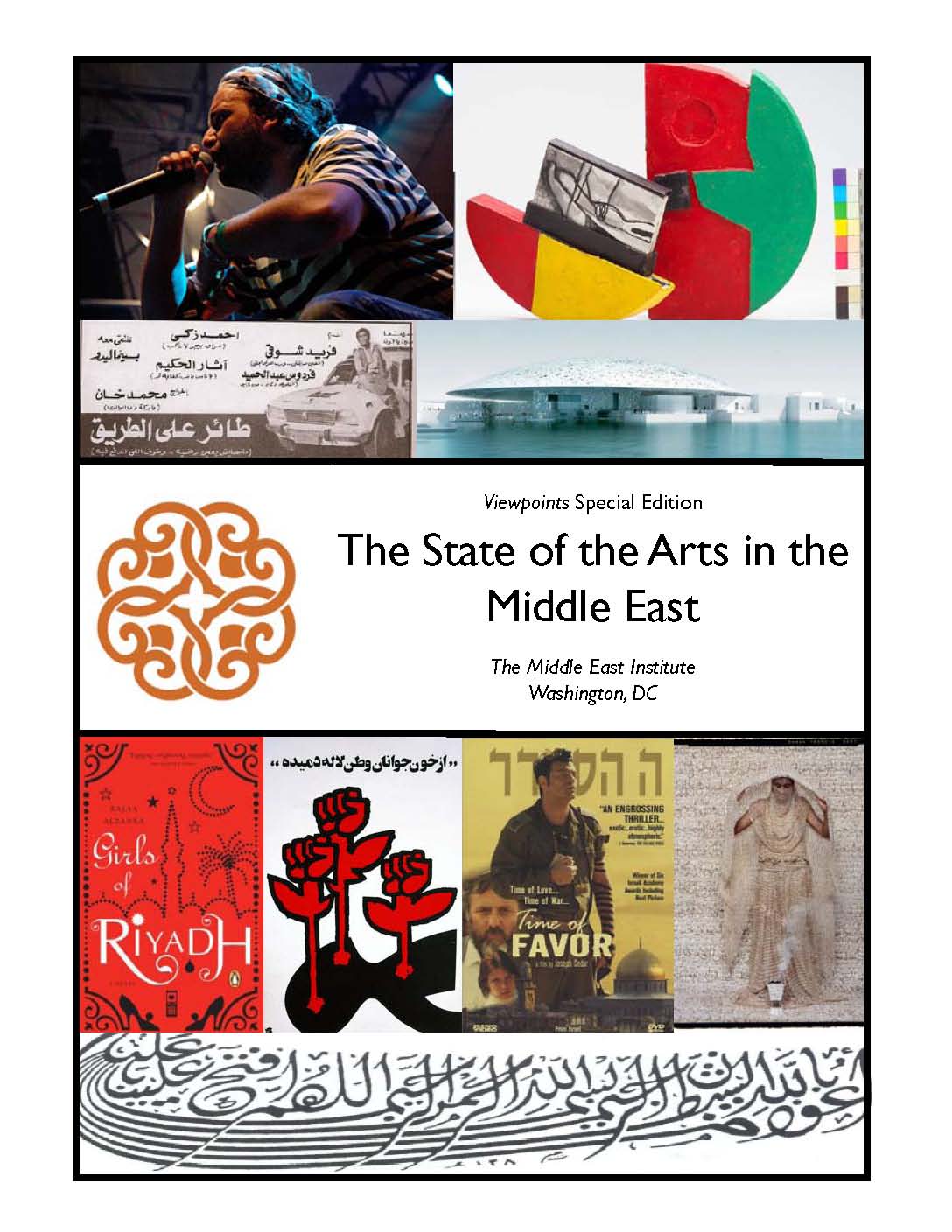
How the New Arab Media Challenges the Arab Militaries: The Case of the War between Israel and Hizbullah in 2006
One, Two / the Arab army where are you?/ The Arab army where are you?/The Egyptian Arab Army/ resides in an-Nasr [victory] compound/ Wakes up in the afternoon/ to drink its tea/ The Gulf Arab army/ can do absolutely nothing/ “Strategic silence” indeed/ “cut us some slack, man!”/ The Tunisian Arab army/ is green like parsley/ But ‘Aziza loves Yunis/ the wars can wait/ The Sudanese Arab army/ I can hear its clamor in my ears/ “Damn it!
Social Change Amidst Terror and Discrimination: Yezidis in the New Iraq
Originally posted August 2008
On August 14, 2007, in the largest single terror attack during the war in Iraq, over 350 Yezidis were killed and two entire villages completely destroyed, leaving over 1,000 families homeless. The two villages, Qahtaniya and Jazeera are located in the Sinjar Mountains, an area in northwestern Iraq that is hotly contested by Sunni Arab insurgents, Kurdish peshmergas, US-led coalition forces, and several minority groups.
US Relations with Pakistan: The Need for a Strategic Shift
Originally posted May 2008
Pakistan has come to reflect and affect many of the critical issues in South Asia that worry the US foreign policy establishment, the media, and the public. But US officials are crafting policy responses to deal with Pakistan that are focused excessively narrowly on a single issue — the war on terrorism. In addition to exacerbating Pakistan’s own problems, these efforts have undermined Pakistan’s capacity and political will to fight this war. As a consequence neither America’s nor Pakistan’s best interests are being served.
Climate Change Threats, Opportunities, and the GCC Countries
Originally posted April 2008
Oil and gas revenues for GCC countries have enabled exceptional and accelerated development in all aspects of life. These countries have become a hub of intense activity in many spheres—geopolitical, military, economic, industrial, construction, and tourism, to name a few. However, the scale of oil and gas production and use has also led to severe environmental problems.
One of the strangest features of contemporary Iranian politics must surely be the reality that despite the concerted and successful effort to narrow the range of candidates allowed to run for various political offices, competition among individuals and groups has not only remained unabated, it has intensified. The elite jockeying that has taken place in the past few months, leading to the upcoming March 14 Majlis elections, is a good example of the competitive intensity that had come to characterize Iranian politics.
On January 3, 2008, Iran’s supreme leader, Ayatollah ‘Ali Khamene’i once again sought to remind domestic and foreign audiences about his stature in Tehran. Stating that “cutting off relations with the US” was one of the “principal policies” of the Iranian government, but that he would be the “first person to endorse these relations” if it benefited the Iranian people, Khamene’i secured news headlines.[1]
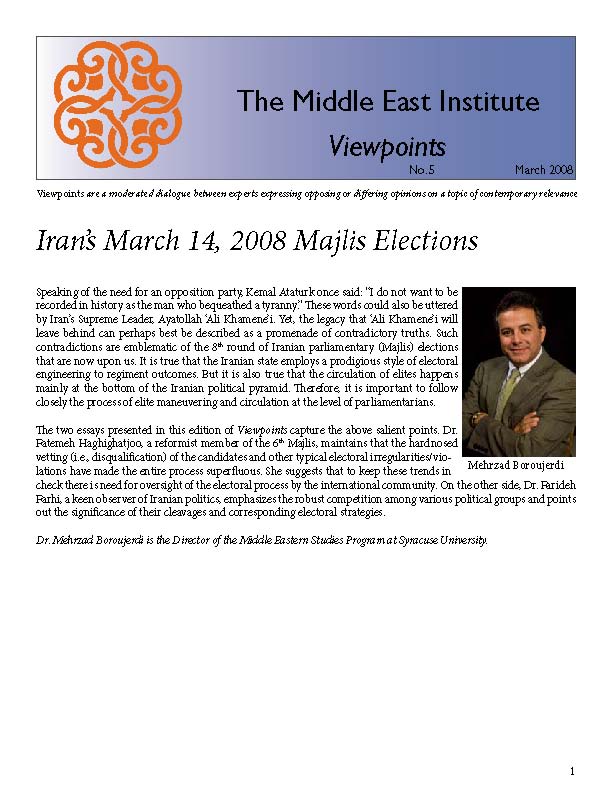
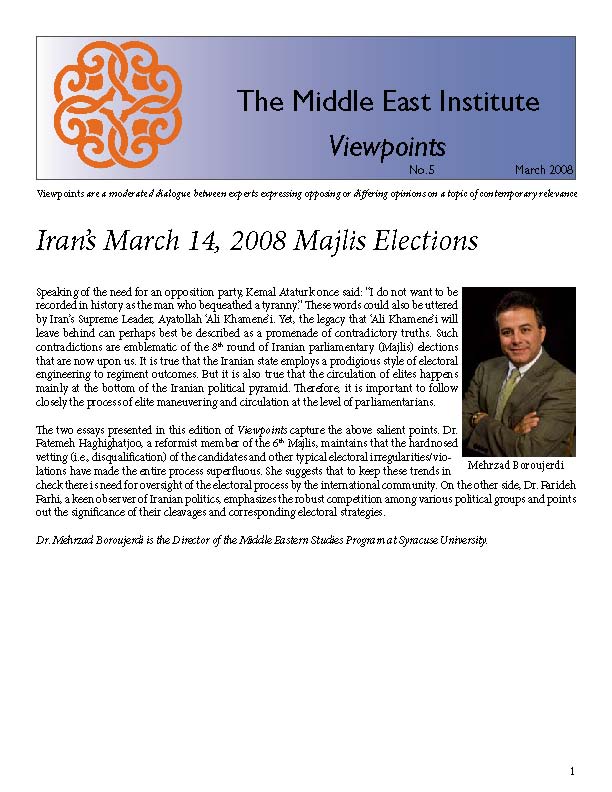
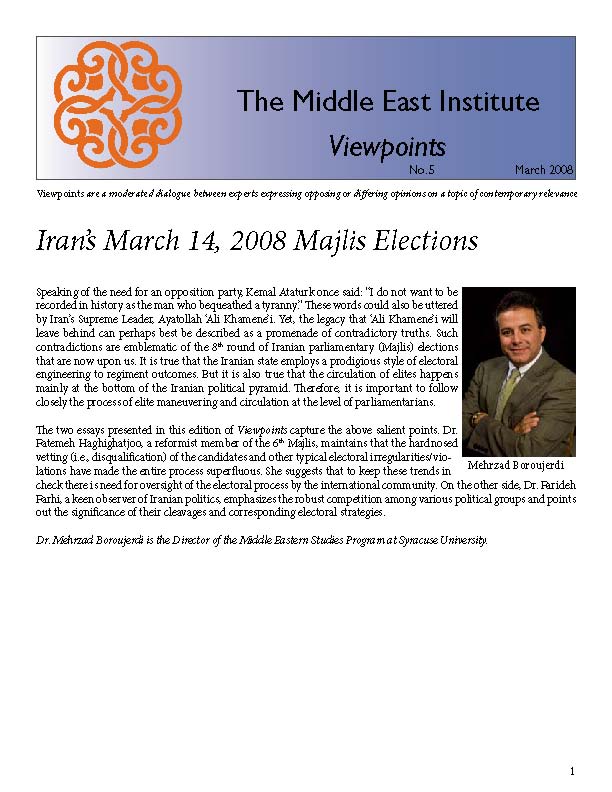
Introducation to Iran's March 14, 2008 Majlis Elections
Speaking of the need for an opposition party, Kemal Ataturk once said: “I do not want to be recorded in history as the man who bequeathed a tyranny.” These words could also be uttered by Iran’s Supreme Leader, Ayatollah ‘Ali Khamene’i. Yet, the legacy that ‘Ali Khamene’i will leave behind can perhaps best be described as a promenade of contradictory truths. Such contradictions are emblematic of the 8th round of Iranian parliamentary (Majlis) elections that are now upon us. It is true that the Iranian state employs a prodigious style of electoral engineering to regiment outcomes.
“In the past week Iran’s president, Mahmud Ahmadinejad, has damned it as a ‘worthless piece of paper’ and China’s premier, Wen Jiabao, has moaned that it is causing his country ‘big pressure’. The dollar’s relentless decline—it hit a new low of $1.49 against the euro on November 21st—is prompting jibes from America’s critics, jangling investors’ nerves and giving policymakers headaches.”[1]