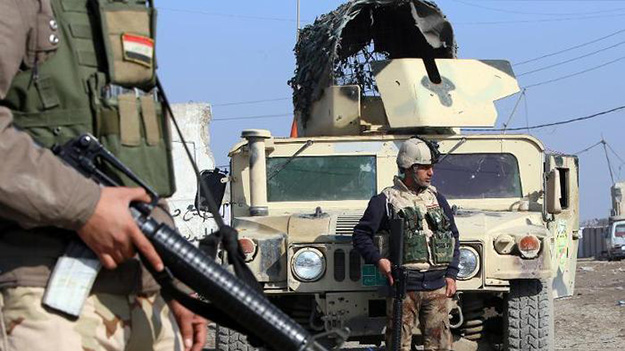
Iraq: Reversing the Reversal
Since the departure of U.S. ground forces from Iraq in 2011 in the wake of failed negotiations to extend the 2008 Status of Forces Agreement, the security situation in Iraq has steadily declined. To many, the situation was predictable, as the absence of a residual U.S. force to mature the Iraqi security forces and moderate long-standing political tensions among the sects led to a security vacuum filled by extremists and terrorists. To others, 10 years of investment and over 4,000 troops lost was enough, and it was time for the Iraqis to resolve their own internal conflicts.

Iraq’s Tangled Foreign Interests and Relations
The following is an excerpt from “Iraq’s Tangled Foreign Interests and Relations,” written by MEI Vice President Paul Salem and published by the Carnegie Middle East Center on December 24, 2013. Click here to view the full report.
Bombings in Beirut Indicate New Escalation
Earlier today, double explosions near the Iranian embassy in Beirut killed at least 23, including an Iranian diplomat. The Abdullah Azzam Brigades, an Islamist group with links to al-Qa`ida, took responsibility for the attack. MEI sat down with its Vice President for Policy and Research, Paul Salem, to discuss the significance of the bombings in Lebanon as well as their regional and global implications.
Tell us about the bombing and the group that claimed responsibility for it.
Maliki in Washington: Arms Deals, Politics, and Proxy Wars
Iraqi Prime Minister Nouri al-Maliki is in Washington this week for meetings with Vice President Joe Biden, Defense Secretary Chuck Hagel, and President Barack Obama. We sat down with MEI’s Vice President for Policy and Research, Paul Salem, to discuss the topics on the table, what each side hopes to accomplish, and how the United States should approach Iraq.
What is Maliki looking to accomplish?
Collection Spotlight: An Iraq of Its Regions

An Iraq of Its Regions, edited by Reidar Vissar and Gareth Stansfield, 2008
Collection Spotlight: Contentious Politics in the Middle East

Gulf Governments Offer Financing for U.S. Strike on Syria
Like pieces fitting together in a jigsaw puzzle, Arab governments – presumably from the oil-rich Gulf Cooperation Council – offered to finance a U.S. military strike on Syria, according to comments made by Secretary of State John Kerry during testimony September 4 with the House Foreign Affairs Committee. In an exchange with Representative Ileana Ros-Lehtinen (R-FL) on the potential cost of U.S. military action in Syria, Kerry said,
“Invisible” White-Collar Indians in the Gulf
Since the 1970s oil boom, the Gulf region has been one of the principal destinations for workers from South Asia, with the result that today Indians constitute a large percentage of the non-nationals living in the region. Indeed, at five million out of an estimated 15 million people, the Indian community forms the largest expatriate group in each of the Gulf countries. Most Indian immigrants are from the south Indian state of Kerala, while many of the rest originate from Tamil Nadu, Punjab, Uttar Pradesh, and Bihar.
The Iraqi Factor in the Syrian Crisis: Catalyst or Inhibitor?
Iraqis who cast their votes in postponed local elections in Anbar and Nineveh on 20 June had a lot on their plates. Beyond issues relating to the provision of services locally, the last weeks before the elections saw massive protests against the central government in Baghdad. The many angry slogans on display included calls for greater autonomy for the Sunni-majority areas of Iraq as well as expressions of solidarity with the mainly Sunni Syrian opposition movement.
Transition in Qatar: Lessons for the GCC States
When the young Shaykh Tamim bin Hamad al-Thani became ruler of Qatar last month after his father stepped aside in a seamless transition, one of his first official acts was to seal the generational shift by appointing a new prime minister.
Collection Spotlight: The Iran-Iraq War

The Iran–Iraq War: Impact and Implications, by Efraim Karsh (edited), 1989
Panel 4: The Turkey-Iran-Iraq Nexus
The Middle East Institute Center for Turkish Studies’ Fourth Annual Conference on TurkeyPanel 4: The Turkey-Iran-Iraq NexusHenri J. Barkey, Lehigh UniversityAlireza Nader, RAND CorporationDenise Natali, National Defense UniversityModerator: Phebe Marr, Author and HistorianJune 14, 2013 3:30pm-5:00 pm
Panel 4: The Turkey-Iran-Iraq Nexus
The Middle East Institute Center for Turkish Studies’ Fourth Annual Conference on TurkeyPanel 4: The Turkey-Iran-Iraq NexusHenri J. Barkey, Lehigh UniversityAlireza Nader, RAND CorporationDenise Natali, National Defense UniversityModerator: Phebe Marr, Author and HistorianJune 14, 2013 3:30pm-5:00 pm