The Third Annual Conference on Turkey: Regional and Domestic Challenges for an Ascendant Turkey
The Middle East Institute’s Center for Turkish Studies in collaboration with the Institute of Turkish Studies present:”Regional and Domestic Challenges for an Ascendant Turkey” June 27th, 20129:00am-5:00pmNational Press Club529 14th Street, NW 13th FloorWashington, DC 20045 Conference Schedule:8:45am – 9:00am: Registration9:00am – 9:15am: WelcomeAmb. Wendy J. Chamberlin, Middle East InstituteGönül Tol, MEI’s Center for Turkish StudiesRoss Wilson, Institute of Turkish Studies 9:15am – 10:00am: Opening KeynoteSenator John McCainUnited States Senate 10:00am – 10:30am: KeynoteAmb.
The Third Annual Conference on Turkey: Regional and Domestic Challenges for an Ascendant Turkey
The Middle East Institute’s Center for Turkish Studies in collaboration with the Institute of Turkish Studies present:”Regional and Domestic Challenges for an Ascendant Turkey” June 27th, 20129:00am-5:00pmNational Press Club529 14th Street, NW 13th FloorWashington, DC 20045 Conference Schedule:8:45am – 9:00am: Registration9:00am – 9:15am: WelcomeAmb. Wendy J. Chamberlin, Middle East InstituteGönül Tol, MEI’s Center for Turkish StudiesRoss Wilson, Institute of Turkish Studies 9:15am – 10:00am: Opening KeynoteSenator John McCainUnited States Senate 10:00am – 10:30am: KeynoteAmb.
The Third Annual Conference on Turkey: Regional and Domestic Challenges for an Ascendant Turkey
The Middle East Institute’s Center for Turkish Studies in collaboration with the Institute of Turkish Studies present:”Regional and Domestic Challenges for an Ascendant Turkey” June 27th, 20129:00am-5:00pmNational Press Club529 14th Street, NW 13th FloorWashington, DC 20045 Conference Schedule:8:45am – 9:00am: Registration9:00am – 9:15am: WelcomeAmb. Wendy J. Chamberlin, Middle East InstituteGönül Tol, MEI’s Center for Turkish StudiesRoss Wilson, Institute of Turkish Studies 9:15am – 10:00am: Opening KeynoteSenator John McCainUnited States Senate 10:00am – 10:30am: KeynoteAmb.
Senator John McCain was uncharacteristically subdued in a key note address yesterday to the Middle East Institute/Institute of Turkish Studies conference on Turkey. He prodded President Obama to be more outspoken in denouncing the Assad regime and advocated a “safe zone” inside Syria along the Turkish border, but only in response to a question. He discounted the likelihood of NATO action, which the Europeans oppose, and suggested that the U.S. and Turkey should form the core of a coalition of the willing to support the Syrian opposition with arms and training.
Bruce Richardson raises an important issue regarding the protection, trafficking, and exploitation of cultural patrimony. Aspects of this issue range across research, polemics, and litigation in attempts to document loss, return treasures, or on the other hand prevent restitution or repatriation. Richardson properly decries cultural looting, but we must distinguish among causes to reach agreement on protective steps.
The Afghanistan Stabilisation Program (ASP): A National Program to Improve Security and Governance
Since the coup in April of 1978 by the People’s Democratic Party of Afghanistan (PDPA), the social, cultural, political, economic, governance, and security fabric of Afghanistan’s institutions have been destroyed by the subsequent Mujahedin and Taleban regimes. It is impossible to have enduring peace, stability, and development in a country without a strong institutional foundation. After 33 years of war and instability, for the most part, the linkages between central, provincial, district, and village governance structures in Afghanistan are either very weak or non-existent.
This Opinion first appeared on CNN.com’s “Global Public Square” blog on June 20, 2012
Ever since Saudi Arabia’s King Abdullah proposed forming a political federation among the six members of the Gulf Cooperation Council, the pros and cons have been fiercely debated across the Middle East.
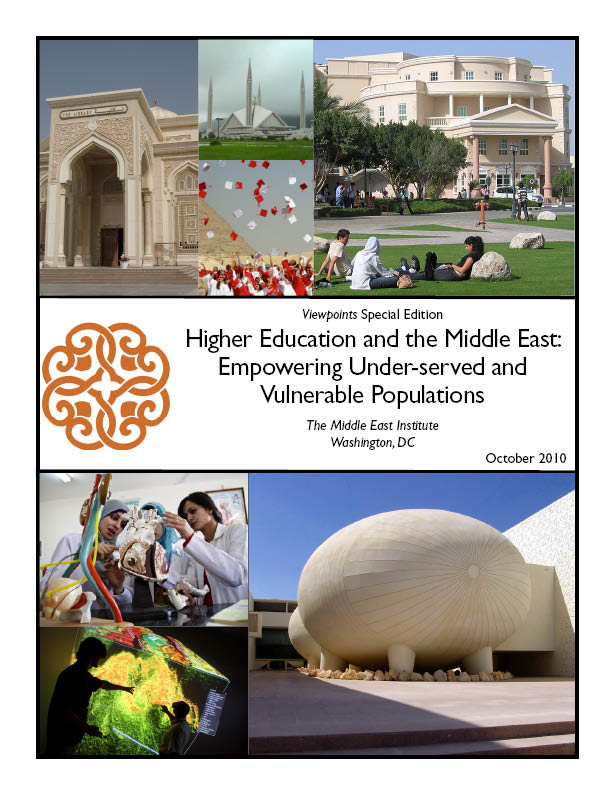
Introduction to Higher Education and the Middle East: Empowering Under-served and Vulnerable Populations
Originally posted October 2010
This second edition of the MEI Viewpoints series on Higher Education and the Middle East focuses on Empowering Under-served and Vulnerable Populations.
The Dearth of Qatari Men in Higher Education: Reasons and Implications
Originally posted October 2010
That education is a major force for socialization is indisputable. Education has the power to shape views of the world, to challenge long-held beliefs, and, therefore, to impact the social order. Its influences on the course of a society’s development are far-reaching, from the public realm of employment patterns and economic development to the private sphere of marriage and childbearing.