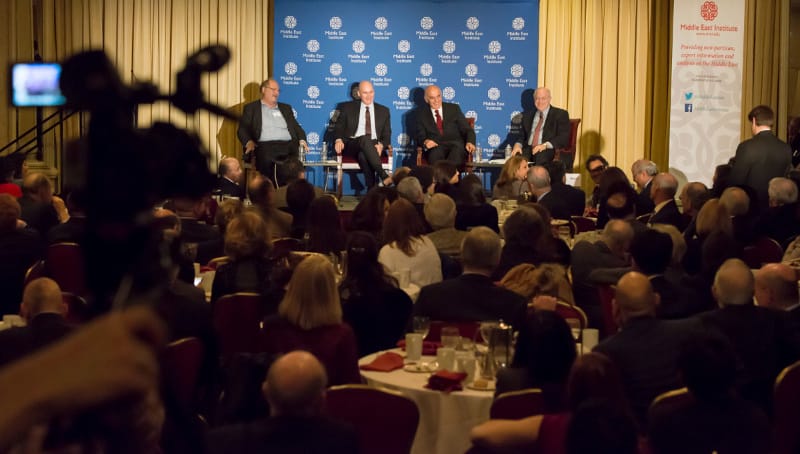
Welcome, Keynote address – MEI's 4th Annual Conference on Turkey
The Middle East Institute Center for Turkish Studies’ Fourth Annual Conference on Turkey8:45am: WelcomeAmb. Wendy Chamberlin, President, Middle East Institute9:00am-9:45 am: Keynote AddressRep. Ed Whitfield (R-KY), United States House of RepresentativesJune 14, 2013, 8:45am, 9:00am
Welcome, Keynote address – MEI's 4th Annual Conference on Turkey
The Middle East Institute Center for Turkish Studies’ Fourth Annual Conference on Turkey8:45am: WelcomeAmb. Wendy Chamberlin, President, Middle East Institute9:00am-9:45 am: Keynote AddressRep. Ed Whitfield (R-KY), United States House of RepresentativesJune 14, 2013, 8:45am, 9:00am
Interview with Professor Selçuk Esenbel, Director of the Asian Studies Center, Boğaziçi University, Istanbul, Turkey
Although Turkey has a long history of continuing interaction with European intelligentsia, politicians and opinion makers, and also with the United States, there is very little experience and background with which to communicate with Asian countries. The Asian Studies Center is now recognized as the institution that can form viable academic connections and develop projects accordingly which will “bring the world to Turkey.”
Women in Turkey: New Opportunities, New Challenges
The Middle East Institute is proud to host three women changemakers in Turkey for a discussion about women in business and women’s rights. In recent years, women in Turkey have made inroads in fields where women have not traditionally been present. They are now successful business owners, managers, entrepreneurs, politicians, engineers, and academics. Their voices have become part of the public debate as they increasingly participate in all aspects of public life.
Women in Turkey: New Opportunities, New Challenges
The Middle East Institute is proud to host three women changemakers in Turkey for a discussion about women in business and women’s rights. In recent years, women in Turkey have made inroads in fields where women have not traditionally been present. They are now successful business owners, managers, entrepreneurs, politicians, engineers, and academics. Their voices have become part of the public debate as they increasingly participate in all aspects of public life.
Women in Turkey: New Opportunities, New Challenges
The Middle East Institute is proud to host three women changemakers in Turkey for a discussion about women in business and women’s rights. In recent years, women in Turkey have made inroads in fields where women have not traditionally been present. They are now successful business owners, managers, entrepreneurs, politicians, engineers, and academics. Their voices have become part of the public debate as they increasingly participate in all aspects of public life.
Women in Turkey: New Opportunities, New Challenges
The Middle East Institute is proud to host three women changemakers in Turkey for a discussion about women in business and women’s rights. In recent years, women in Turkey have made inroads in fields where women have not traditionally been present. They are now successful business owners, managers, entrepreneurs, politicians, engineers, and academics. Their voices have become part of the public debate as they increasingly participate in all aspects of public life.
After the Jordan Elections: Challenges Ahead for the Hashemite Kingdom
The Middle East Institute is proud to host Leslie Campbell, senior associate and regional director for the Middle East, and Danya Greenfield, deputy director of the Rafik Hariri Center for the Middle East at the Atlantic Council, for an assessment of the Jordanian elections and an examination of the political challenges ahead for Jordan’s King Abdullah II.
After the Jordan Elections: Challenges Ahead for the Hashemite Kingdom
The Middle East Institute is proud to host Leslie Campbell, senior associate and regional director for the Middle East, and Danya Greenfield, deputy director of the Rafik Hariri Center for the Middle East at the Atlantic Council, for an assessment of the Jordanian elections and an examination of the political challenges ahead for Jordan’s King Abdullah II.
After the Jordan Elections: Challenges Ahead for the Hashemite Kingdom
The Middle East Institute is proud to host Leslie Campbell, senior associate and regional director for the Middle East, and Danya Greenfield, deputy director of the Rafik Hariri Center for the Middle East at the Atlantic Council, for an assessment of the Jordanian elections and an examination of the political challenges ahead for Jordan’s King Abdullah II.
After the Jordan Elections: Challenges Ahead for the Hashemite Kingdom
The Middle East Institute is proud to host Leslie Campbell, senior associate and regional director for the Middle East, and Danya Greenfield, deputy director of the Rafik Hariri Center for the Middle East at the Atlantic Council, for an assessment of the Jordanian elections and an examination of the political challenges ahead for Jordan’s King Abdullah II.