This text has been translated by AI and may contain errors.
Skip to Content

Research & Commentary Results

Filter by
967 Results
Idlib’s Uncertain Future
Middle East Institute
  • Podcast
  • Idlib’s Uncertain Future

    Although Syria’s civil war has largely wound down, fighting in Idlib in the country’s northwest has heated up in the last two months. Charles Lister, MEI senior fellow and Director of the Countering Terrorism and Extremism Program, and Sasha Ghosh-Siminoff, executive director and co-founder of People Demand Change, join host Alistair Taylor to discuss the ongoing conflict and what impact it might have on Syria’s future.

    July 11, 2019

    The UAE drawdown in Yemen is a welcome step, but it needs to be reciprocated
    August 2018: An Emirati soldier watching from a military plane a ship crossing through the strategic strait of Bab al-Mandab
  • Analysis
  • The UAE drawdown in Yemen is a welcome step, but it needs to be reciprocated

    Reports that the UAE, a key member of the Saudi-led coalition fighting in Yemen, has decided to draw down and reposition its troops should be welcomed and taken seriously. It is not a small or symbolic move, but rather a serious, strategic, and thoughtful military and political decision. If reciprocated by the Iranian-backed Houthi militia, it could serve as the long-awaited breakthrough in the five-year-old Yemen war.

    July 11, 2019

    Turkey, Russia, and the Looming S-400 Crisis
    Russian S-400 missile system
  • Analysis
  • Turkey, Russia, and the Looming S-400 Crisis

    With delivery of the Russian S-400 air defense system to Turkey looming, a new crisis in U.S.-Turkey relations is slowly emerging. While it is obvious that Turkey needs a new air and missile defense system given the security risks in its region, it remains unclear why Turkish President Recep Tayyip Erdogan seeks to acquire the capability from a historical rival and potential adversary instead of through NATO. This decision will likely have major consequences for Turkey and its future geopolitical orientation.

    July 10, 2019

    As violence flares up in Daraa, control can be an illusion
    A young boy rides his bicycle in the southern Syrian city of Daraa on August 14, 2018. Behind him is a gate ornated with images of Syrian President Bashar al-Assad (L) and his late father Hafez al-Assad. (Photo by Andrei BORODULIN / AFP) (Photo credit should read ANDREI BORODULIN/AFP/Getty Images)
  • Analysis
  • As violence flares up in Daraa, control can be an illusion

    Violence has been flaring up at an alarming rate in the southern Syrian province of Daraa, amid dozens of unclaimed attacks by gunmen. Over the last three months, assassinations, checkpoint attacks, fires, and sporadic clashes have wreaked havoc in the area and signaled a potential return of conflict. 

    UNIFIL and the Lebanese Army, a worthwhile US investment
    A picture taken from Naqoura city of Lebanon shows UNIFIL bases as construction works those are being conducted by Israeli Army along the Israel-Lebanon border on April 20, 2017. Hezbollah militias hosted press members to let them observe the mined border line, known as
  • Analysis
  • UNIFIL and the Lebanese Army, a worthwhile US investment

    My colleagues and I at the American Task Force for Lebanon (ATFL) visited the LAF southern headquarters, the UNIFIL headquarters, and the Blue Line, established in 2000, separating Israel and Lebanon. We were encouraged by what we saw.

    July 2, 2019

    Monday Briefing: Iran exceeds nuclear deal enrichment limits
  • Analysis
  • Monday Briefing: Iran exceeds nuclear deal enrichment limits

    In this week’s Monday Briefing, MEI experts Alex Vatanka, Gonul Tol, Gerald Feierstein, Marvin G. Weinbaum, Rauf Mammadov, and Robert S. Ford provide analysis on recent and upcoming events including Iran’s announcement that it has exceeded its enriched uranium limit, Turkey’s purchase of Russia’s S-400s missile defense system over American objections, an Emirati announcement that it will downsize military involvement in Yemen, the resumption of intra-Afghan peace talks, Russia’s continuing embrace of OPEC+ oil production cuts, and the emergence of potential threats to Tunisia’s democracy.

    A way out for Russia and Turkey from Idlib's spiral of violence
    Heavy armoured vehicles of Syrian opposition forces are being withdrawn from Syria's Idlib to complete the establishment of the disarmament field due to the Sochi Agreement, agreed by Turkey and Russia, on October 08, 2018. (Photo by Gokhan Balci/Anadolu Agency/Getty Images)
  • Analysis
  • A way out for Russia and Turkey from Idlib's spiral of violence

    Since the start of the regime’s military campaign in Idlib last month, a group of Free Syrian Army factions that fought alongside Turkish soldiers has gradually entered the region. This development may balance the Hayat Tahrir al-Sham presence and ultimately help to force the group out of the demilitarized zone, ensuring a continued Turkish-Russian consensus on Idlib.

    July 1, 2019

    Stuck in the Middle With Iran
  • Analysis
  • Stuck in the Middle With Iran

    Although relations between the neighbors have had their ups and downs, Tehran has invested deeply in Iraq, both politically and economically, and these investments will only multiply in the short term. After all, U.S. sanctions on Iran have made Iraq an essential link in Iran’s potential chain of commerce. How such plans play out will put the Iranians, the Iraqis, and the administration of U.S. President Donald Trump to the test.

    Gas heats up the Eastern Mediterranean
    Worker at a gas refinery in the Western Desert, Egypt
  • Analysis
  • Gas heats up the Eastern Mediterranean

    Competition for security and energy is at the center of recent developments in the Eastern Mediterranean. Countries from Egypt to Turkey are moving to secure, exploit, and market their (not always fair) share of the game-changing offshore natural gas reserves. Russia, China, and Iran are securing port facilities, and in the case of Russia, drilling rights, in Lebanon and Syria. 

    June 25, 2019

    Monday Briefing: Bahrain workshop is little more than a kabuki show
  • Analysis
  • Monday Briefing: Bahrain workshop is little more than a kabuki show

    In this week’s Monday Briefing, MEI experts Gerald Feierstein, Guney Yildiz, Nathan Stock, Elizabeth Dent, and Eran Etzion provide analysis on recent and upcoming events including this week’s Bahrain “workshop” on Palestine’s economic development, an opposition victory in Istanbul’s rerun election, the release of a portion of the Trump administration’s Israel-Palestine peace plan, the fracturing of the Global Coalition to Defeat ISIS, and Tuesday’s trilateral meeting between the U.S., Israel, and Russia.

    June 24, 2019

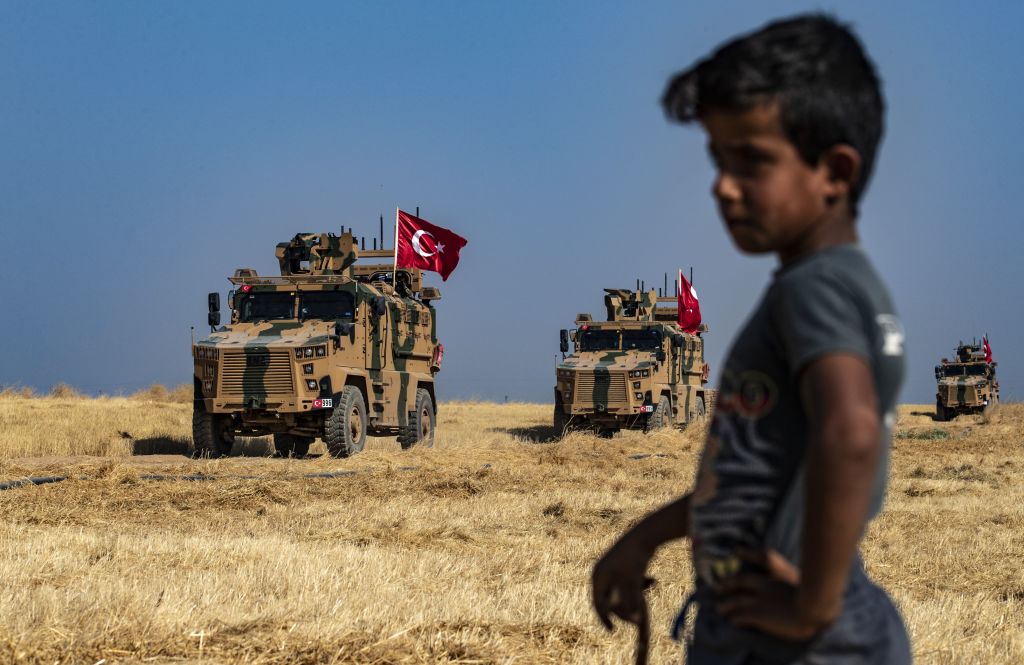
    Between Ankara and Damascus: The role of the Turkish state in north Aleppo
    Turkish army completes round of patrols in Manbij. Credit: Anadolu Agency / Contributor
  • Analysis
  • Between Ankara and Damascus: The role of the Turkish state in north Aleppo

    It’s been nearly three years since the Turkish incursion into northern Syria in August 2016, but one central question remains unanswered: What is Ankara’s plan for the area now under its control? This paper examines the complex relationship between local governance and service provision in the Euphrates Shield (ES) area of north Aleppo and the Turkish state. Using secondary sources and interviews with Syrian and Turkish activists and officials, this paper establishes that, first and foremost, Turkey has no coherent policy with regards to local governance in ES.

    June 20, 2019

    Five scenarios for the US-Iran conflict
    This photo reportedly shows fire and smoke billowing from Norwegian owned Front Altair tanker said to have been attacked in the waters of the Gulf of Oman
  • Analysis
  • Five scenarios for the US-Iran conflict

    The U.S. and Iran are locked in conflict. Regardless of the details or culpability regarding the latest attack on two tankers in the Gulf, the conflict is centered on Washington’s “maximum pressure” campaign and Tehran’s response that it will not sit idly by while its economy is brought to its knees. Paul Salem sketches out five possibilities for where things might be headed.

    June 14, 2019

    Countering Extremism After the Fall of the ISIS Caliphate
  • Podcast
  • Countering Extremism After the Fall of the ISIS Caliphate

    The territorial defeat of ISIS in March 2019 was a significant victory in the fight against terrorism, but the struggle to defeat violent extremism is far from over. Ambassador Edmund Fitton-Brown and Charles Lister join guest host Gerald Feierstein to discuss the latest developments in policy to combat regional terrorist threats.

    June 13, 2019

    Coastal breakdown in Syria creates opportunities for Russia
    Syria's President Bashar al-Assad, Russia's President Vladimir Putin, and Russia's Defence Minister Sergei Shoigu (L-R) at the Russian Hmeimim air base.
  • Analysis
  • Coastal breakdown in Syria creates opportunities for Russia

    The growing power of paramilitary groups and the response of Bashar al-Assad’s foreign backers illustrates how local skirmishes over smuggling routes can have much broader geopolitical implications as Russia gains ground at the expense of both the regime and Iran.

    June 13, 2019