This text has been translated by AI and may contain errors.
Skip to Content

Research & Commentary Results

Filter by
2668 Results
Iran, Russia and the Caucasus
Middle East Institute
  • Podcast
  • Iran, Russia and the Caucasus

    Brenda Shaffer (Georgetown University), Anna Borshchevskaya (Washington Institute for Near East Policy), and Alex Vatanka (MEI) join host Alistair Taylor to discuss how the dynamics between Russia and Iran are playing out in the Caucasus, and what it means for the countries of the region.

    November 18, 2019

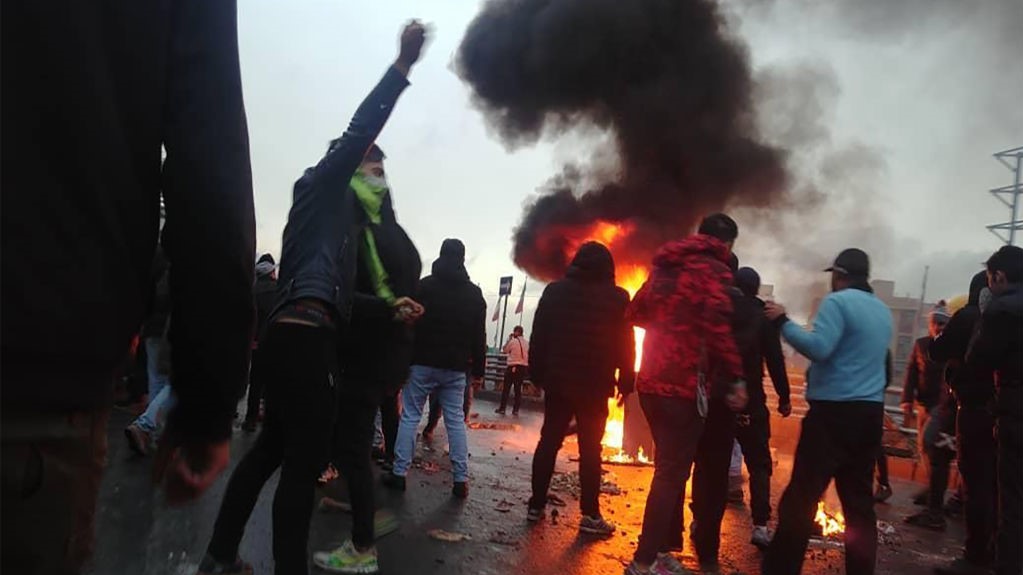
    Iran protests take aim at the regime
    Iranian protesters gather around a burning motorcycle during a demonstration against an increase in gasoline prices in the central city of Isfahan, on November 16, 2019.
  • Commentary
  • Iran protests take aim at the regime

    On the surface the latest protests in Iran appear to be not that different from the previous ones in late 2017 and early 2018. In reality, however, things are quite different this time around, and the Iranian authorities are deeply alarmed.

    Iranian government cuts internet access amid protests
    A man looks at a smartphone in his hand while walking outside along a street in the Iranian capital Tehran on November 17, 2019. - Iran's supreme leader on November 17 threw his support behind a decision to hike petrol prices, a move that sparked nationwide unrest in which he said
  • Commentary
  • Iranian government cuts internet access amid protests

    Amid widespread protests over an abrupt decision to hike gasoline prices by 50 percent, Iran’s internet is out again. The government cut access in what is widely seen as an attempt to stem the flow of information, pictures, and videos of protests that reportedly took place in at least 100 cities and towns and involved an estimated 87,000 Iranians.

    November 18, 2019

    Punching above their weight: Cyber lessons for small states
    The NATO Cooperative Cyber Defence Centre of Excellence (CoE) in Tallinn, Estonia, 14 April 2015.
  • Analysis
  • Punching above their weight: Cyber lessons for small states

    The role of cybersecurity in the future of geopolitics in the Middle East and the surrounding regions will have much to do with individual state and enterprise preparedness. With cyber threats a growing source of interstate tension, governments must take measures to increase national cyber preparedness that are tailored to their vulnerabilities and cyber ecosystems. Israel and Estonia are examples of states that prove this rule. Despite their relatively small size, both have demonstrated an exceptional capacity to deter or defend against cyber aggression from their much larger, more aggressive neighbors.

    November 18, 2019

    Iranian hacking and US election cybersecurity
    Middle East Institute
  • Podcast
  • Iranian hacking and US election cybersecurity

    Emerson T. Brooking of the Digital Forensics Research Lab at the Atlantic Council and Steph Shample of Flashpoint join guest host Mike Sexton, director of MEI’s Cyber Program, to discuss several recent investigations into Iranian and Russian hacking and disinformation campaigns that have targeted US politics and other international organizations.

    November 15, 2019

    Othman & Leila Benjelloun receive 2019 MEI Visionary Award
  • Video
  • Othman & Leila Benjelloun receive 2019 MEI Visionary Award

    Philanthropists Othman & Leila Benjelloun received the 2019 Middle East Institute Visionary Award at MEI’s 73rd Annual Awards Gala on November 12 in Washington, DC.

    November 13, 2019

    Morocco seeks to position itself on the world stage
    This picture taken on June 28, 2019 shows a view of container cranes at terminal I of the Tanger Med port in the northern city of Tangiers on the Strait of Gibraltar
  • Commentary
  • Morocco seeks to position itself on the world stage

    The Royal Institute for Strategic Studies (IRES), charged by the Government of Morocco with analyzing and monitoring the country’s external relations, turned its attention to the U.S.-Morocco relationship at a conference conducted at its Rabat headquarters on Oct. 29. Taking note of the long history of the bilateral relationship — Morocco was one of the first countries in the world to recognize the new American republic in 1777 — panelists reviewed the current state of political, economic, and cultural engagement between the two nations.

    November 12, 2019

    The fall of the other wall
    The US Department of State building is seen in Washington, DC, on July 22, 2019.
  • Analysis
  • The fall of the other wall

    With the fall of the Berlin Wall 30 years ago, ties between Western and Eastern Europe were renewed. In the same period, another wall crumbled — between the Middle East and the former Soviet states. And yet, to this day, U.S. national security institutions continue to view these two regions through a Cold War lens, separating how they are handled. This approach needs to change; integrating research and policy toward the Middle East and the bordering states of the former Soviet Union would improve analytical understanding and help identify new policy options.

    40 years on from the moment that forever changed US-Iranian relations
     People gather in front of the former US Embassy building to stage a protest against United States due to the 40th anniversary of the occupation of former US Embassy building in Tehran, Iran on November 04, 2019.
  • Commentary
  • 40 years on from the moment that forever changed US-Iranian relations

    Taking the American diplomats hostage for 444 days consolidated the Iranian revolution around the Khomeinists, but very few people in Tehran today will deny that it came at the great expense of isolating Iran internationally for the past 40 years.

    Securing the 2020 election from disinformation is going to get complicated
    The fourth Democratic primary debate of the 2020 presidential campaign season co-hosted by The New York Times and CNN at Otterbein University in Westerville, Ohio on October 15, 2019.
  • Commentary
  • Securing the 2020 election from disinformation is going to get complicated

    The increasing involvement of Iran in disinformation and attempted email hacking, in tandem with the revelation of Turla hijacking Iranian hacking infrastructure, risks muddying the waters even further with regard to attributing and countering election interference in 2020.

    October 28, 2019

    Iran may not like it, but it can live with a Turkey-Russia deal on Syria
    A convoy of Russian military vehicles drives toward the northeastern Syrian city of Kobane on October 23, 2019.
  • Commentary
  • Iran may not like it, but it can live with a Turkey-Russia deal on Syria

    While the Iranians would have preferred it if the Turks had not invaded Syria, it does not change their most immediate policy objective, which is the survival of the Assad regime. As long as the Russians keep the Turks away from Assad’s forces, Tehran will, at least in the short term, be able to manage the consequences of Ankara’s actions.

    The US eyes the exit as Afghan election results are once again delayed
    Independent Election Commission (IEC) workers sit at a computer terminal while election information from all over the country is gathered at the Data Centre in Kabul on October 2, 2019. - Voter participation in last weekend's Afghan presidential election will be much less than a third, the country's Independent Election Commission said on October 1, marking a record-low turnout. (Photo by WAKIL KOHSAR / AFP) (Photo by WAKIL KOHSAR/AFP via Getty Images)
  • Analysis
  • The US eyes the exit as Afghan election results are once again delayed

    In a move that surprised no one, on Oct. 19 the Afghan election commission said it was unable to announce the preliminary results of the Sept. 28 presidential election as planned, due to delays in processing biometric data. Held amid political uncertainty, terrorist violence, and general skepticism, the September election was the fourth presidential contest in Afghanistan since 2001, when the brutal Taliban regime was toppled in the wake of the Sept. 11 terror attacks on the United States.

    October 24, 2019

    Divide and Conquer: The Growing Hezbollah Threat to the Druze
    Cover photo: Druze men in the Israeli-annexed Golan Heights look out across the southwestern Syrian province of Quneitra, visible across the border on July 7, 2018. (Photo by JALAA MAREY/AFP/Getty Images)
  • Analysis
  • Divide and Conquer: The Growing Hezbollah Threat to the Druze

    Deep political, familial, and religious ties have allowed Druze communities across the Levant to remain largely unified against external threats, but eight years of violence in Syria and a coordinated campaign by the regime and its allies now threaten to destabilize regional Druze politics and erode the sect’s political and military power. An Iranian-backed campaign by Hezbollah to incite inter-Druze violence in Lebanon has curtailed this unity, laying the groundwork for Hezbollah to expand into Syria’s Suwayda province with impunity.

    October 21, 2019