The Middle East Institute is proud to host Dr. Mona Makram-Ebeid, Professor of Political Science, American University of Cairo, and former Egyptian Parliamentarian, for an examination of the unprecedented changes that have taken place in Egypt over the last three months. Dr. Makram-Ebeid will analyze the current situation in Egypt, as well as expectations for upcoming parliamentary and presidential elections.
Israel After Egypt: Opportunities and Challenges for Peace
The Middle East Institute is proud to host the Honorable Robert Wexler and Dr. Yoram Peri for a discussion about the challenges facing Israel and the Middle East peace process in the wake of the resignation of Egyptian president Hosni Mubarak. Some in Israel, including former Israeli Prime Minister Ehud Olmert, argue that current events in the region make it imperative that Israel move quickly to secure a peace treaty with the Palestinians. Others insist Israel proceed with caution, given the increased instability in the region.
After the People's Revolution: An Examination of the Egyptian Military
The Middle East Institute is proud to host Dr. Graeme Bannerman and Col. Joseph Engelhardt for an in-depth look at the Egyptian military and its anticipated role in the wake of the resignation of Egyptian President Hosni Mubarak. Bannerman and Engelhardt have had extensive interaction with members of the Egyptian military over the past thirty years.
Covering Egypt, Covering Islam: What the Media Get Wrong (and Occasionally Right)
Drawing on over thirty years' experience covering Middle Eastern and Islamic issues, mostly for the BBC, Roger Hardy argues that the media have all too often shown a chronic lack of understanding of Islam and Muslim societies – and by distorting or sensationalizing Muslim issues have made it harder to combat extremism and win the 'war of ideas.' As Arab and Muslim protesters take to the streets of Cairo and the Arab world, Hardy examines if coverage and understanding of the Muslim world has deepened or improved.
After Mubarak:What do the Egyptian People Really Want?
The Middle East Institute is proud to host Steven Kull and Shibley Telhami for an examination of Egyptian views and attitudes towards governance and their future. As Egyptian demonstrators celebrate the resignation of President Hosni Mubarak, many wonder what kind of system the Egyptian people really want. How do they view the Muslim Brotherhood? If Egypt were to become more democratic what are we likely to see in terms of its relation with the US, Israel and other countries in the region?
The Middle East Institute is proud to host Amb. Alan Goulty and Amb. Edward Walker for an examination of the unrest roiling Tunisia and Egypt and its implications for the region at large. Between them, Goulty and Walker have more than 60 years of experience serving in the Arab world. They will draw upon their unique experience and understanding of the region to examine the evolving crises in Tunisia and Egypt, the impact of the street protests on regional governments and the role that Western governments can play during this period of transition.
With Pakistan caught up in four wars during the past nine years — the Afghanistan war, the War on Terror, the insurgency in the tribal areas, and the wave of terrorism unleashed by the Tehrik-i-Taliban (TTP) and the Punjabi Taliban in the rest of the country — it has often been said that the country is facing an existential threat. If this was a cliché before, it is no more so after the catastrophic floods. Pakistan had been living dangerously in the past, but the wars and floods threaten to wash away its future.
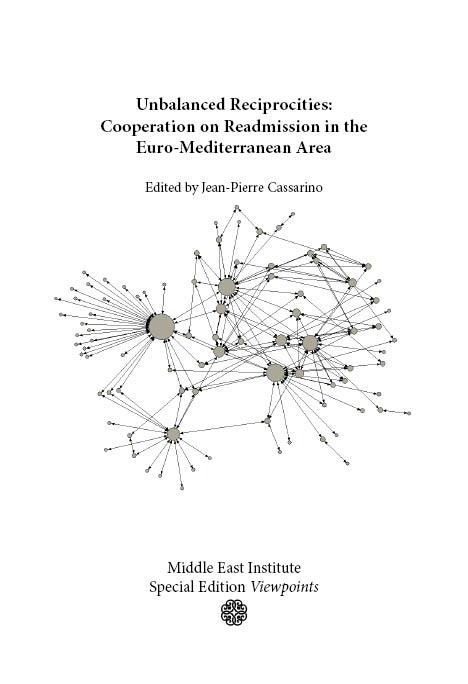
Unbalanced Reciprocities: Cooperation on Readmission in the Euro-Mediterranean Area
Readmission Agreements are a mechanism for countering illegal immigration. Such agreements involve reciprocal undertakings to return illegal residents (or irregular migrants) to their country of origin or transit. This special edition of MEI Viewpoints brings together extensive research on agreements between European and North African states. The following chapters explore what can be argued as the unbalanced costs and benefits for all parties.
The Middle East Institute is proud to host Salman Taseer, the Governor of Pakistan's Punjab province. He will examine Pakistan's accomplishments over the past year and its looming challenges.
Several months ago on a Tuesday afternoon, a local girls football team was practicing on a dirt field in Sidi Moumen, a notorious 350,000-person shantytown on the outskirts of Casablanca, Morocco. A crowd of boys had gathered along the fence. One of the boys began making comments. “Look at her touch on the ball,” he mumbled to his friend, “where did she learn to play football?” “My five-year old brother has better control,” shot back the other, slapping his friend’s hand and laughing.
Children can learn many lessons from playing sports: leadership, self-confidence, and the concept of working toward a common goal are a few such lessons. These are all skills that, when applied in life off the field, can augment the potential for success there as well.