This text has been translated by AI and may contain errors.
Skip to Content

Research & Commentary Results

Filter by
3012 Results
US-Iran escalation and its implications for the South Caucasus
 Iranian President Hassan Rouhani (L) meets President of Azerbaijan Ilham Aliyev (R) during his official visit in Baku, Azerbaijan on March 28, 2018.
  • Analysis
  • US-Iran escalation and its implications for the South Caucasus

    Over the past several weeks geopolitical experts have been talking a lot about what the surprise U.S. drone attack on Iranian Gen. Qassem Soleimani, head of the IRGC – Quds Force, on Jan. 3 means for the Middle East and relations between the major powers. What has received considerably less attention, however, is what Soleimani’s killing means for the South Caucasus, a region whose small size belies its strategic importance.

    January 28, 2020

    Precarious Workers and Neoliberal Narratives in Post-revolutionary Iran: Top-down Strategies and Bottom-up Responses
    Middle East Institute
  • Analysis
  • Precarious Workers and Neoliberal Narratives in Post-revolutionary Iran: Top-down Strategies and Bottom-up Responses

    How did the Islamic Republic of Iran’s dominant narratives over labor evolve since the 1979 revolution? What paved the way to neoliberal discourses, particularly since the 1990s? Which processes and legal measures made workers precarious? What role did workers play, and along which lines did they develop their trajectories of resistance? These questions are at the core of this article, which explores the above-mentioned issues from two different vantage points: a top-down approach, which looks at official narratives, as well as the legal strategies that contribute to the precarization of workers; and a bottom-up perspective, which seeks to understand workers’ practices of resistance and counter-hegemonic actions.

    January 28, 2020

    The day after Soleimani: Israel contemplates “success leveraging”
     A file photo dated September 18, 2016 shows Iranian Revolutionary Guards' Quds Force commander Qasem Soleimani during Iranian Supreme Leader Ayatollah Ali Khamenei's meeting with Revolutionary Guards, in Tehran, Iran.
  • Analysis
  • The day after Soleimani: Israel contemplates “success leveraging”

    Iranian Gen. Qassem Soleimani was on Israel’s “most wanted” list for more than a decade. Israeli intelligence identified him as a looming threat early in his career, and with time he outperformed even the graver threat predictions, as he systematically built the Islamic Revolutionary Guard Corps’ (IRGC) Quds Force into a formidable regional stealth operation. Soleimani was a highly sophisticated executioner of Iran’s long-term strategy, which can be described as an effort to build a “double crescent.”

    The real cost of US-Iran escalation in Iraq
    Iraqi Anti-government demonstrators protest in Tahrir Square in the capital Baghdad, on January 10, 2020.
  • Analysis
  • The real cost of US-Iran escalation in Iraq

    As an Iraqi American who lived through the 1991 Gulf War and 2003 U.S.-led invasion to bring about regime change, I have witnessed firsthand how U.S. wars in the region can break out when Baghdad and Washington fail to understand each other’s intentions and motives.

    January 27, 2020

    Iraq: Sadr withdraws support for protests in a political power play
    Thousands of Iraqis demonstrate in the heart of Baghdad on January 24, 2020 to demand the ouster of US troops from the country.
  • Commentary
  • Iraq: Sadr withdraws support for protests in a political power play

    So far, disproportionate violence by security forces against the civilian protesters has led to the exact opposite of what they sought to achieve, causing protesters’ numbers to swell.

    January 27, 2020

    The ties that bind: The South Caucasus and the Middle East
    Turkish Foreign Affairs Minister Mevlut Cavusoglu (C), Minister of Foreign Affairs of Iran, Javad Zarif (R) and Azerbaijani Minister of Foreign Affairs, Elmar Mammadyarov (L) pose for a photo prior the tripartite meeting of foreign ministers of Turkey, Azerbaijan and Iran in Istanbul, Turkey on October 30, 2018.
  • Analysis
  • The ties that bind: The South Caucasus and the Middle East

    As neighboring regions, the South Caucasus and the Middle East are inextricably intertwined — so much so that the former is sometimes even considered part of the Greater Middle East. While geographical proximity is the strongest driver of interconnectivity between the two regions, geopolitics, business ties, and energy interests also link countries from the South Caucasus and the Middle East and form the basis for important bilateral and regional relationships.

    January 24, 2020

    Iran’s “harsh revenge”: Is blocking the Strait of Hormuz really a plausible option?
    Iranian soldiers take part in the
  • Analysis
  • Iran’s “harsh revenge”: Is blocking the Strait of Hormuz really a plausible option?

    In the immediate aftermath of the assassination of Gen. Qassem Soleimani, head of the Islamic Revolutionary Guard Corps – Quds Force, on Jan. 3, Ayatollah Ali Khamenei warned the U.S. of Iran’s “harsh revenge.” There has been much speculation around the timing, location, and the type (or form) of Iran’s promised revenge. Amin Mohseni-Cheraghlou takes a closer look at the impact of the widely discussed strategy of blocking the Strait of Hormuz.

    January 23, 2020

    Why Iran will keep defying US and EU pressure
    Iranian Supreme Leader Ayatollah Ali Khamenei gives his first Friday sermon after eight years in the Imam Khomeini Musalla, in Tehran, Iran on January 17, 2020.
  • Analysis
  • Why Iran will keep defying US and EU pressure

    On Jan. 5, shortly after Qassem Soleimani was assassinated in Iraq by an American drone strike, Tehran announced that it would no longer remain committed to the enrichment restrictions laid out under the 2015 nuclear deal. Even though European diplomats have rushed to assuage Iranian concerns about the possible resumption of international sanctions, Tehran perceives this as an extension of the U.S. “maximum pressure” campaign and is very unlikely to back down or substantially change its defiant behavior — domestically promoted as a counterpolicy of “maximum resistance” — even if punitive UNSC resolutions against it are reinstated. 

    January 22, 2020

    Qassem Soleimani’s reign may be over, but his legacy in Syria will endure
    yrians take part in a protest against the United States and in support of Iranian general Qassem Soleimani at the Saadallah al-Jabiri Square in Aleppo, northern Syria, on Jan. 7, 2020.
  • Analysis
  • Qassem Soleimani’s reign may be over, but his legacy in Syria will endure

    The U.S. assassination of Iranian Gen. Qassem Soleimani came as a seismic shock to the Middle East, not least to the embattled political system in Damascus that has reaped the benefits of Iran’s military involvement across the region. While his death will be a severe blow, it will not necessarily translate into a decline in Iran’s influence or military presence in Syria. Soleimani’s army of militias and supporters will outlast him, possibly by decades. 

    Where will Iran hit next? Cyber
    A billboard bearing a portrait with the black mourning ribbon of slain Iranian military commander Qasem Soleimani (L) and Iraqi paramilitary chief Abu Mahdi al-Muhandis hangs on a main road in the Iranian capital Tehran on January 4, 2020, one day after Soleimani and other members of the pro-Iranian Iraqi paramilitary group Al-Hashed Al-Shaabi were killed in a US air strike near Baghdad international airport.
  • Analysis
  • Where will Iran hit next? Cyber

    Following the recent escalation in U.S.-Iran tensions, the threat of Iranian cyberattacks is likely to intensify in the near to medium term. There are three possible fronts where Iran might look to carry out cyber operations: targeting the energy infrastructure of America’s Gulf allies; deploying malware against U.S. private sector companies; and launching disinformation campaigns that would aim to influence public opinion in both the Middle East and the U.S. 

    Trends to Watch in the Middle East in 2020
    Middle East Institute
  • Podcast
  • Trends to Watch in the Middle East in 2020

    MEI experts Robert S. Ford, Fatima Abo Alasrar, and Emad Badi join host Alistair Taylor to survey what lies ahead for the Middle East in 2020, with particular attention to Iran, Syria, Yemen, Libya, Iraq and Algeria.

    January 17, 2020

    The EU and the ongoing US-Iran crisis
  • Analysis
  • The EU and the ongoing US-Iran crisis

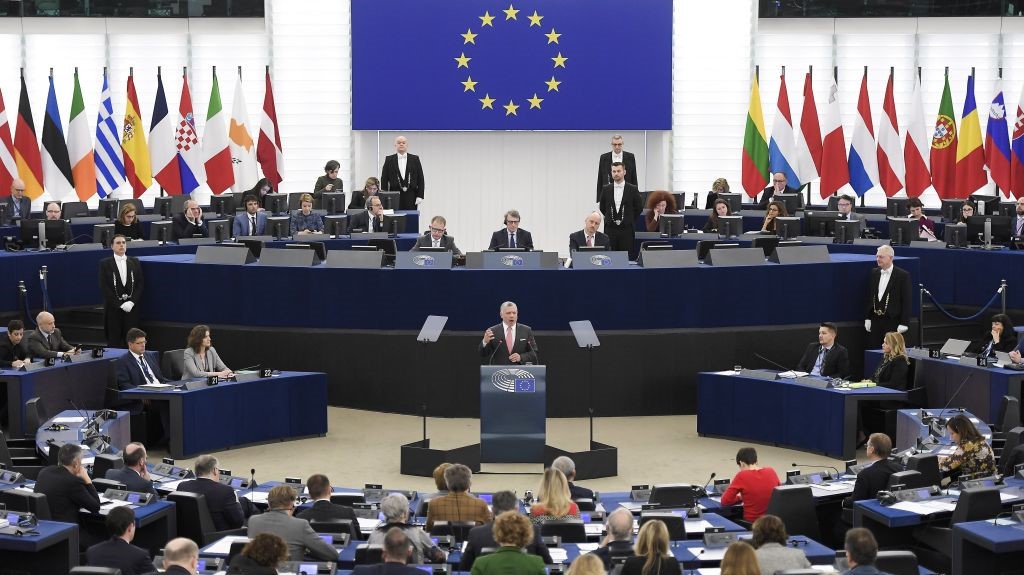
    President Donald Trump’s decision to eliminate Iranian Gen. Qassem Soleimani, the head of the Islamic Revolutionary Guard Corps – Quds Force, might have caught his European partners by surprise, but it shouldn’t have. Key European decision makers have had enough time to learn and understand that the U.S. president makes unilateral decisions, paying no attention to their views or national interests. Throughout the ongoing crisis, Trump has called on European allies to sacrifice the Joint Comprehensive Plan of Action (JCPOA), as the Iran nuclear deal is officially known, and exert more diplomatic and economic pressure on Tehran — a call no one wants to heed. It is irrelevant which side is right; lack of transatlantic solidarity is a disservice to both American and European interests in the Middle East.

    January 16, 2020

    Turkey’s westward energy shift
    President of Turkey Recep Tayyip Erdogan and his Russian counterpart Vladimir Putin (not seen) attend the opening ceremony of TurkStream natural gas pipeline project, at Halic Congress Center in Istanbul, Turkey on January 08, 2020.
  • Analysis
  • Turkey’s westward energy shift

    On Jan. 8, Turkey inaugurated the TurkStream natural gas pipeline from Russia, seemingly deepening Ankara’s ties with Moscow. However, a fuller analysis of Turkey’s current energy policies and consumption trends indicate a dramatic shift westward, away from Russia and Iran.

    January 15, 2020

    The killing of Qassem Soleimani: Was there a better way?
     A file photo dated September 18, 2016 shows Iranian Revolutionary Guards' Quds Force commander Qasem Soleimani during Iranian Supreme Leader Ayatollah Ali Khamenei's meeting with Revolutionary Guards, in Tehran, Iran.
  • Analysis
  • The killing of Qassem Soleimani: Was there a better way?

    In the early hours of Jan. 3, 2020, a U.S. Military MQ-9 drone fired multiple air-to-ground missiles and killed the commander of the elite Iranian Islamic Revolutionary Guard Corps (IRGC) – Quds Force, Major General Qassem Soleimani. The targeted killing of Soleimani was carried out as he left the Baghdad International Airport under overt military authorities. Given that the strike was carried out under this authority, it was publicized globally shortly after it was completed. There were other options available to target Soleimani, however.