This text has been translated by AI and may contain errors.
Skip to Content

Research & Commentary Results

Filter by
1369 Results
Pakistan’s Gen. Bajwa gets an extension amid political drama
Pakistan Army Chief General Qamar Javed Bajwa arrives to attend the Pakistan Day parade in Islamabad on March 23, 2019.
  • Analysis
  • Pakistan’s Gen. Bajwa gets an extension amid political drama

    Understanding a state and its society involves understanding how the state treats its military, its record of governance, and the relationship between the military and civilian politicians. By all accounts, Pakistan, a state founded in 1947 as a homeland for the Muslim population of British India, is a unique case where the military dominates all other institutions in both state and society. This was on clear display in the recent court battle over the extension of Army Chief of Staff Gen. Qamar Javed Bajwa’s tenure.

    December 6, 2019

    Could a gas cartel become as powerful as OPEC?
  • Analysis
  • Could a gas cartel become as powerful as OPEC?

    The 12-country Gas Exporting Countries Forum (GECF), which held its latest meeting in Equatorial Guinea on Nov. 28, has never had OPEC’s ability to control energy prices, but that is likely to change as liquefied natural gas (LNG) transforms the gas market from a regional to a global one.  

    December 6, 2019

    Gen. Votel on US Policy in Afghanistan
    Middle East Institute
  • Video
  • Gen. Votel on US Policy in Afghanistan

    Gen. (Ret.) Joseph Votel discusses the role of Afghanistan in US regional strategic interests, whether a peace deal is possible with the Taliban, and how important Pakistan is to achieving a sustainable political settlement.

    December 3, 2019

    The Caucasus and the Middle East
    Georgian soldiers run during a farewell ceremony before their departure to Afghanistan in Tbilisi, June 27, 2013.
  • Analysis
  • The Caucasus and the Middle East

    For years, politics and conflicts in the Middle East have spilled over into many other regions of the world. Refugee crises, terrorism, and political instability in the Middle East have impacted foreign and domestic policy and politics in North America and Europe, but the Caucasus is much closer and, therefore, a particularly important case for policymakers in Washington and Brussels.

    December 2, 2019

    US-Taliban talks are back on but little has changed
    US President Donald Trump holds a bilateral meeting with Afghan's President Ashraf Ghani at Bagram Air Field during a surprise Thanksgiving day visit, on November 28, 2019 in Afghanistan.
  • Commentary
  • US-Taliban talks are back on but little has changed

    President Donald Trump’s lightning fast roundtrip to Bagram airbase north of Kabul had its share of surprises. In addressing troops, he confirmed previous reports that talks are once again underway with the Taliban, but then went on to inject a ceasefire as a condition for a new agreement.

    A prisoner swap with the Taliban, but will it lead to anything?
    Security stands guard at the Ghani headquarters on September 29, 2019 in Kabul, Afghanistan.
  • Commentary
  • A prisoner swap with the Taliban, but will it lead to anything?

    Last week saw the Taliban’s release of two kidnapped professors in exchange for the Kabul government’s freeing of three prized Taliban prisoners. While the swap may have been necessary on humanitarian grounds, it was unfortunate otherwise. Rather than defending the swap on its own merits, Kabul and Washington are hailing the exchange as a possible breakthrough following the collapse of the Doha agreement and the stalling of planned intra-Afghan discussions.

    Traces of the 1979 assault on the Grand Mosque still roil the Middle East today
     Muslim pilgrims gather at the Grand Mosque in Saudi Arabia's holy city of Mecca on August 7, 2019, prior to the start of the annual Hajj pilgrimage in the holy city.
  • Commentary
  • Traces of the 1979 assault on the Grand Mosque still roil the Middle East today

    Four decades on, echoes of the November 1979 assault on the Grand Mosque in Mecca continue to reverberate. Coming on the heels of the Iranian revolution and days after the Iran hostage-taking, the Mecca attack, carried out by a group of several hundred Saudi extremist Islamists declaring a new Mahdi, shocked the Sunni world and pushed Muslims in a far more conservative direction.

    November 20, 2019

    Setting the Middle Corridor on track
    China Railway Express crosses Istanbul's sub-sea tunnel, Marmaray (the railway system linking the eastern and western sides of Istanbul from under the Marmara Sea) in Istanbul, Turkey on November 7, 2019. The first freight train from China crossed to Europe using Marmaray.
  • Analysis
  • Setting the Middle Corridor on track

    China’s Belt and Road Initiative (BRI) has been a powerful driver of the development of existing and new Eurasian rail routes. A web of competing and complementary rail lines has begun to form across the Eurasian landmass. Railway cargo service between China and Europe has fast become a compelling “middle option” — cheaper than air and faster than sea.

    The Saudi Aramco IPO: Short-term success, long-term loss
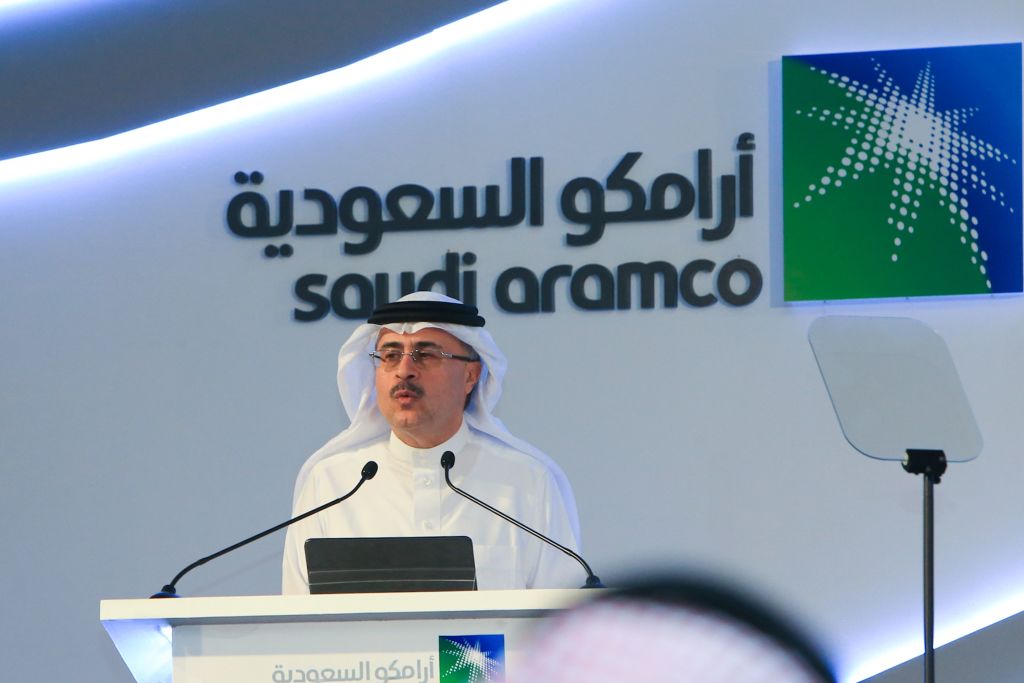
    A picture taken on November 3, 2019 shows a sign of Saudi Aramco's initial public offering (IPO) during a press conference by the state company in the eastern Saudi Arabian region of Dhahran.
  • Commentary
  • The Saudi Aramco IPO: Short-term success, long-term loss

    The Saudi Aramco IPO got started this Sunday morning with shares priced at SAR 30-32 ($8-8.50) each, valuing the company at $1.7 trillion, $300 billion below the original estimate. The lower valuation has been expected for some time by most investment banks and many financial analysts. The proceeds are expected to fund the Public Investment Fund’s forays into non-energy-based companies, advanced technologies, and even robot-filled cities.

    November 18, 2019

    Punching above their weight: Cyber lessons for small states
    The NATO Cooperative Cyber Defence Centre of Excellence (CoE) in Tallinn, Estonia, 14 April 2015.
  • Analysis
  • Punching above their weight: Cyber lessons for small states

    The role of cybersecurity in the future of geopolitics in the Middle East and the surrounding regions will have much to do with individual state and enterprise preparedness. With cyber threats a growing source of interstate tension, governments must take measures to increase national cyber preparedness that are tailored to their vulnerabilities and cyber ecosystems. Israel and Estonia are examples of states that prove this rule. Despite their relatively small size, both have demonstrated an exceptional capacity to deter or defend against cyber aggression from their much larger, more aggressive neighbors.

    November 18, 2019

    Balance in the Black Sea: The complex dynamic between Turkey, Russia, and NATO
    Russian Tapir class landing warship BSF Nikolay Filchenkov 152 passes the Bosphorus Strait off Istanbul on October 18, 2016.
  • Analysis
  • Balance in the Black Sea: The complex dynamic between Turkey, Russia, and NATO

    Turkey’s relations with its Western allies are at an all-time low while its partnership with Russia is flourishing. Since Russia began delivery of its S-400 advanced aerial defense system in July, questions have abounded about Turkey’s future in the NATO alliance. Such concerns are not baseless. Turkey-Russia ties have never been closer. The two countries cooperate closely not only on energy and trade but also in the defense sector. But fears of a Turkish withdrawal from the alliance overlook the continued tension between Ankara and Moscow, which makes NATO an indispensable partner for Turkey.

    Pakistan’s anti-government protests put Khan in a bind
    Activists and supporters of Islamic political party Jamiat Ulema-e-Islam (JUI-F) attend an anti-government
  • Analysis
  • Pakistan’s anti-government protests put Khan in a bind

    Pakistan’s capital, Islamabad, has been paralyzed in recent days by supporters of Maulana Fazlur Rehman and his Jamiat-Ulema-e-Islam (JUI-F), a well-entrenched Islamist party. The protestors are seeking the resignation of the military-backed Prime Minister Imran Khan and fresh elections, and the demonstration has emerged as an existential problem for Khan.

    November 9, 2019

    Despite the hurdles, an opportunity for de-escalation in Yemen
    ) Yemeni Deputy Prime Minister Ahmed Saeed al-Khanbashi (R) and Southern Transitional Council (STC) representative Nasser al-Habci (L) are seen during a signing ceremony of 'Riyadh Agreement' between the Yemeni government and the United Arab Emirates (UAE)-backed separatist forces, Southern Transitional Council (STC) in Riyadh, Saudi Arabia on November 05, 2019.
  • Analysis
  • Despite the hurdles, an opportunity for de-escalation in Yemen

    After more than two months of Saudi-mediated indirect talks between the Republic of Yemen Government (ROYG) and the UAE-backed Southern Transitional Council (STC), the two sides finally reached a deal on Nov. 5. The Saudi effort, which culminated in the signing of the Riyadh Agreement, is aimed at resolving the conflict within the Arab coalition-backed front and uniting the two parties in the fight against the Iranian-backed Houthi militias. The agreement, which spans political, economic, security, and military arrangements, involves restructuring the executive, military, and security branches of the ROYG, partial disarmament of STC-loyal forces, and the demilitarization of Aden — all of which will be phased in over the next three months.

    November 8, 2019

    The fall of the other wall
    The US Department of State building is seen in Washington, DC, on July 22, 2019.
  • Analysis
  • The fall of the other wall

    With the fall of the Berlin Wall 30 years ago, ties between Western and Eastern Europe were renewed. In the same period, another wall crumbled — between the Middle East and the former Soviet states. And yet, to this day, U.S. national security institutions continue to view these two regions through a Cold War lens, separating how they are handled. This approach needs to change; integrating research and policy toward the Middle East and the bordering states of the former Soviet Union would improve analytical understanding and help identify new policy options.

    Saudi Arabia’s quick fix of Yemen’s southern conflict will face a durability problem
    A fighter of the UAE-trained Security Belt Force, dominated by backers of the the Southern Transitional Council (STC) which seeks independence for south Yemen, mans the turret of a technical (pickup truck mounted with an anti-aircraft gun) displaying portraits of separatist leader Aidarus al-Zubaidi and showing the logo of the STC, in the Crater district in the centre of Yemen's second city of Aden on August 12, 2019.
  • Analysis
  • Saudi Arabia’s quick fix of Yemen’s southern conflict will face a durability problem

    After violent confrontations with the government of Yemen and repeated struggles for autonomy, members of the Southern Transitional Council (STC), which represents a political movement that calls for secession, appeared satisfied with the terms of a deal that will be signed with the government of Yemen in Riyadh on Oct. 31. The Saudi-brokered agreement united the conflicting parties in their fight against the Iran-backed Houthis, with a strong vision aimed at stopping any side-show that could endanger this effort.

    October 29, 2019