Turkey as an Alternative Democratization Model for the Middle East
The popular uprisings against authoritarian regimes in Tunisia, Yemen, Jordan and Egypt herald the beginning of a new political era in the Middle East. At the center of this new political order is a generation of young Arabs, educated, highly marginalized, and numerous. The members of the so-called Arab “youth bulge” are demanding neither the unification of the Arab world as espoused by the pan-Arabists of the 1960s, nor an Islamic state of the 1980s, but rather a dignified life, social justice, and freedom.
A New Paradigm of Educational Borrowing in the Gulf States: The Qatari Example
More than in any other world region, the Arab Gulf states are experiencing a “higher education boom” in terms of the quantity and quality of institutions and programs now available. Over the past two decades, the Gulf states have imported a Western, largely American, model of higher education to address inefficiencies in labor markets and invest in their economic futures, to meet national reform agendas, and in some cases, to function as profit-making ventures.
Turkey's Dual Track Approach Toward the Kurdistan Regional Government
Turkey’s policy toward the Kurdistan Regional Government (KRG) in northern Iraq has undergone an important shift since 2009. Only a few years ago, Turkey did not recognize Iraq’s Kurdish Regional Government and refused to meet with its representatives in any official capacity due to its fear that recognition would embolden Turkey's own Kurdish minority to demand similar home-rule status.
Turkey’s professional military has been a force for modernization and progress throughout the nation’s history. As the constitutionally-appointed guardian of the Turkish Republic, however, the military has often intervened in political affairs, resulting in a constant, underlying tension between the government and the military establishment in Turkey.
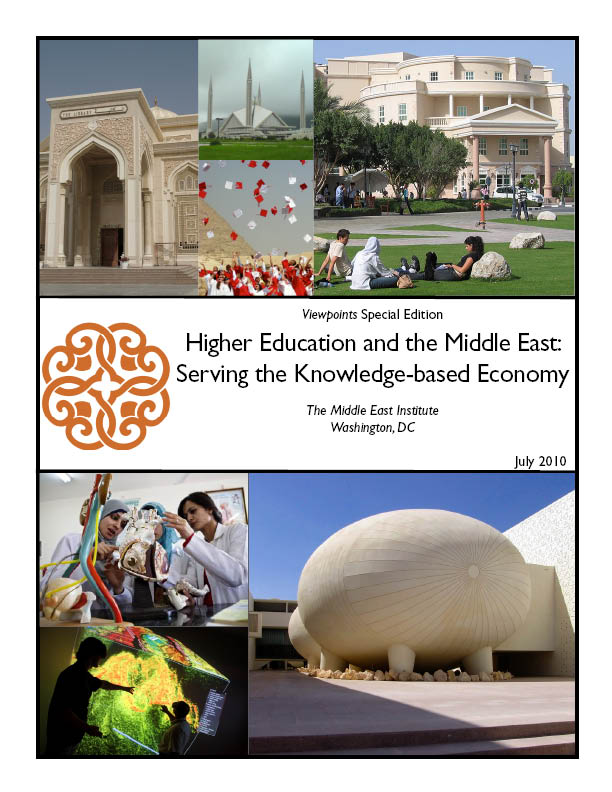
Higher Education and the Middle East: Serving the Knowledge-based Economy
This is the first of three volumes examining the internationalization of higher education and the Middle East. The 12 essays included in this volume explore some of the changes that are taking place and the challenges that lie ahead as Middle Eastern countries seek to build sustainable higher education systems and strengthen their economies. Within the dynamic global higher education landscape, is the Middle East a stagnant backwater or a center of creative initiative? What are, and should be the roles of foreign partners and providers?
United States Will Pay a Heavy Price for the Gaza Flotilla Incident
Asserting its need to be secure from future terrorism launched from Gaza, Israel used force last week to maintain a blockade that has been creating a humanitarian cataclysm for the people of Gaza. In the early days following the attack on the aid flotilla, the Israeli military interpretation of events dominated much of the popular media coverage in the United States. Gradually, though, attention shifted to the incident’s negative impact on Israel’s international standing and the security implications of continued international and regional uproar.
Turkey and the Middle East: Ambitions and Constraints
Hugh Pope, Turkey/Cyprus Project Director for the International Crisis Group (ICG), discussed the issue of recent speculation regarding Turkey’s “shift away from the West.”
Turkey and Israel: What Lies Behind the Recent Volte Face
In recent months, the Israeli-Turkish relationship, strong and stable during the 1990s, has been placed under severe pressure. Tensions began in January 2009 when Israel launched military operations in Gaza, later prompting Turkish Prime Minister Recep Tayyip Erdogan to walk out of a televised debate with Israeli President Shimon Peres following a heated exchange over the issue.
Over the past decade, migration to the wealthy states of the Arabian Peninsula has emerged as an increasingly central facet of scholarly attention to the region. This attention has resulted in the exponential expansion of our collective knowledge, and the near future promises even more nuanced and microcosmic analyses as recent and current fieldwork in the region bears fruit. Nevertheless, there has been little discussion of the “labor camps” in which many of the unskilled migrants dwell during their sojourn in the Gulf states.