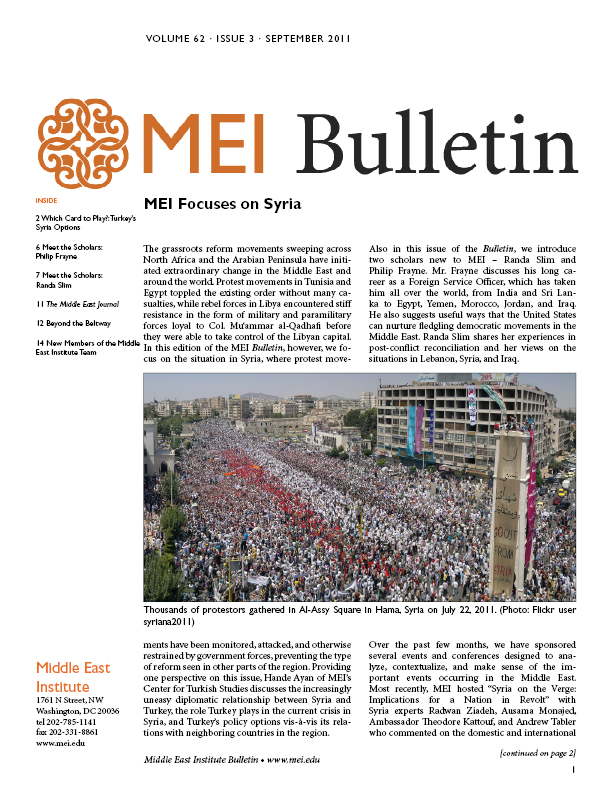
Amidst ongoing violence against protestors in Syria, Hande Ayan of the Center for Turkish Studies discusses the uneasy diplomatic relationship between Turkey and Syria and Turkey’s role in the political situation there. The September 2011 Bulletin also introduces MEI scholars Philip Frayne, who speaks on his Foreign Service career and offers his insights on how the US can support democratic transitions in the Middle East, and Randa Slim, who is interviewed on her experience in post-conflict reconciliation.
When President Obama met with Turkish Prime Minister Recep Tayyip Erdogan on Tuesday, the two discussed cooperation on Syria, counter-terrorism and supporting the Arab spring. But a central theme of the talks, and what most concerns the U.S. at the moment, is a sharply deteriorating Turkish relationship with Israel that the U.S. hopes to reverse. Conversely, this deterioration was the source of much acclaim when Erdogan visited Arab spring countries last week.
The release of last week’s UN Palmer Report, assessing Israel’s attack on the Mavi Marmara and five other ships carrying aid to Gaza, sparked outrage in Turkey. Many criticized the report’s alleged bias, and claimed it failed to provide a credible legal analysis of the Mavi Marmara incident in which nine Turkish citizens were shot to death by Israeli commandos, some at close range and from behind.
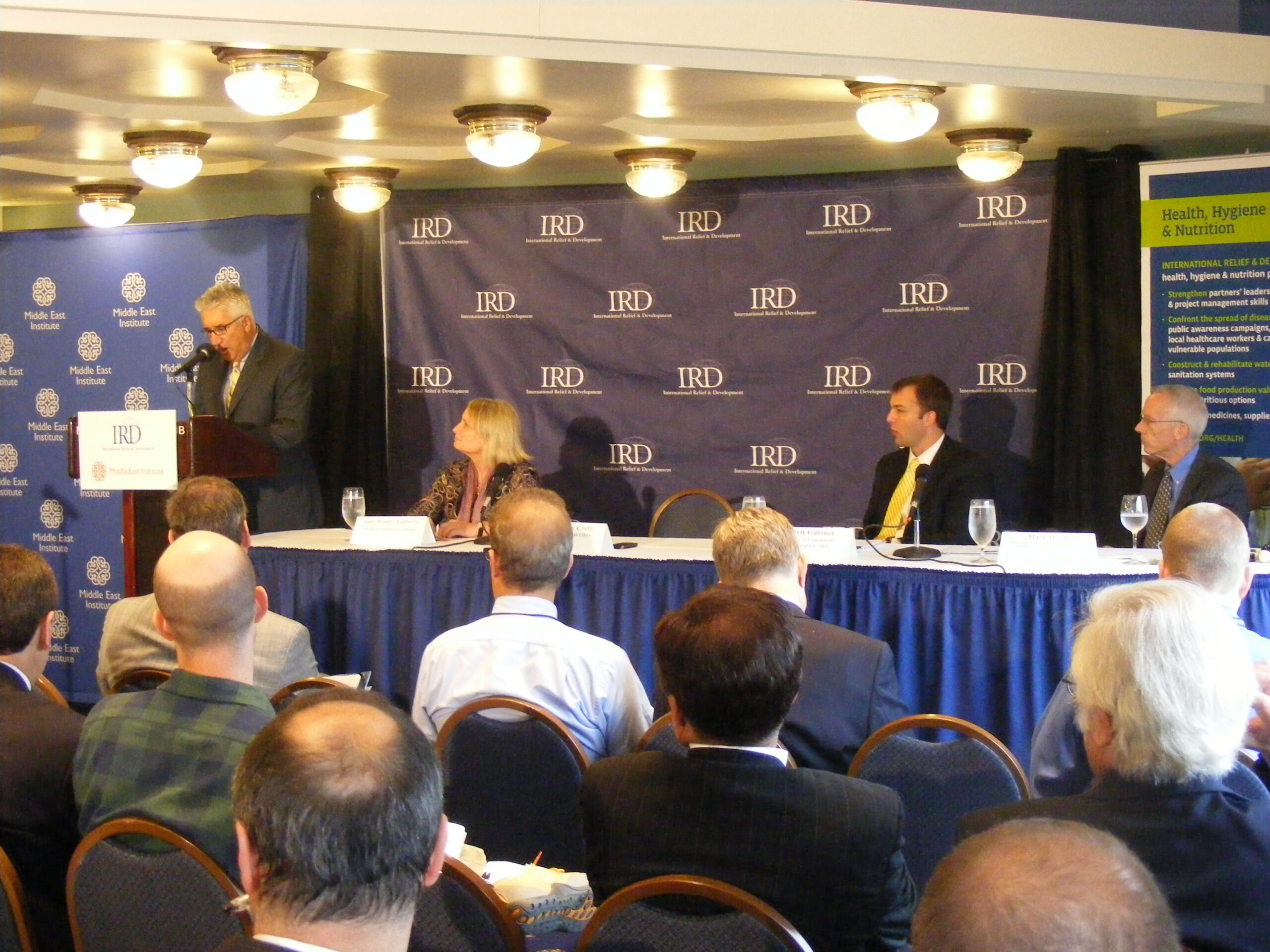
Rebuilding Libya: A Status Report on the Humanitarian Situation on the Ground
Speakers: Amb. Wendy Chamberlin, MEI President
Amb. Gene Cretz, US Ambassador to Libya
Mark Ward, Deputy Assistant Administrator for the Bureau of Democracy, Conflict, and Humanitarian Assistance, USAID
Travis Gartner, Director of Community Stabilization, IRD
Governments in the Middle East and North Africa have long relied on repression to intimidate, harass, and punish political opponents. During the Arab uprisings, dictators under threat have all ordered and used violence against peaceful protestors as a way to maintain power. But this repression has had widely divergent effects on the course of the different conflicts.
This Commentary was first published as an op-ed in the Washington Post on August 22, 2011
A relatively successful transition from the Gaddafi regime to a united, stable, more open and democratic Libya would be seen in the region, and more widely, as a credit to the NATO-led intervention. It would enable Libya to resume its oil and gas exports, demonstrate international community capacity to manage such transitions and encourage positive outcomes to other Arab Spring protests.
F. Stephen Larrabee, Distinguished Chair in European Security at the RAND Corporation, and Gonul Tol, Executive Director of the Middle East Institute’s Center for Turkish Studies, highlight the importance of drafting a new civilian constitution to solve Turkey’s Kurdish issue.
The recent uprisings in Bahrain, Egypt, Libya, Syria, Tunisia, and Yemen share associated economic grievances and a common call for responsive government and a more dignified way of life; however, their underlying social dynamics are the product of diverse encounters with the outside world and years of oppression under very different political regimes. This is particularly true in the Libyan case, where socioeconomic and political structures and institutions shaped before as well as during the Qadhafi years have combined to produce a unique political economy.
*This Commentary first appeared on neimanwatchdog.org on July 8, 2011
While political debate still roils over the legality of the American role in Libya, other questions have grown more pressing. Those questions include whether the European side of the NATO operation can be sustained and whether the Libyan opposition truly has the ability to achieve their goal of taking down the regime of Muammar Qaddhafi & Co.
These issues are critical for those favoring US participation in NATO operations as well as those opposed.
After the Arab Spring: Toward Political & Economic Inclusion in the Arab World
The Middle East Institute and the UNDP are proud to host a discussion with UNDP Administrator Helen Clark, Under Secretary for Economic, Energy and Agricultural Affairs Robert D. Hormats, and Middle East Institute Scholar Amb. Edward Walker about how best to address political, economic and human development needs in the Arab world today.