*This article originally appeared in the Project Syndicate online on May 23, 2011.
As the Arab Spring enters its fourth month, it faces challenges but also presents opportunities. Despite setbacks in Libya, Yemen, and Syria, the democratic wave has already begun to change the Middle East’s political landscape.
The Upcoming Turkish Elections: Implications for Domestic and Foreign Policy
The Middle East Institute's Center for Turkish Studies is proud to host Mr.Taha Ozhan, Director General of the Foundation for Political, Economic and Social Research (SETA Ankara), for a discussion on Turkey's upcoming elections on June 12.
Various Track Two approaches to peacebuilding in the Middle East have been pursued through ecumenical dialogue and educational programs such as The University of the Middle East Project.[1] Yet the direct use of environmental conservation as a mutually agreeable way to approach territorial conflict resolution has thus far not been seriously deliberated. Some “realists” might be dismissive of such a prospect, but the concept of “peace parks” has shown practical promise in resolving territorial disputes.
Environmental Peacebuilding in the Eastern Mediterranean
Environmental peacebuilding is both the theory and practice of identifying environmental initiatives that promote a sustainable peace between those who have previously been adversaries, and implementing those initiatives. Environmental peacebuilding combines two elements.
Arava Institute for Environmental Studies: Teaching Environment as a Bridge to Peace & Understanding in the Middle East
The Arava Institute for Environmental Studies (AIES) is the premier environmental studies institute in the Middle East and is accredited under the auspices of the Ben Gurion University (BGU) of the Negev. Since 1996, the Institute has been teaching environmental studies to university students from the Middle East and other parts of the world. The unique approach of the Institute is to teach the environment, in which all share, as a bridge to cooperation and peacebuilding in the Middle East.
Turkey as an Alternative Democratization Model for the Middle East
The popular uprisings against authoritarian regimes in Tunisia, Yemen, Jordan and Egypt herald the beginning of a new political era in the Middle East. At the center of this new political order is a generation of young Arabs, educated, highly marginalized, and numerous. The members of the so-called Arab “youth bulge” are demanding neither the unification of the Arab world as espoused by the pan-Arabists of the 1960s, nor an Islamic state of the 1980s, but rather a dignified life, social justice, and freedom.
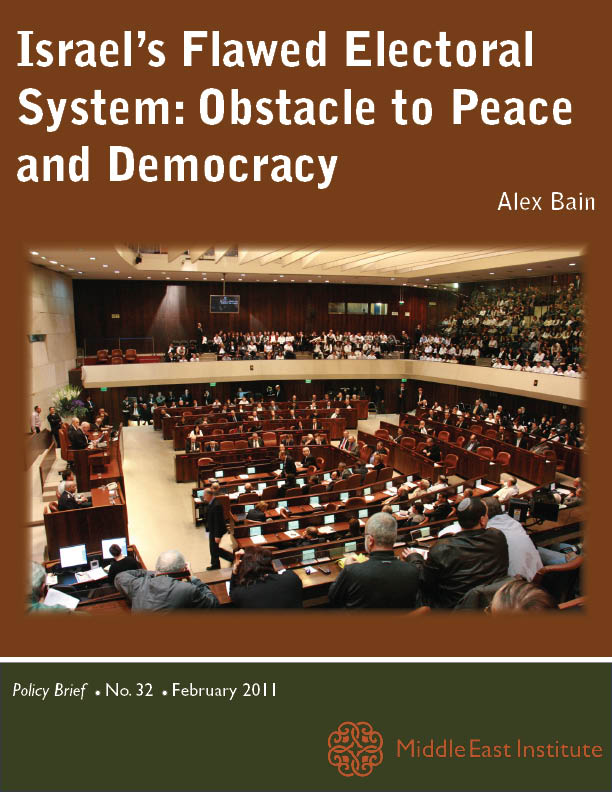
Israel's Flawed Electoral System: Obstacle to Peace and Democracy
Israeli politics is notable for its wide array of parties and unstable coalition governments. The main institutional cause of this chronic instability is the system of nationwide proportional representation, which gives disproportionate influence to minor parties. This instability limits the ability of Israeli governments to pursue coherent long-term strategies and leads to policies that address the concerns of minority groups at the expense of the national interest.
Turkey's Dual Track Approach Toward the Kurdistan Regional Government
Turkey’s policy toward the Kurdistan Regional Government (KRG) in northern Iraq has undergone an important shift since 2009. Only a few years ago, Turkey did not recognize Iraq’s Kurdish Regional Government and refused to meet with its representatives in any official capacity due to its fear that recognition would embolden Turkey's own Kurdish minority to demand similar home-rule status.
Turkey’s professional military has been a force for modernization and progress throughout the nation’s history. As the constitutionally-appointed guardian of the Turkish Republic, however, the military has often intervened in political affairs, resulting in a constant, underlying tension between the government and the military establishment in Turkey.
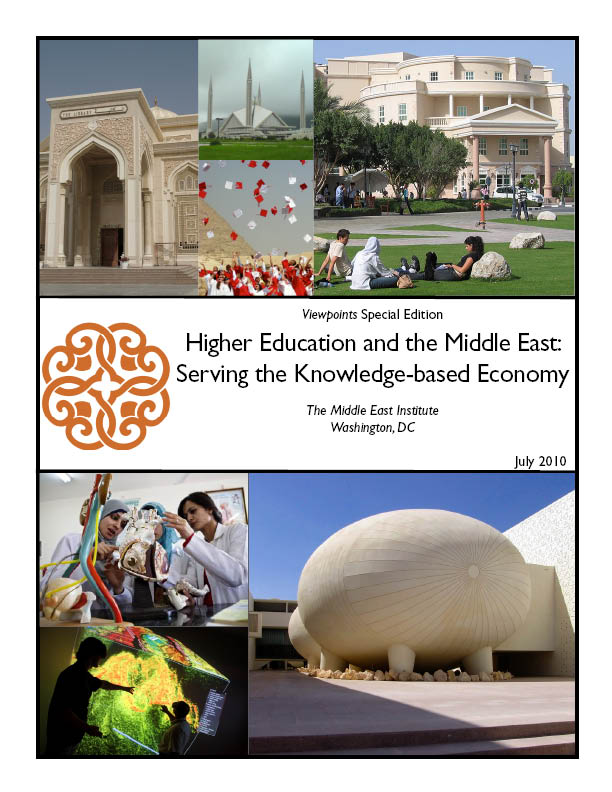
Higher Education and the Middle East: Serving the Knowledge-based Economy
This is the first of three volumes examining the internationalization of higher education and the Middle East. The 12 essays included in this volume explore some of the changes that are taking place and the challenges that lie ahead as Middle Eastern countries seek to build sustainable higher education systems and strengthen their economies. Within the dynamic global higher education landscape, is the Middle East a stagnant backwater or a center of creative initiative? What are, and should be the roles of foreign partners and providers?
United States Will Pay a Heavy Price for the Gaza Flotilla Incident
Asserting its need to be secure from future terrorism launched from Gaza, Israel used force last week to maintain a blockade that has been creating a humanitarian cataclysm for the people of Gaza. In the early days following the attack on the aid flotilla, the Israeli military interpretation of events dominated much of the popular media coverage in the United States. Gradually, though, attention shifted to the incident’s negative impact on Israel’s international standing and the security implications of continued international and regional uproar.