Business Elites, Unofficial Citizenship, and Privatized Governance in Dubai
Several scholars of citizenship and migration in the oil-rich Gulf Arab states have noted the divisions between citizens and non-citizens in terms of mobility, access, geographic location, job prospects, and rights (or lack thereof) in these countries.[1]These “rentier” states, such as the United Arab Emirates (UAE), which rely on oil for the majority of their income, highly police the boundaries of citizenshi
Westerners in the United Arab Emirates: A View from Abu Dhabi
It is not hyperbole to say that Emirati nationals (al-muwatinin) are vastly outnumbered by foreigners in their country at a ratio higher than almost anywhere else on earth. And, while a growing ethnographic literature documents late 20th century trends among South Asian migrant workers in the Gulf states, few have examined the less populous though highly visible and influential Westerners who work and live there. They deserve our attention.
Iranian Migrants in the Arab Countries of the Persian Gulf
This essay examines migration from the Iranian coastal region of the Persian Gulf to the nearby Arab countries. At the center of this research are questions of cross-border relationships, the construction of transnational spaces in border migration, and strategies for maintaining networks in both the home and host countries.
Over the past decade, migration to the wealthy states of the Arabian Peninsula has emerged as an increasingly central facet of scholarly attention to the region. This attention has resulted in the exponential expansion of our collective knowledge, and the near future promises even more nuanced and microcosmic analyses as recent and current fieldwork in the region bears fruit. Nevertheless, there has been little discussion of the “labor camps” in which many of the unskilled migrants dwell during their sojourn in the Gulf states.
Families and Bachelor: Visa Status, Lives, and Community Structure among Bahrain's Foreign Residents
Formal and informal practices of immigration and employment in the Gulf render inappropriate the classic image of an individual immigrant arriving to set stake and soon send for family. The majority of the foreigners in Bahrain reside there without family and until the 1980s were overwhelmingly male. Nonetheless, over the past century, the unique histories and circumstances of the various nationalities resident in Bahrain have led to the emergence and entrenchment of communities of foreigners.
Omanization Policy and International Migration in Oman
The six states of the Gulf Cooperation Council (GCC)[1]have over five million migrant workers — one of the highest concentrations of migrant workers in the world. According to the World Migration Report (2003), 25% of the workers in Saudi Arabia, 65% in Kuwait, 67% in the UAE, and as much as 70% in Qatar are immigrants or non-nationals.
Paradigm Shifts in India's Migration Policy Toward the Gulf
From fewer than 258,000 in 1975, the migrant Indian population in the Gulf rose to 3.318 million in 2001 and is now estimated at over four million. Indian migrant workers in the GCC countries belong to all three categories of labor: 1) professionals (e.g., doctors, nurses, engineers, architects, accountants, and managers), 2) semi-skilled workers (e.g., craftsmen, drivers, artisans, and other technical workers), and 3) unskilled laborers in construction sites, farmlands, livestock ranches, shops and stores, and households.
Labor Migration in the GCC Countries: Some Reflections on a Chronic Dilemna
After four decades of successive waves of labor migration to the GCC states, three fundamental questions are still subject to debate: In what way can we better comprehend the role and functions in the Arab Gulf societies of this unique phenomenon? How should we assess the labor migrations policies adopted by the countries of this region? What are the possible outcomes of the current trends of this process?
What the US Can Learn from the Gulf States about Immigration: Visa Bonds and a Novel Proposal for Financing Them
Consider the following fact pattern regularly encountered by Iraqi immigration officers: a poor South Asian farmer submits an application for a temporary guest worker visa that would allow him to take a housekeeping position on an American military base. The Iraqi immigration officer is concerned about two potential difficulties with the application. First, the prospective migrant may overstay his visa. Second, the applicant may impose welfare costs on the state.
The flow of ideas, people, and commerce across national boundaries has been occurring with breathtaking rapidity in the broader Middle East, as elsewhere. These increasingly dense exchanges have generated new threats and vulnerabilities that have tended to impact women, children, and the poorest members of society disproportionately. At the same time, however, they have given people more resources and opportunities with which to shape their lives and their futures.
Kuwait Looks towards the East: Relations with China
Originally posted September 2009
There is a growing tendency among the Gulf Cooperation Council (GCC) states to benefit from the favorable conditions in the rapidly growing economies of the East. As was amply demonstrated at a symposium organized by the Centre for Gulf and Arabian Peninsula Studies at Kuwait University in May 2009 on the “Reality of GCC-Asian Relationship — opportunities and challenges,” Kuwait exemplifies this trend.
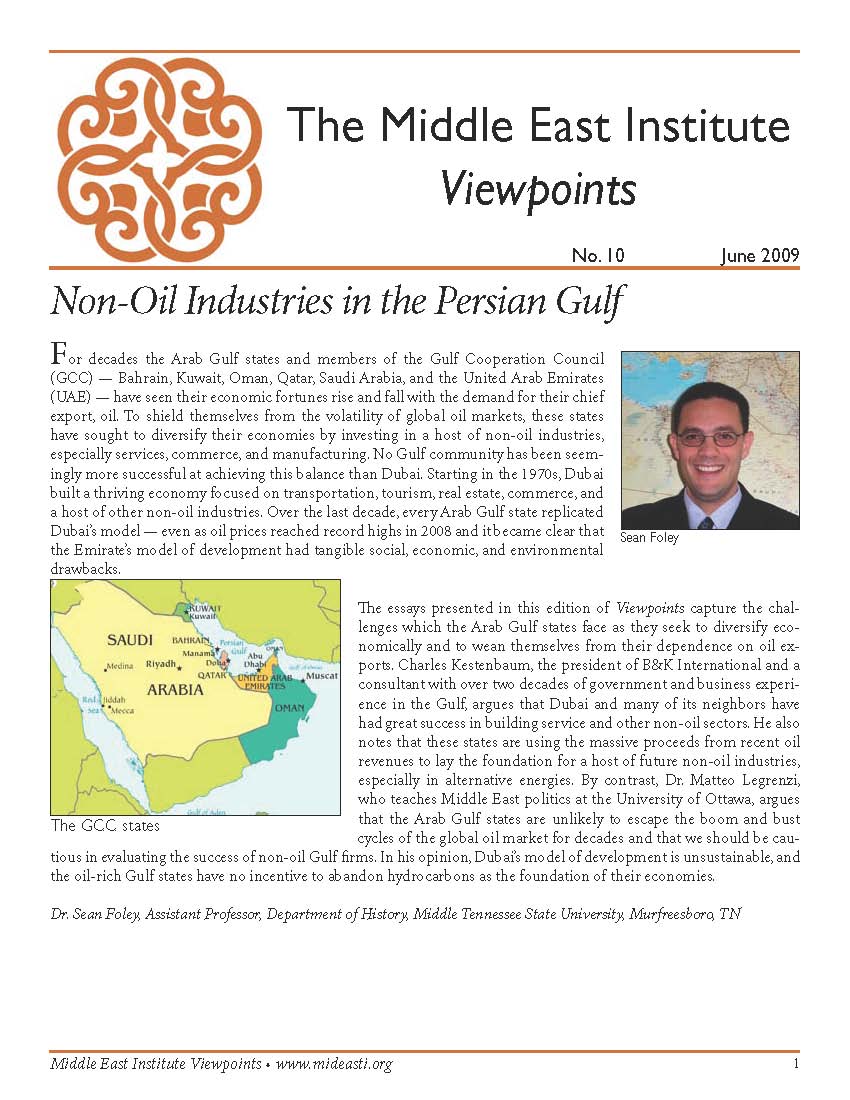
For decades the Arab Gulf states and members of the Gulf Cooperation Council (GCC) — Bahrain, Kuwait, Oman, Qatar, Saudi Arabia, and the United Arab Emirates (UAE) — have seen their economic fortunes rise and fall with the demand for their chief export, oil. To shield themselves from the volatility of global oil markets, these states have sought to diversify their economies by investing in a host of non-oil industries, especially services, commerce, and manufacturing.