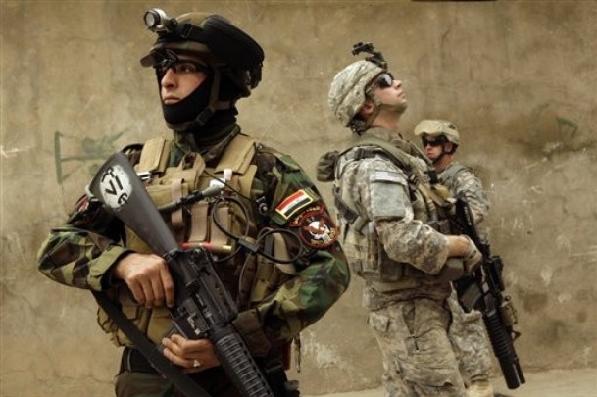
Mark N. Katz, examines the impact of the current and future US withdrawals from Iraq and Afghanistan on Islamic radicals. Katz argues that the US withdrawals from both countries will lead radicals to conclude they have defeated the US in the "War on Terror" and that US regional strength is on the decline. This, he argues, will spur Islamic radicals to seek further gains elsewhere. But regardless of the boost to their cause that the withdrawals from Iraq and Afghanistan may provide, they will likely meet three key obstacles in their pursuit of increased power and influence.
Afghanistan: Looking Ahead to the Next Fighting Season
Andrew Exum, Fellow at the Center for A New American Security, assesses the possibility of a new Taliban insurgency in Afghanistan and its ramifications for U.S. strategy there. The past six months have seen some remarkable successes in southern Afghanistan. But if hard-won security gains collapse in the face of a renewed Taliban offensive in 2011, the NATO strategy to secure Afghanistan will be in grave danger. Andrew Exum will discuss the situation in southern Afghanistan as well as how the American public can know whether the strategy is succeeding or failing this summer.
This Opinion piece first appeared in Frontline’s Tehran Bureau on January 19, 2012.
After months of frosty relations, Iran and Turkey are talking again. The ostensible reason for Turkish Foreign Minister Ahmet Davutoglu’s visit to Tehran two weeks ago was to try to jump start stalled nuclear talks with the so-called P5+1 group of nations. Davutoglu conveyed to Iranian chief nuclear negotiator Saeed Jalili the European Union’s invitation to resume the talks in Turkey that were suspended a year ago for lack of progress.
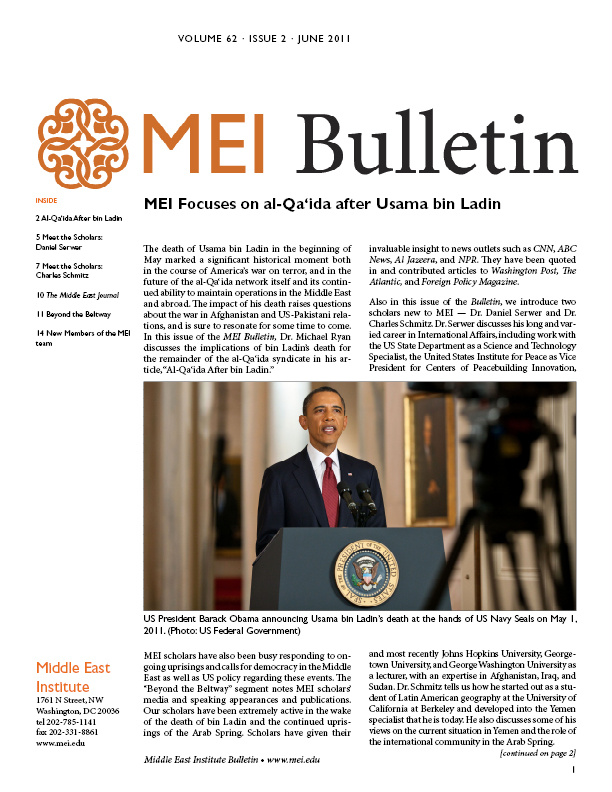
In the June 2011 Bulletin, Dr. Michael Ryan discusses the implications of bin Ladin’s death for the remainder of the al-Qa’ida network. It also introduces new MEI scholars Dr. Daniel Serwer, who is interviewed on his career in technology and peacebuilding, and Dr. Charles Schmitz, who speaks about his work on Yemen.
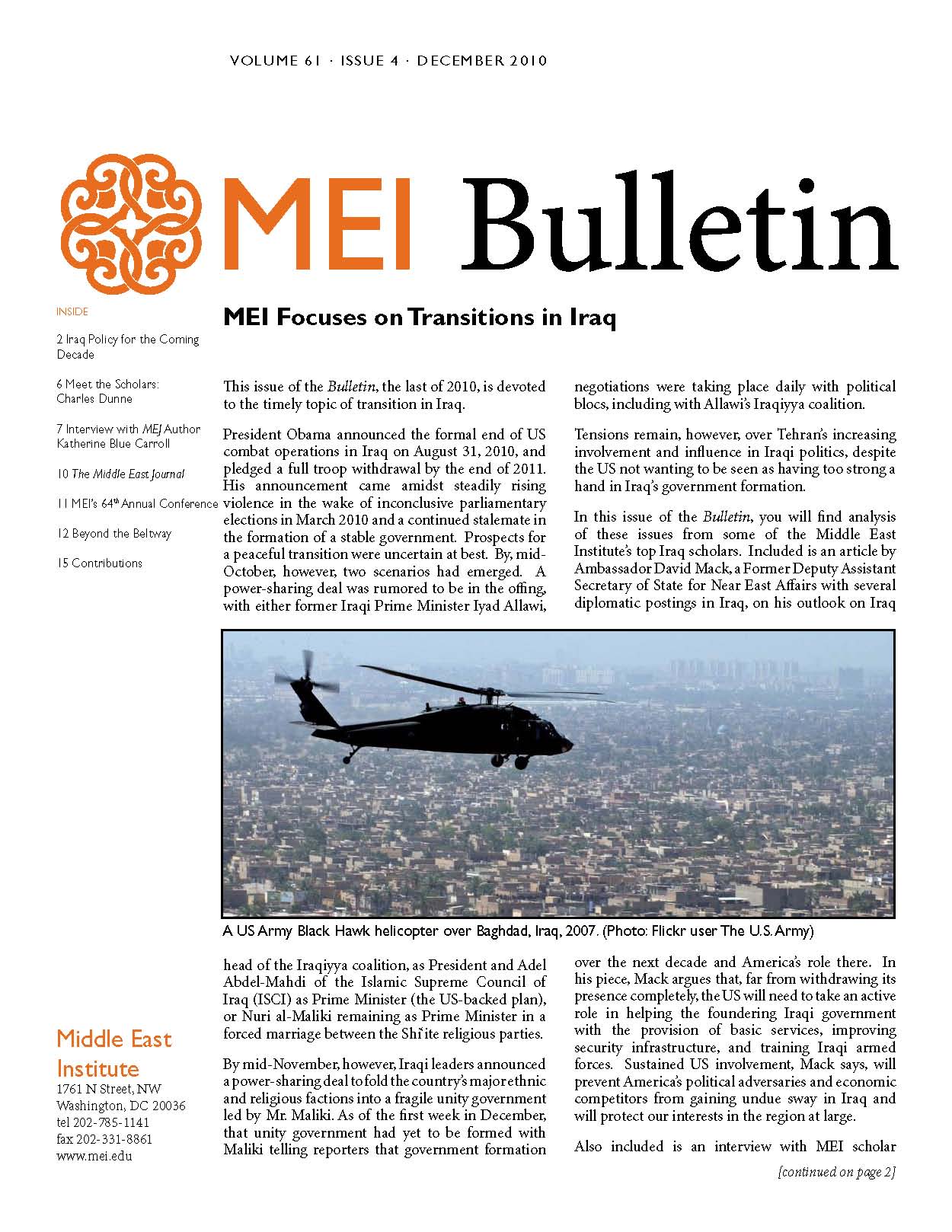
In the wake of the August 31 drawdown of US forces and the formation of a fragile unity government after months of negotiations, the December 2010 Bulletin features an argument from Ambassador David Mack for sustained US assistance to the Iraqi government, interviews with MEI Scholar Charles Dunne the political situation in Iraq and with Katherine Blue Carroll on her forthcoming MEJ article, and a summary of MEI’s 64th Annual Conference.